HIGHLIGHTS
- Florida police deployed an ultra-compact single-seat eVTOL quadcopter that dramatically reduces emergency response time by bypassing ground traffic entirely.
- The micro aircraft accesses urban environments impossible for traditional vehicles, including pedestrian zones, parking-restricted areas, and congested city blocks.
- Despite its unconventional appearance, the platform demonstrates that specialized eVTOL designs can solve specific operational challenges more effectively than generalist solutions.
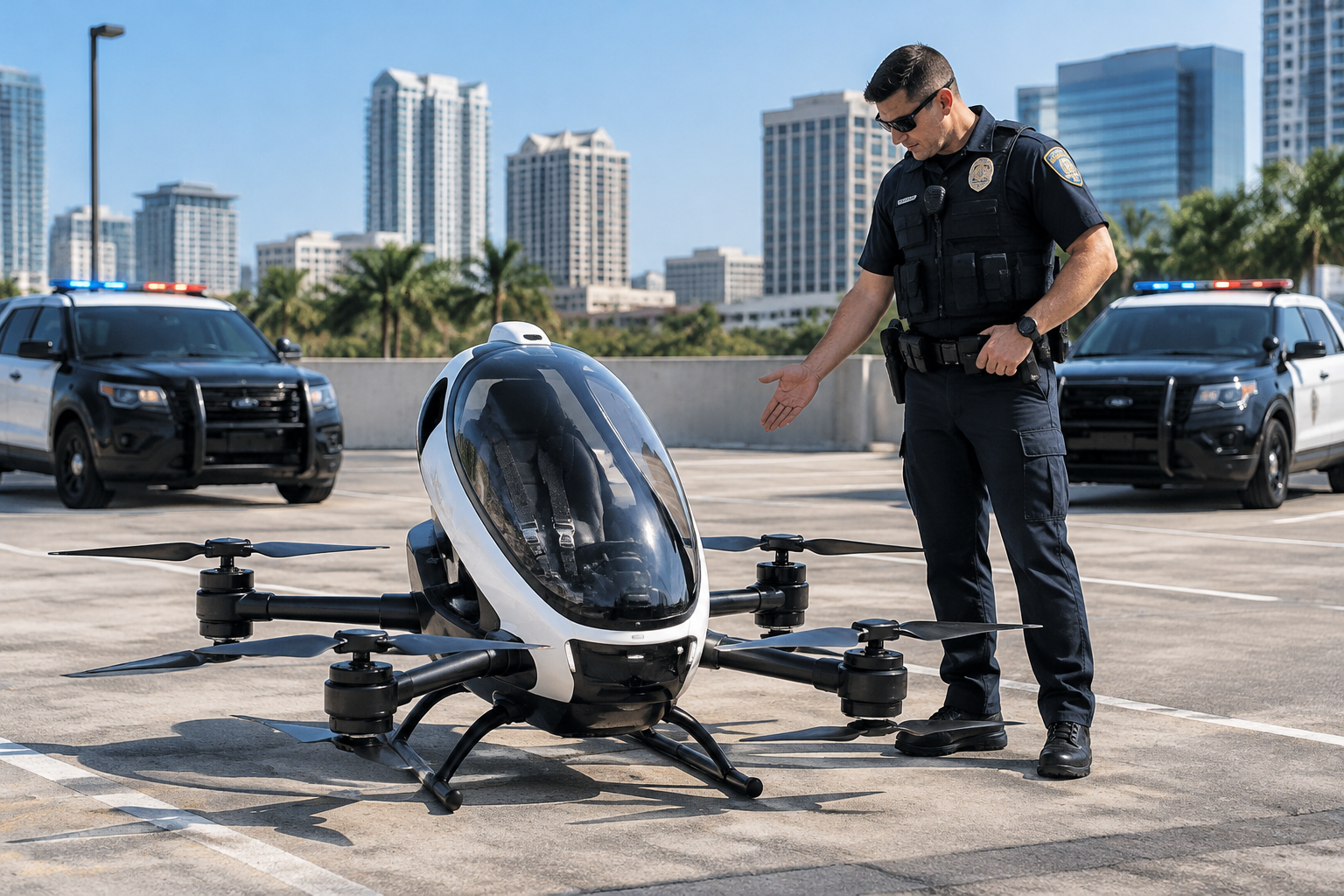
Florida law enforcement has unveiled an unconventional addition to its emergency response arsenal: an incredibly compact single-seat quadcopter specifically engineered to transport individual police officers. The pint-sized electric vertical takeoff and landing (eVTOL) craft represents an experimental foray into hyper-localized personal air mobility, challenging traditional assumptions about police vehicles and rapid deployment tactics.
A New Class of Police Mobility
The micro quadcopter, small enough to raise eyebrows and generate considerable social media attention, addresses a genuine operational challenge: getting officers to scenes faster than traditional ground vehicles in congested urban or suburban areas. By designing a vehicle that accommodates a single officer rather than attempting to transport multiple passengers, Florida police engineers dramatically reduced weight, power requirements, and certification complexity.
This minimalist approach to police air mobility diverges sharply from conventional helicopter and drone deployment strategies. Rather than attempting to build a multi-passenger aircraft or a remotely operated surveillance drone, the department has embraced a radical simplification: a flying platform for one person at a time. The vehicle’s compact footprint allows it to operate in environments where larger aircraft cannot, including parking lots, athletic fields, and even narrow industrial corridors.
The design philosophy reflects pragmatic operational thinking. Not every emergency response requires transporting an entire tactical team. Many situations—traffic control, rapid reconnaissance, scene assessment, or officer positioning—benefit from getting a single trained operator to a location within seconds rather than minutes. The tiny quadcopter fulfills that specific niche with apparent enthusiasm from the department.
Technical Specifications and Design Constraints
The vehicle’s diminutive size imposes significant engineering tradeoffs. A single-seat eVTOL designed to be “incredibly tiny” must optimize for minimal structural weight while maintaining sufficient battery capacity for meaningful endurance. Battery technology and motor efficiency become critical success factors; every kilogram of unnecessary mass directly reduces flight time and range.
Quadcopter configurations with four rotors offer inherent redundancy and stability advantages, particularly for a novel platform carrying human cargo. The design choice reflects safety prioritization, ensuring that loss of a single rotor doesn’t result in catastrophic failure. Electric propulsion provides instant throttle response, critical for handling wind gusts and making rapid altitude adjustments in urban environments.
Power density—the watts per kilogram available from the aircraft’s battery and motor system—determines whether the vehicle can actually achieve vertical takeoff while carrying a 70-kilogram (154-pound) officer plus any mandatory safety equipment. The fact that Florida police have successfully demonstrated the concept suggests they’ve solved these engineering puzzles acceptably, even if the solution appears “goofy” to casual observers.
Regulatory and Safety Considerations
Deploying piloted eVTOL aircraft for police operations sits in an increasingly complex regulatory landscape. The Federal Aviation Administration (FAA) continues developing rules for low-altitude urban air mobility, but operational frameworks for emergency vehicles differ from commercial passenger transport. Florida police likely negotiated specific waivers or experimental authorizations to conduct these demonstrations.
Safety protocols for a vehicle small enough to generate public amusement must address pilot training, redundant systems, emergency procedures, and collision avoidance. The quadcopter design’s apparent simplicity masks considerable complexity in systems architecture. Pilots require certification and ongoing proficiency validation; the aircraft needs regular maintenance and inspection; and flight corridors must remain clear of other airspace users.
Public perception, while initially humorous, may prove decisive for regulatory acceptance. If the tiny quadcopter can demonstrate genuine operational value while maintaining an excellent safety record, it establishes precedent for similar platforms. Conversely, even minor incidents could trigger restrictions that slow personal air mobility adoption across the entire industry.
Operational Advantages in Emergency Response
The micro eVTOL offers compelling advantages for specific police operations. Traffic congestion becomes irrelevant; the aircraft bypasses gridlock entirely. Response time to scene—measured in seconds rather than minutes—could prove decisive for officer safety, crime scene preservation, or medical emergencies requiring rapid personnel arrival.
Urban geography that constrains ground vehicle access becomes navigable from the air. Parking-restricted areas, pedestrian zones, and infrastructure-dense regions all become accessible in ways traditional police vehicles cannot match. An officer can be positioned precisely where needed without searching for vehicle parking or navigating traffic patterns.
The vehicle’s diminutive size creates psychological and practical advantages. Reduced noise signature compared to traditional helicopters minimizes public disruption. Smaller airspace requirements simplify urban flight operations. Lower power consumption extends endurance and reduces operating costs. The combination of factors suggests that while the platform appears goofy visually, its operational logic deserves serious consideration.
Key Operational Benefits
- Zero ground traffic congestion; response time measured in seconds rather than minutes for rapid officer deployment
- Access to parking-restricted and pedestrian-heavy urban areas impossible for traditional police vehicles
- Dramatically reduced noise signature and power requirements compared to traditional police helicopters
Florida police have demonstrated impressive pragmatism in developing this micro eVTOL platform. The combination of apparent technical success, regulatory permission to demonstrate publicly, and genuine operational benefits suggests the tiny quadcopter addresses real needs in modern police work. While observers may chuckle at its unusual form factor, the underlying concept represents legitimate innovation in emergency response technology. As personal air mobility technology matures and regulatory frameworks evolve, similar hyper-specialized platforms may become standard equipment for forward-thinking police departments nationwide. The Florida demonstration, regardless of its comedic exterior, may be remembered as a crucial step toward practical police air mobility adoption.