HIGHLIGHTS
- EHang launches the EH216-EK, a high-payload eVTOL specifically engineered for firefighting and rapid emergency response in urban environments
- The multi-scenario platform supports disaster relief, search & rescue, and medical supply delivery, maximizing commercial viability and government adoption
- Emergency response eVTOLs face faster regulatory approval pathways than passenger transport, enabling EHang to achieve near-term commercialization and revenue
EHang Holdings, a leading autonomous aerial vehicle (AAV) manufacturer, has unveiled the EH216-EK, an advanced high-payload firefighting eVTOL specifically engineered for emergency response operations. This strategic expansion marks a significant milestone in the company’s mission to diversify eVTOL applications beyond passenger transportation, positioning autonomous aerial vehicles as critical infrastructure assets for public safety and disaster management.
EHang’s Emergency Response Evolution
The introduction of the EH216-EK represents a pivotal shift in how EHang approaches market diversification. Rather than solely focusing on urban air mobility and passenger transport, the company is now actively targeting emergency services, where eVTOLs can deliver substantial value through rapid response times, improved accessibility, and reduced operational costs. This approach aligns with global trends in the air mobility industry, where manufacturers recognize that specialized use cases offer immediate commercialization opportunities.
EHang has a proven track record of innovation in the eVTOL space, having conducted thousands of autonomous flights and successfully navigated regulatory frameworks in multiple markets. The development of the EH216-EK demonstrates the company’s commitment to leveraging its technological expertise to address real-world challenges facing emergency responders. By focusing on firefighting applications, EHang is positioning itself at the forefront of a new category of mission-critical aerial systems.
The EH216-EK builds upon EHang’s established eVTOL platform, incorporating design enhancements specifically tailored for emergency operations. This includes payload optimization, enhanced safety systems, and operational features that cater to the unique demands of firefighting and other emergency response scenarios. The progression from passenger-focused designs to specialized emergency vehicles showcases the inherent flexibility of modern eVTOL architecture.
High-Payload Capabilities and Technical Specifications
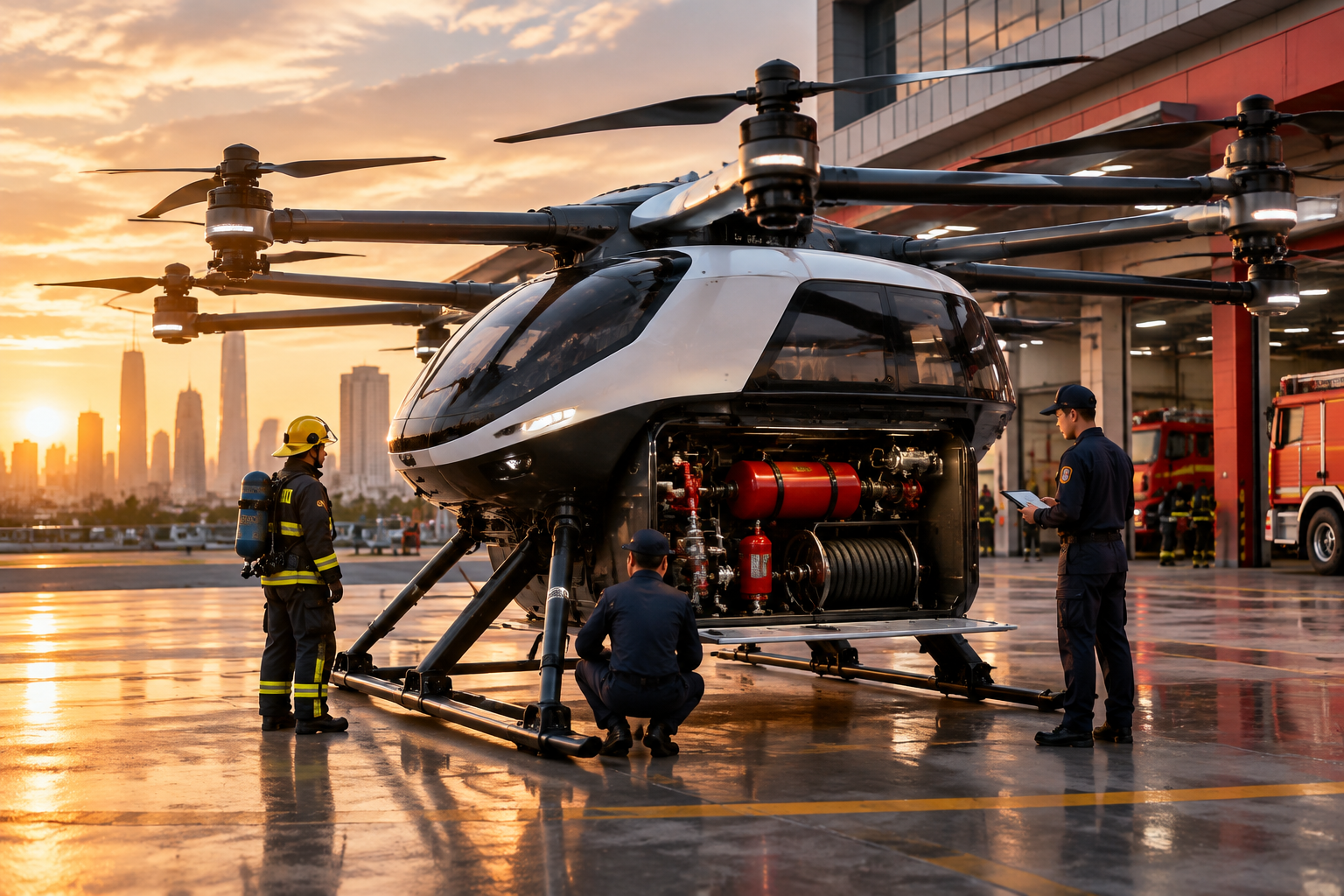
The EH216-EK’s defining characteristic is its enhanced payload capacity, which enables it to carry specialized firefighting equipment, water dispersal systems, or emergency supplies to areas where traditional ground vehicles cannot easily access. This capability is particularly valuable in urban environments where terrain, congestion, and infrastructure limitations often impede conventional emergency response operations. High-payload eVTOLs can significantly reduce response times and expand the geographic reach of emergency services.
The aircraft’s design incorporates redundancy systems and safety features essential for emergency operations, ensuring reliability when lives depend on rapid, accurate deployment. EHang’s autonomous flight technology minimizes pilot workload, allowing operators to focus on mission execution rather than manual flight control. This automation advantage is particularly valuable during high-stress emergency scenarios where split-second decisions and precise positioning are critical.
The EH216-EK’s specifications reflect careful optimization for emergency response efficiency. The vehicle’s vertical takeoff and landing (VTOL) capability eliminates the need for runway infrastructure, allowing deployment from urban fire stations, heliports, and emergency command centers. Extended flight range and battery capacity ensure the aircraft can operate effectively across metropolitan service areas, while payload configuration flexibility accommodates various emergency equipment profiles.
Firefighting and Multi-Scenario Applications
Firefighting represents just the initial focus of the EH216-EK platform. The aircraft’s versatility enables adaptation for multiple emergency and non-emergency scenarios, including medical supply delivery, disaster assessment, search and rescue operations, and environmental monitoring. This multi-scenario approach maximizes return on investment for government agencies and emergency service providers, as a single platform can address diverse operational needs.
In firefighting specifically, eVTOLs offer unprecedented advantages. They can deliver fire suppression agents to difficult-to-reach locations, provide real-time aerial reconnaissance of active fire zones, and transport injured personnel from remote or hazardous terrain. The EH216-EK’s payload capacity enables it to carry meaningful quantities of fire retardant or water, making it a genuine asset rather than merely a reconnaissance tool. Speed of deployment is another critical advantage—aerial response measured in minutes rather than hours can mean the difference between containment and catastrophic spread.
Beyond firefighting, the EH216-EK’s capabilities extend to natural disaster response, where rapid deployment of supplies and personnel to isolated or damaged areas can accelerate rescue and recovery efforts. Urban search and rescue, medical emergency response, and hazmat incident management all represent potential applications. This versatility transforms the EH216-EK from a single-purpose vehicle into a platform for comprehensive emergency service modernization.
Market Impact and Industry Trajectory
The EH216-EK launch signals EHang’s confidence in the near-term commercialization of eVTOL technology for specialized operations. Unlike consumer passenger services, which face complex regulatory and infrastructure challenges, emergency response applications often benefit from accelerated approvals and government support. Agencies worldwide are actively seeking innovative solutions to enhance emergency capabilities, making them ideal early adopters of eVTOL technology.
This development reflects broader industry trends demonstrating that practical eVTOL applications are moving from theoretical concepts to operational reality. Companies including Joby Aviation, Archer Aviation, and others are pursuing emergency and parcel delivery use cases alongside passenger transport. EHang’s focus on emergency services positions the company competitively within a rapidly evolving market where first-mover advantage in specialized applications can establish dominant market positions.
The regulatory landscape is increasingly accommodating specialized eVTOL operations. Government aviation authorities are developing frameworks specifically designed for emergency response vehicles, recognizing that traditional passenger aircraft certification processes may not represent the optimal path for these systems. EHang’s announcement of the EH216-EK suggests the company has assessed regulatory feasibility and identified concrete pathways to deployment across multiple markets.
Future Outlook and Strategic Implications
EHang’s expansion into firefighting eVTOLs represents a deliberate strategy to establish revenue-generating operations while passenger transport infrastructure matures. Emergency response services generate consistent demand, operate within defined geographic areas, and benefit from government procurement processes that favor innovative safety solutions. These characteristics make emergency applications an ideal foundation for sustainable commercial eVTOL operations.
The success of the EH216-EK will likely accelerate industry adoption of specialized eVTOLs across multiple public safety applications. Government agencies observing the platform’s performance will evaluate similar systems for their operations, creating a competitive market that drives innovation and operational efficiency. International regulatory harmonization around emergency eVTOL operations would further accelerate global deployment.
Looking forward, EHang’s multi-scenario approach suggests the company intends to build an entire ecosystem of specialized eVTOL platforms, each optimized for specific operational requirements. This strategy mirrors successful patterns in the broader aerospace industry, where platforms achieve maximum value through customization for diverse end-user needs. The EH216-EK represents the opening chapter in what will likely become an expansive portfolio of mission-specific aircraft.
Key Takeaways: EHang’s Emergency Aviation Breakthrough
- EHang’s EH216-EK high-payload firefighting eVTOL addresses immediate market needs in emergency response, offering faster deployment and access to areas traditional vehicles cannot reach
- The platform’s versatility enables multi-scenario applications including disaster relief, search and rescue, and medical supply delivery, maximizing commercial viability and government procurement appeal
- Specialized emergency eVTOL operations face accelerated regulatory pathways compared to passenger transport, positioning EHang for near-term commercialization and revenue generation
The unveiling of EHang’s EH216-EK firefighting eVTOL marks a critical inflection point in the maturation of autonomous aerial vehicles. By focusing on emergency response rather than consumer passenger transport, EHang is pursuing a commercially viable pathway that addresses genuine market needs while navigating regulatory environments more efficiently. As the eVTOL industry continues evolving, specialized platforms like the EH216-EK will likely drive the first wave of profitable commercial operations, establishing proof-of-concept for broader aerial mobility ecosystems. Government agencies and emergency service providers worldwide are watching closely, and successful deployment of these systems could accelerate investment and innovation across the entire personal air mobility sector.