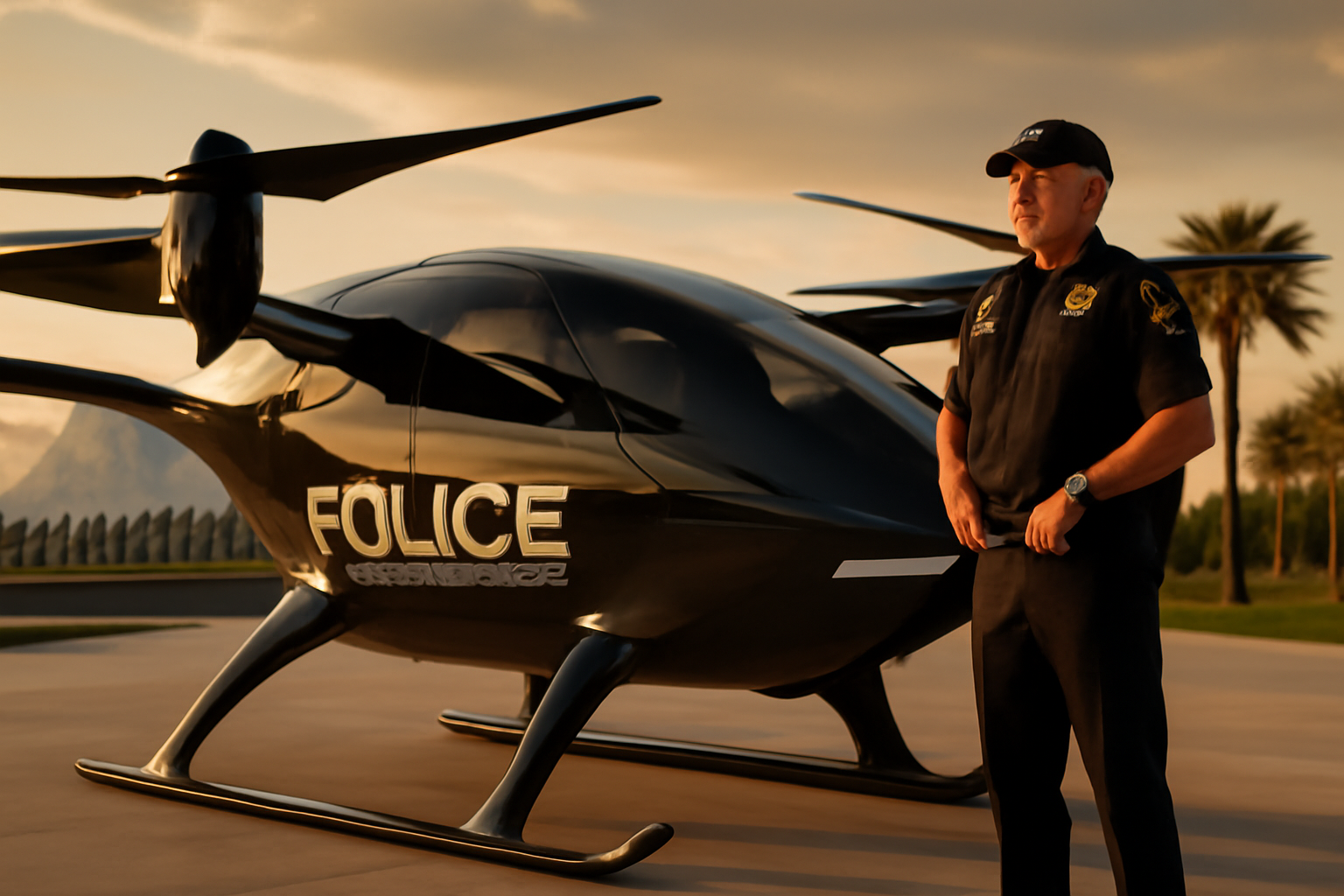
HIGHLIGHTS
- Florida Poly Police become first law enforcement agency in the U.S. to operationally deploy an eVTOL vehicle, setting a national precedent for emergency services adoption.
- eVTOL deployment enables rapid campus response, zero-emission operations, and flexible vertical launch without runway infrastructure—ideal for modern policing.
- Successful FAA regulatory compliance demonstrates electric aircraft viability for government operations, potentially triggering nationwide adoption by other agencies.
In a groundbreaking move that marks a historic moment for U.S. law enforcement and urban air mobility, the Florida Polytechnic University Police Department has become the first police force in the nation to officially integrate an eVTOL (electric vertical takeoff and landing) vehicle into its operational fleet. This milestone announcement, made in October 2026, signals a transformative shift in how emergency services may respond to incidents, conduct surveillance, and manage campus safety in the future.
A Historic First for American Law Enforcement
The addition of an eVTOL aircraft to the Florida Polytechnic Police Department represents more than just a technological upgrade—it represents a fundamental reimagining of what modern policing can achieve. As the first department of its kind in the United States to deploy such an aircraft operationally, Florida Poly is setting a precedent that could reshape emergency response protocols nationwide. The decision to integrate this advanced technology demonstrates a progressive approach to public safety and a commitment to leveraging cutting-edge innovation.
This development comes at a critical juncture in the eVTOL industry’s maturation. With regulatory frameworks becoming increasingly established and aircraft proving their reliability in controlled environments, law enforcement agencies have begun to seriously consider the operational advantages these vehicles offer. Florida Polytechnic’s initiative positions the university as a leader in both aerospace innovation and practical emergency management.
The move also reflects growing confidence in electric vertical takeoff technology among institutional leaders. By choosing to deploy an eVTOL on a major university campus, Florida Poly’s administration is making a bold statement about the safety and viability of these aircraft in real-world conditions.
Operational Advantages for Campus Safety
An eVTOL vehicle offers Florida Polytechnic Police unprecedented capabilities for responding to emergencies and monitoring the expansive campus. Unlike traditional helicopters, eVTOLs are quieter, faster to deploy, and more cost-effective to operate—making them ideally suited for dense urban and campus environments. The ability to respond to incidents with an aerial asset that can launch in minutes rather than hours could prove invaluable in time-sensitive situations.
The aircraft’s vertical takeoff and landing capabilities eliminate the need for traditional runway infrastructure, allowing deployment from small designated launch zones scattered across the 600-acre Florida Polytechnic campus. This operational flexibility enables rapid response to medical emergencies, campus security incidents, and environmental monitoring tasks that previously would have required significantly more time and resources.
Beyond emergency response, the eVTOL can support critical campus functions including perimeter surveillance, search and rescue operations, and event security during large gatherings. The combination of speed, maneuverability, and zero-emission operation makes it an ideal tool for a technologically advanced institution committed to sustainability and innovation.
Regulatory Compliance and Safety Standards
The successful integration of an eVTOL into police operations required navigating a complex web of Federal Aviation Administration (FAA) regulations and obtaining appropriate operational waivers. Florida Poly Police’s achievement demonstrates that these regulatory hurdles are surmountable and that the FAA is increasingly receptive to innovative uses of eVTOL technology in controlled, well-planned environments like university campuses.
The department worked closely with FAA officials, aircraft manufacturers, and aviation safety experts to develop comprehensive operating procedures, pilot training protocols, and emergency contingency plans. This collaborative approach ensured that safety standards exceeded existing requirements and that the deployment would serve as a model for other agencies considering similar initiatives.
Florida Poly’s methodical approach to regulatory compliance strengthens the credibility of eVTOL technology in the eyes of other government agencies and insurance providers. By demonstrating that electric aircraft can be safely integrated into law enforcement operations, the department is helping to establish best practices that will guide future deployments across the country.
Implications for the Future of Emergency Services
Florida Polytechnic Police’s pioneering deployment opens the door for other law enforcement agencies, fire departments, and emergency medical services to seriously evaluate eVTOL integration. If the program proves successful operationally and financially, it could trigger a wave of similar adoptions among police departments, particularly those serving large campuses or sprawling jurisdictions where rapid aerial response provides substantial benefits.
The visibility and credibility gained by this first-mover advantage cannot be overstated. As other agencies observe the results of Florida Poly’s deployment, they will gain confidence in the technology’s reliability and begin to justify eVTOL acquisition programs to their own leadership and budgeting authorities. This ripple effect could accelerate adoption across the public safety sector by years.
Furthermore, this deployment provides invaluable operational data that will inform future eVTOL designs and capabilities. Real-world law enforcement use cases will help manufacturers refine aircraft for emergency service requirements, including improved payload capacity for rescue equipment, enhanced communication systems, and specialized sensors for surveillance and search operations.
Economic and Sustainability Implications
The move to electric vertical takeoff aircraft also aligns with growing institutional commitments to sustainability and carbon reduction. Florida Polytechnic, as an educational institution focused on engineering and technology, has positioned itself as a leader in environmental responsibility by choosing zero-emission aircraft over traditional fuel-powered alternatives. This decision sends a powerful message about the viability of sustainable emergency response systems.
From a financial perspective, eVTOL operations offer compelling long-term economics. While acquisition costs remain significant, the operational savings from reduced fuel expenses, minimal maintenance requirements, and lower training costs compared to traditional helicopter operations can lead to substantial savings over a vehicle’s lifecycle. As production scales and competition increases, eVTOL acquisition costs are projected to decline substantially in coming years.
Florida Poly’s pioneering deployment may also open doors to grant funding and research partnerships with government agencies interested in studying eVTOL adoption for public safety. Universities and police departments considering similar programs could benefit from the data and lessons learned from this initial deployment.
Key Takeaways from Florida Poly’s eVTOL Deployment
- Florida Polytechnic University Police become the first law enforcement agency in the United States to operationally deploy an eVTOL vehicle, setting a precedent for emergency services nationwide
- eVTOL technology provides law enforcement with rapid response capabilities, zero-emission operations, and flexible deployment options ideal for campus and urban environments
- Successful FAA regulatory compliance and rigorous safety protocols demonstrate that electric aircraft can be safely integrated into government operations, paving the way for broader adoption across public safety agencies
The Florida Polytechnic University Police Department’s integration of an eVTOL vehicle represents a watershed moment for both the emergency services sector and the personal air mobility industry. As the first police force in the nation to operationalize this technology, Florida Poly is writing the opening chapters of a new era in law enforcement response. The success or challenges encountered in this deployment will reverberate across police departments, fire services, and emergency medical agencies nationwide, potentially reshaping how first responders manage critical incidents. This historic achievement underscores the growing maturity of eVTOL technology and its real-world applicability beyond concepts and demonstrations—it’s now part of America’s emergency response infrastructure.