HIGHLIGHTS
- Joby Aviation achieves a pivotal commercial milestone by launching piloted electric air taxi operations across Florida, advancing the personal air mobility industry from testing to revenue-generating service.
- Florida’s adoption of eVTOL air taxi services positions the state as a hub for urban air mobility innovation and demonstrates regulatory approval for next-generation transportation infrastructure.
- Joby’s piloted flights validate electric propulsion technology at scale, proving that zero-emission air taxis can operate safely and efficiently in real-world commercial conditions.
The personal air mobility revolution has reached a critical inflection point. Joby Aviation, one of the most anticipated players in the electric vertical takeoff and landing (eVTOL) sector, has officially launched piloted electric air taxi operations across Florida, marking the transition from flight testing and certification to genuine commercial service. This milestone represents far more than a technical achievement—it signals that electric air taxis are no longer theoretical transportation solutions but operational, revenue-generating services that real passengers can experience today.
Joby Aviation’s Path to Commercial Operations
Joby Aviation’s journey to this historic launch has spanned years of rigorous development, testing, and regulatory navigation. The company received its Part 135 air taxi certification from the Federal Aviation Administration (FAA), a critical regulatory approval that permits commercial passenger operations. This certification didn’t come easily; it required Joby to demonstrate that its aircraft met all safety, performance, and reliability standards demanded by the FAA, even exceeding requirements typically applied to traditional rotorcraft.
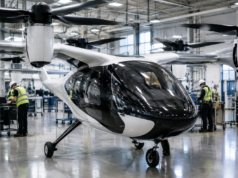
The company’s aircraft is a six-rotor, all-electric eVTOL vehicle designed specifically for short-haul urban and regional flights. With a range of approximately 150 miles per charge and a cruise speed around 150 mph, the vehicle is optimized for point-to-point city connections and airport transfers—precisely the use cases that industry analysts identified as the most viable near-term market for air taxi services. The aircraft’s design emphasizes redundancy, with multiple independent rotor systems ensuring safety even in the unlikely event of a single motor or rotor failure.
Joby’s expansion into Florida represents a strategic choice. The state’s geography—with multiple metropolitan areas separated by distances ideal for eVTOL coverage (Miami, Fort Lauderdale, Tampa, and Orlando)—combined with its tourism infrastructure and progressive stance on transportation innovation, makes it an ideal market for launch. Florida’s regulatory environment and existing aviation infrastructure also provide operational advantages that accelerate service expansion and customer acquisition.
The Commercial Air Taxi Market Takes Shape
Joby’s entry into commercial operations validates a business model that has attracted billions in venture capital and strategic partnerships. The company has secured backing from major investors, including Japanese automotive conglomerate Toyota and other institutional players who see the long-term value in urban air mobility. These partnerships extend beyond funding; they reflect confidence in the commercial viability and technical feasibility of Joby’s approach.
The pricing model for these air taxi services is expected to fall between premium car services (like Uber Black) and helicopter charter services, positioning eVTOLs as an attractive alternative for business travelers, airport commuters, and time-sensitive travelers. Initial flights across Florida are likely priced at a premium, reflecting early-stage operations, limited fleet capacity, and the novelty of the service. However, as fleets scale and operational efficiency improves, pricing is projected to decrease, eventually becoming competitive with ground-based alternatives for specific routes and use cases.
The environmental implications cannot be overstated. Unlike traditional rotorcraft powered by jet fuel or piston engines, Joby’s electric aircraft produce zero direct emissions during flight. When charged using renewable energy sources, these air taxis offer a genuinely sustainable alternative to fuel-burning helicopters and aviation. This environmental advantage has resonated with municipalities, environmental advocates, and consumers alike, creating strong market tailwinds for the company.
Regulatory Approval and Safety Validation
Joby’s FAA Part 135 certification is not a rubber-stamp approval; it represents a comprehensive validation of safety, reliability, and operational capability. The FAA’s certification process for eVTOL aircraft is more stringent than traditional aircraft certification in many respects, given the novel nature of the technology and the dense urban environments where these aircraft are expected to operate. Joby had to demonstrate compliance with performance standards for redundancy, emergency operations, pilot training, maintenance protocols, and accident investigation procedures.
The pilot-in-the-loop model that Joby has adopted is important for this early phase of operations. Human pilots provide a critical layer of oversight, decision-making, and emergency response capability that reassures regulators, passengers, and the public. While the long-term industry vision includes autonomous or minimally-crewed operations, the current piloted model allows for iterative learning, operational refinement, and customer confidence-building as the technology matures in real-world conditions.
Safety data gathered during these initial commercial operations will be invaluable for the entire industry. Insurance companies, regulatory agencies, and potential competitors will scrutinize Joby’s safety record, maintenance requirements, incident reports, and operational procedures. Strong performance during this launch phase will accelerate regulatory approval for other eVTOL operators and support the case for expanded vertiport infrastructure and airspace integration across the United States.
Infrastructure, Vertiports, and Urban Integration
Launching a commercial air taxi service requires more than aircraft and pilots; it demands integrated infrastructure. Vertiports—specialized landing and takeoff facilities designed for eVTOL operations—must be constructed, maintained, and networked across service areas. These facilities include charging infrastructure, passenger terminals, weather monitoring systems, and emergency response capabilities. Joby’s operations across Florida necessitate a distributed network of vertiports that enable passengers to access air taxi services from multiple convenient locations.
The vertiport ecosystem also creates opportunities for real estate developers, municipalities, and ancillary service providers. Vertiports can be integrated into existing aviation facilities (like airports), parking structures, rooftops, and dedicated facilities. This flexibility in placement supports diverse operational models and helps maximize the economic value of eVTOL infrastructure. Forward-thinking cities are already investing in vertiport planning, recognizing that early adoption of air mobility infrastructure positions them competitively for talent, tourism, and economic development.
Florida’s existing aviation infrastructure, including its network of regional airports and established air traffic control systems, provides a foundation upon which eVTOL operations can be layered. The state’s experience managing high volumes of general aviation traffic, combined with its tourism-driven demand for premium transportation services, creates favorable conditions for Joby’s expansion. As operations scale, Joby and other eVTOL operators will work with the FAA and local air traffic control facilities to integrate eVTOL corridors into the national airspace system, establishing efficient routing and separation standards.
Competitive Landscape and Industry Acceleration
Joby Aviation is not alone in the race to commercialize eVTOL services. Companies like Archer Aviation, Lilium, Archer, and others are pursuing their own certification paths and commercial launch timelines. However, being first to achieve sustained commercial operations carries substantial competitive advantages—brand recognition, operational data, regulatory relationships, and customer acquisition. Joby’s Florida launch may accelerate the timeline for its competitors, as investors and regulators alike gain confidence in the commercial viability of the sector.
The competitive dynamics will intensify as multiple operators scale simultaneously. Differentiation will occur along several dimensions: aircraft performance (speed, range, efficiency), route networks, pricing models, customer service quality, and safety records. Network effects will eventually favor integrated platforms that offer seamless booking, payment, and multi-modal connectivity, similar to how ride-sharing platforms emerged in the ground transportation sector. Joby’s early mover advantage provides opportunity to establish such a platform and lock in customer loyalty and operational data advantages.
Investment capital continues to flow into the eVTOL sector, despite economic uncertainties. Venture capital firms, aerospace companies, automotive manufacturers, and strategic investors see eVTOL services as a multi-hundred-billion-dollar opportunity within the next 10-20 years. Joby’s commercial launch validates this investment thesis and will likely stimulate a new wave of capital deployment toward both established eVTOL operators and early-stage technology companies supporting the ecosystem.
Key Takeaways: Joby’s Florida Milestone
- Joby Aviation’s piloted eVTOL flights represent the industry’s transition from development and testing to commercial operations, validating the business model and technology at scale.
- FAA Part 135 certification demonstrates that electric air taxi operations meet rigorous safety and performance standards, paving the way for broader industry expansion and regulatory approval.
- Florida’s infrastructure, geography, and regulatory environment position it as an ideal launch market, with implications for vertiport networks, urban air mobility integration, and industry competitiveness.
Joby Aviation’s launch of piloted electric air taxi operations across Florida marks a watershed moment for the personal air mobility industry. What was once speculative future technology is now operational reality serving real passengers. The technical, regulatory, and commercial lessons learned through these Florida operations will shape the next decade of eVTOL development and expansion. As Joby scales its fleet and route network, and as competitors race to achieve their own certifications and launches, the urban and regional transportation landscape is on the cusp of fundamental transformation. The electric air taxi revolution is no longer coming—it has already begun.