
HIGHLIGHTS
- EHang partners with CSCEC Sixth Engineering Bureau to develop low-altitude vertiport infrastructure across China
- Vertiport infrastructure is moving from pilot projects to large-scale real-world commercial deployment
- This infrastructure-first partnership model is becoming the industry template for eVTOL market expansion globally
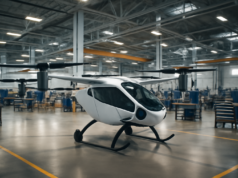
EHang Holdings Limited and CSCEC Sixth Engineering Bureau have announced a strategic framework agreement focused on advancing low-altitude vertiport infrastructure development. This partnership marks a significant step forward in establishing the foundational systems required to support widespread adoption of electric vertical takeoff and landing (eVTOL) aircraft in urban environments. The collaboration brings together EHang’s cutting-edge autonomous aviation technology with CSCEC’s extensive engineering expertise and infrastructure development capabilities.
Strategic Partnership Overview
The framework agreement between EHang and CSCEC Sixth Engineering Bureau represents a convergence of two industry leaders with complementary strengths. EHang, a pioneer in autonomous aerial vehicle technology, has developed one of the most mature eVTOL platforms globally, while CSCEC Sixth Engineering Bureau brings decades of experience in large-scale infrastructure projects across China and beyond. Together, they aim to create a comprehensive ecosystem for low-altitude air mobility operations.
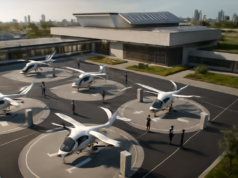
This partnership underscores the growing recognition that eVTOL success depends not only on vehicle technology but also on robust ground infrastructure. Vertiports—the landing and charging stations for aerial vehicles—are essential to enabling the urban air mobility revolution. By combining EHang’s operational knowledge with CSCEC’s engineering prowess, the two companies are positioned to design and construct vertiports that meet both technical and commercial requirements.
The framework agreement establishes a collaborative foundation for identifying suitable locations, designing facilities, and coordinating with local authorities. This structured approach is critical in markets like China, where regulatory coordination and urban planning integration are essential for successful infrastructure deployment.
Low-Altitude Vertiport Infrastructure Development
Low-altitude vertiports serve as the critical nexus points for eVTOL operations in urban and semi-urban environments. Unlike traditional airports, vertiports can be developed on rooftops, parking structures, or ground-level facilities with minimal space requirements, making them ideal for dense city centers. The partnership between EHang and CSCEC will focus on creating modular, scalable vertiport designs that can be adapted to various urban contexts.
The technical specifications for these facilities must address multiple challenges: safe aircraft operations, passenger safety and comfort, rapid turnaround times between flights, and seamless integration with ground transportation networks. CSCEC’s expertise in structural engineering, environmental compliance, and project management will be instrumental in translating EHang’s operational requirements into buildable infrastructure.
Additionally, the framework agreement likely encompasses sustainability considerations, including energy management systems for aircraft charging, rainwater management, noise mitigation, and green space integration where feasible. Modern vertiports must be designed not just for functionality but also for compatibility with urban environments and environmental standards.
Market Expansion and Regulatory Alignment
China represents one of the world’s most promising markets for eVTOL development, with supportive government policies, rapid urbanization, and significant investment in advanced transportation technologies. The EHang-CSCEC partnership capitalizes on these favorable conditions by positioning both companies to respond quickly to regulatory developments and market demand in China’s low-altitude economy.
The framework agreement likely includes provisions for compliance with Chinese Civil Aviation Administration (CAAC) standards and local municipal requirements. As eVTOL regulations continue to evolve globally, having a partner with deep expertise in regulatory affairs—as CSCEC possesses through its extensive work with Chinese government agencies—provides EHang with a significant competitive advantage.
Beyond China, this partnership model may serve as a template for EHang’s expansion into other markets. The demonstration of successful vertiport infrastructure development in China could accelerate approvals and deployments in Southeast Asia, Europe, and beyond, as regulators in other regions look to proven operational models.
Implications for the eVTOL Industry
The EHang-CSCEC partnership sends a clear market signal: mature eVTOL platforms are moving beyond the proof-of-concept phase toward real-world commercial deployment. Infrastructure development is no longer theoretical—it is becoming concrete (literally) through partnerships between aerospace innovators and construction firms. This represents a maturation of the industry as a whole.
Other eVTOL manufacturers are likely watching this development closely. Companies such as Joby Aviation, Archer Aviation, and Lilium have emphasized vertiport partnerships in their own strategies, but EHang’s collaboration with a major Chinese engineering firm demonstrates the advantage of working with established infrastructure players. This dynamic is likely to accelerate similar partnerships globally.
The agreement also underscores the importance of integration between vehicle manufacturers and infrastructure providers. Vertiports must be optimized for specific aircraft types, charging protocols, operational volumes, and safety procedures. By securing CSCEC’s commitment early, EHang ensures that vertiport designs will be engineered specifically for EHang aircraft, creating a competitive moat in the Chinese market.
Key Takeaways
- EHang’s autonomous eVTOL technology combined with CSCEC’s engineering expertise accelerates practical vertiport deployment in urban environments
- Low-altitude vertiport infrastructure is transitioning from concept to real-world projects, signaling industry maturation and commercial viability
- Strategic infrastructure partnerships like this may become the template for eVTOL market expansion across Asia, Europe, and North America
The EHang-CSCEC framework agreement represents a watershed moment for the eVTOL industry. As autonomous aerial vehicles move closer to mainstream commercial operation, the availability of purpose-built vertiports becomes the critical enabler of widespread adoption. By uniting cutting-edge autonomous aviation technology with world-class infrastructure engineering, EHang and CSCEC are building the physical foundation upon which the urban air mobility revolution will operate. This partnership demonstrates that the future of air transportation is not just about better aircraft—it’s about better infrastructure designed specifically for them. For investors, regulators, and urban planners watching the eVTOL space, this announcement signals that the transition from innovation to infrastructure is already underway.