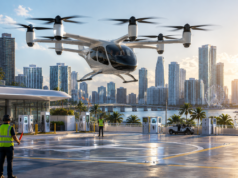
HIGHLIGHTS
- eVTOL market will experience exponential growth through 2035, with major manufacturers like Joby Aviation and Lilium targeting commercial operations as early as 2028-2029
- Electric air taxis launching first in premium routes (airport transfers, executive travel) in cities like LA, NYC, and Dubai before mainstream urban adoption
- Regulatory approvals and vertiport infrastructure development are accelerating in parallel, with international harmonization reducing certification timelines
The electric vertical takeoff and landing (eVTOL) aircraft market is poised for unprecedented growth through 2035, according to new market analysis from DataM Intelligence. This comprehensive forecast reveals how electric air taxis and urban air mobility solutions are transitioning from futuristic concepts into imminent commercial reality, reshaping how passengers move through congested cities worldwide.
Market Growth Trajectory and Valuation Surge
DataM Intelligence’s research indicates the eVTOL market will experience exponential expansion over the next decade, with significant capital investment flowing into aircraft development, infrastructure, and regulatory framework establishment. The anticipated compound annual growth rate reflects investor confidence in urban air mobility as a viable solution to urban congestion and transportation challenges.
Current market valuations already demonstrate strong interest from venture capital, aerospace giants, and automotive manufacturers who recognize eVTOLs as the next frontier in mobility. Airlines, ride-sharing platforms, and logistics companies are actively evaluating implementation strategies for commercial deployment by the early 2030s.
The financial trajectory suggests that early-stage operators will capture significant market share as adoption accelerates. Infrastructure investments in vertiports, charging stations, and air traffic management systems are expected to unlock hundreds of billions in economic activity across aviation, real estate, and technology sectors.
Electric Air Taxi Commercialization Timeline
Multiple manufacturers including Joby Aviation, Lilium, Archer Aviation, and Vertical Aerospace are targeting initial commercial operations within the next 2-4 years, with full-scale deployment occurring throughout the 2030s. These companies have secured regulatory approvals, customer pre-orders, and substantial funding to accelerate production timelines.
Electric air taxis will launch in major metropolitan areas where traffic congestion creates the highest demand: Los Angeles, New York, Tokyo, Dubai, and London are among the prioritized launch cities. Initial operations will focus on airport transfers, business travel, and premium point-to-point routes that justify the premium pricing required during early-stage commercialization.
As battery technology improves and manufacturing scales, operational costs will decrease significantly, eventually making air taxi fares competitive with premium ground transportation options. The transition from niche luxury service to mainstream urban mobility is projected to accelerate dramatically during the 2030-2035 period.
Regulatory Framework and Certification Advances
Aviation regulators including the FAA, EASA, and national authorities worldwide are actively developing certification standards and operational procedures for eVTOL aircraft. These regulatory frameworks are critical enablers that transform speculative ventures into government-approved commercial operations with defined safety parameters.
The FAA has already issued special conditions and issued guidance documents establishing pathways to type certification for multiple eVTOL designs. International harmonization efforts are reducing fragmentation and enabling manufacturers to pursue global certifications more efficiently, accelerating the timeline to service entry.
Regulatory clarity around pilot training, maintenance protocols, vertiport requirements, and airspace integration is emerging from collaboration between regulators, manufacturers, and operators. This collaborative approach reduces regulatory delays while ensuring safety standards meet or exceed traditional aviation requirements.
Infrastructure Development and Vertiport Network Expansion
Real estate developers and transportation authorities are planning vertiport networks designed to maximize coverage and minimize passenger ground travel times. These specialized facilities require unique design elements including vertical takeoff/landing pads, charging infrastructure, passenger terminals, and integration with existing transit systems.
Urban air mobility hubs are being strategically positioned at airports, downtown business districts, hospitals, and transportation centers to create seamless multi-modal journey experiences. Advanced air traffic management systems are being developed to safely coordinate thousands of eVTOL operations within busy urban airspace.
Public-private partnerships are accelerating vertiport deployment, with government agencies recognizing urban air mobility as essential infrastructure for future congestion management. Investment in ground infrastructure is expected to match or exceed aircraft manufacturing expenditures as the market develops through 2035.
Key Takeaways from Market Analysis
- eVTOL market growth through 2035 will be driven by regulatory approvals, technological maturation, and aircraft certification from major manufacturers targeting commercial operations by 2028-2029
- Electric air taxi services will launch in premium routes (airport transfers, business travel) before scaling to mainstream urban mobility as battery costs decline and production increases
- Vertiport infrastructure, air traffic management systems, and regulatory frameworks are advancing simultaneously to enable safe, coordinated eVTOL operations across major metropolitan areas by mid-2030s
The eVTOL market represents a transformative shift in urban transportation, with the 2035 timeline marking the emergence of electric air mobility as an integral component of metropolitan transportation systems. Success depends on continued technological innovation, regulatory cooperation, and sustained investor commitment to building the infrastructure and supply chains required for commercial viability.