HIGHLIGHTS
- Tampa Bay air taxis will slash commute times from 45 minutes to just 10-15 minutes, delivering unprecedented time savings for regional transit.
- Zero-emission eVTOL operations meet Florida’s sustainability goals while operating under FAA regulatory oversight ensuring public safety and operational standards.
- Strategic vertiport infrastructure creates seamless multi-modal connectivity while generating thousands of new jobs in aircraft operations, maintenance, and support services.
Florida’s transportation landscape is undergoing a dramatic transformation as electric air taxi services prepare to launch over the Tampa Bay area. This milestone represents a significant leap forward in urban air mobility (UAM), bringing cutting-edge eVTOL technology from concept to operational reality. The initiative signals a growing acceptance of electric vertical takeoff and landing aircraft as viable solutions for congested metropolitan transit corridors.
The Rise of Urban Air Mobility in Florida
Tampa Bay has emerged as a prime testing ground for eVTOL operations, with its unique geography and traffic patterns making it an ideal location for pioneering air taxi services. The region’s congestion challenges and booming population growth have created urgent demand for alternative transportation solutions. City planners and aviation authorities have collaborated to establish the regulatory framework necessary for safe, efficient electric air taxi operations.
Florida’s position as a technological hub and its favorable climate conditions provide advantages for year-round eVTOL operations. The state has actively pursued partnerships with emerging air mobility companies, positioning itself as a leader in this transformative sector. Tampa Bay’s progressive stance on innovation has attracted investment and expertise from around the globe, establishing the area as a gateway for American eVTOL deployment.
The economic implications are substantial, with air taxi services expected to generate new jobs in maintenance, operations, and infrastructure development. Tourism and business travel sectors stand to benefit from faster, more convenient transit options. Local businesses are preparing for the operational changes that electric air taxis will bring to the Tampa Bay skyline.
How Electric Air Taxis Will Transform Tampa Bay Commuting
Electric air taxis promise to dramatically reduce commute times across the Tampa Bay area, offering point-to-point transportation that bypasses ground-level traffic entirely. A journey that might take 45 minutes by car could be completed in just 10-15 minutes by air taxi, revolutionizing how residents and visitors navigate the region. This efficiency gain translates to recovered productivity hours and improved quality of life for regular commuters.
The environmental benefits of electric-powered aircraft represent a major advantage over traditional helicopters and combustion-engine alternatives. Zero direct emissions, reduced noise pollution, and lower operational carbon footprints align with Florida’s sustainability goals and growing environmental consciousness. As the grid shifts toward renewable energy sources, the environmental profile of eVTOL operations will improve even further.
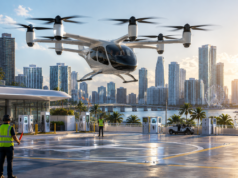
Integration with existing transit infrastructure is crucial for seamless user experience. Vertiports—specialized landing facilities for air taxis—are being strategically positioned throughout Tampa Bay to connect with transit hubs, hotels, and commercial centers. This multi-modal approach ensures that electric air taxis complement rather than compete with buses, trains, and other ground transportation systems.
Regulatory Framework Supporting Safe Operations
Federal Aviation Administration (FAA) oversight has been instrumental in enabling these operations while maintaining rigorous safety standards. Tampa Bay’s air taxi operators are working within comprehensive regulatory guidelines that govern aircraft certification, pilot training, airspace management, and emergency procedures. This balanced regulatory environment encourages innovation without compromising public safety.
Local and state government agencies have collaborated with the FAA to develop operational procedures specific to Tampa Bay’s airspace and geography. Airspace coordination systems ensure that eVTOLs operate safely alongside traditional aircraft, helicopters, and other aerial traffic. Continuous monitoring and feedback loops allow regulators to refine protocols as operational experience accumulates.
Public transparency and community engagement have been central to regulatory success in Tampa Bay. Town halls, pilot programs, and stakeholder consultations have addressed noise concerns, safety apprehensions, and integration challenges. This collaborative approach has built public confidence in eVTOL technology and demonstrated government commitment to responsible urban air mobility development.
Technological Innovation Behind Tampa Bay’s Air Taxi Fleet
Modern eVTOL aircraft represent the pinnacle of aviation and electrical engineering, combining advanced battery technology, autonomous flight systems, and sophisticated navigation capabilities. Aircraft operating over Tampa Bay feature redundant safety systems, real-time weather monitoring, and collision avoidance technology that exceeds traditional aviation standards. These technical achievements make electric air taxis not just environmentally superior, but operationally safer than many existing transportation methods.
Battery technology has undergone revolutionary improvements, enabling aircraft to achieve multi-passenger capacity with sufficient range for urban and suburban routes. Fast-charging infrastructure is being deployed at Tampa Bay vertiports to minimize turnaround times between flights. Ongoing research promises even higher energy density, longer endurance, and faster charging capabilities in coming generations of aircraft.
Autonomous and semi-autonomous flight systems are gradually being integrated into Tampa Bay air taxi operations, with human pilots maintaining oversight during this transitional phase. Advanced sensors, artificial intelligence, and machine learning algorithms enable aircraft to navigate complex urban environments, respond to changing weather, and optimize flight paths in real time. These systems represent years of development and testing, prioritizing safety above all other considerations.
Economic Impact and Future Growth Prospects
Key Takeaways from Tampa Bay’s Air Taxi Revolution
- Electric air taxis launching over Tampa Bay will reduce commute times from 45 minutes to 10-15 minutes, offering point-to-point transportation that transforms regional mobility patterns and enhances productivity.
- Zero-emission eVTOL operations deliver substantial environmental benefits aligned with Florida’s sustainability goals while operating under comprehensive FAA regulatory frameworks ensuring public safety and operational integrity.
- Strategic vertiport placement throughout Tampa Bay connects seamlessly with existing transit infrastructure, creating multi-modal transportation networks that complement buses, trains, and ground services while generating new employment opportunities.
Tampa Bay’s emergence as an eVTOL hub creates substantial economic opportunities across multiple sectors. Aircraft manufacturing, infrastructure development, maintenance facilities, and operational staffing represent immediate job creation. Hospitality and tourism industries stand to benefit from enhanced connectivity and reduced travel times for visitors navigating the region.
Real estate markets are already responding to air taxi availability, with properties near proposed vertiports commanding premium valuations. Commercial developers are incorporating air taxi access into mixed-use projects and corporate campuses. This real estate transformation reflects long-term market confidence in eVTOL technology and its role in shaping urban development patterns.
As Tampa Bay’s air taxi network matures and expands, neighboring regions will examine replicating this model, potentially establishing Florida as the national hub for eVTOL operations. Success in Tampa Bay provides the proof of concept that drives investment in similar projects throughout the country. The region’s pioneering efforts today are laying groundwork for nationwide air mobility transformation tomorrow.
Florida’s electric air taxi revolution over Tampa Bay marks a pivotal moment in transportation history. This convergence of technological achievement, regulatory clarity, and community support demonstrates that the future of urban mobility is no longer speculative—it’s arriving now. As eVTOLs take to Tampa Bay skies, they carry with them the promise of faster commutes, cleaner air, and a more connected region. The sky above Tampa Bay is opening to a new era of transportation, one electric flight at a time.