HIGHLIGHTS
- Trump Administration announces historic policy shift to accelerate eVTOL aircraft certification and deployment across U.S. airspace.
- New regulatory framework could eliminate years from approval timeline, enabling commercial urban air mobility services within the decade.
- Federal action positions America as global leader in personal air mobility while addressing growing demand for alternative transportation solutions.
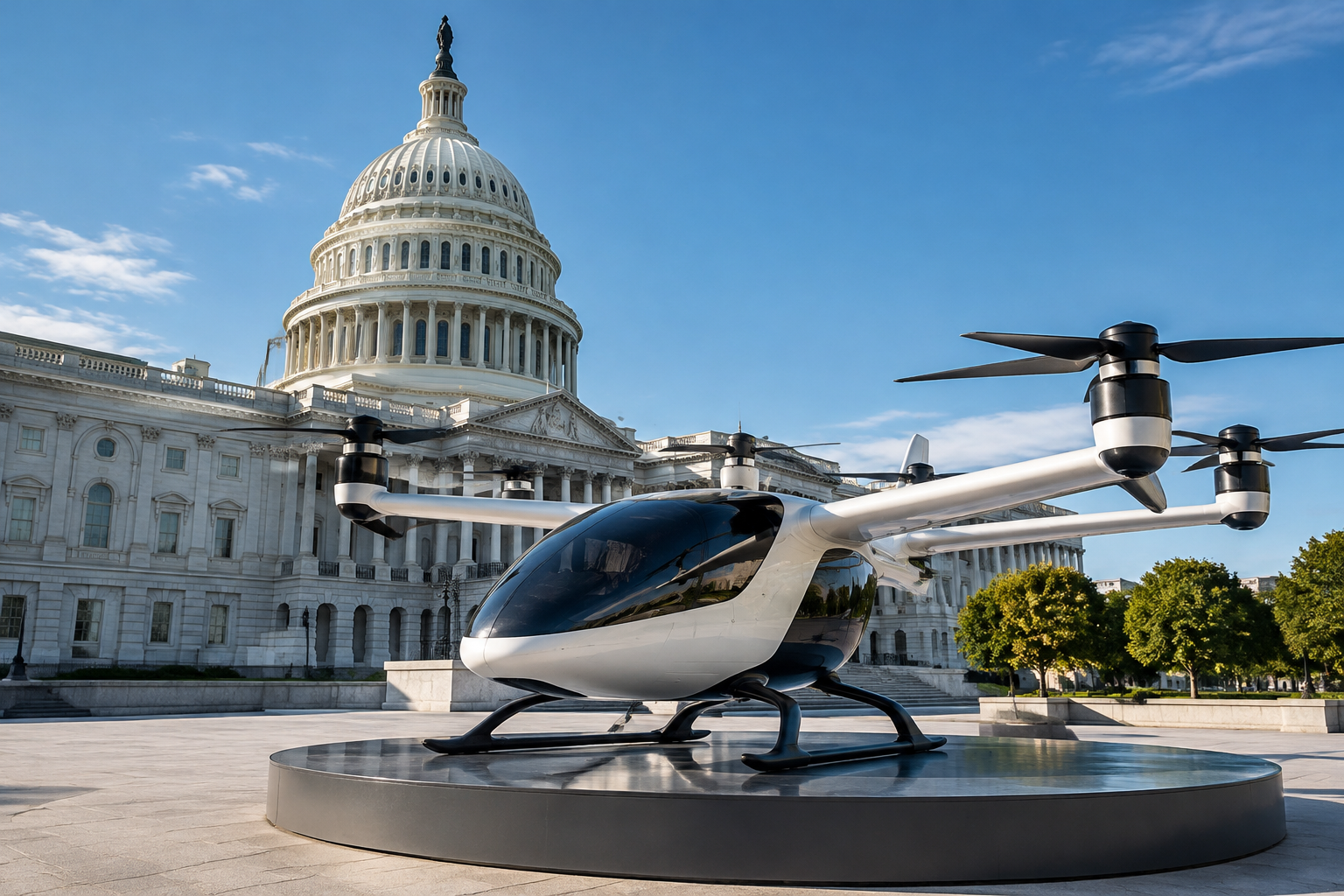
In a groundbreaking development that signals accelerated progress for the personal air mobility industry, the Trump Administration has announced unprecedented regulatory measures to expedite the certification and deployment of electric vertical takeoff and landing (eVTOL) aircraft across the United States. This historic policy shift represents a pivotal moment for an industry that has long awaited clearer federal guidance and streamlined approval pathways. The announcement underscores growing recognition at the highest levels of government that eVTOL technology is not a distant fantasy but an imminent transportation solution ready for real-world implementation.
A New Era of Regulatory Streamlining
The Trump Administration’s decision to prioritize eVTOL aircraft certification marks a dramatic departure from the cautious, multi-year approval processes that have historically characterized aviation innovation in America. Federal regulators have established new expedited pathways designed to cut through bureaucratic obstacles that have previously delayed certifications by years. This regulatory overhaul recognizes that eVTOL manufacturers have reached technological maturity and that the traditional slow-moving approval framework is no longer necessary or beneficial to American competitiveness.
By implementing streamlined certification protocols, the administration aims to transition from research-and-development phases directly into commercial deployment within a compressed timeline. The new framework allows manufacturers to demonstrate safety and airworthiness through alternative compliance methods that leverage real-world testing data and advanced modeling capabilities. This approach maintains rigorous safety standards while eliminating redundant procedural delays that once stretched certification timelines to five, ten, or more years.
Industry stakeholders have welcomed the announcement as validation of their technological achievements and proof that federal leadership recognizes eVTOL’s transformative potential. The policy shift also sends a clear message to international manufacturers and investors that the United States remains committed to maintaining its position as the innovation hub for advanced aviation technologies. With regulatory barriers significantly lowered, the timeline for commercial service launch has shifted from the distant future to the near term.
Commercial Urban Air Mobility on the Horizon
The regulatory breakthroughs announced by the Trump Administration create concrete pathways for commercial urban air mobility services to launch across major U.S. metropolitan areas. Cities from Los Angeles to New York, Miami to San Francisco, now have a realistic opportunity to establish eVTOL networks connecting airports to downtown districts, reducing commute times from hours to minutes. This transformation addresses chronic congestion challenges and offers commuters a premium mobility option that combines speed, sustainability, and futuristic appeal.
Several manufacturers have already begun site preparation and infrastructure planning in anticipation of imminent certification approvals. Vertiport development—specialized facilities designed to accommodate electric aircraft operations—has accelerated in major cities as companies prepare for launch-phase commercial services. The administration’s policy support has catalyzed investment decisions that were previously on hold pending regulatory certainty. Real estate developers, municipality officials, and transportation authorities are now actively collaborating to identify optimal vertiport locations that maximize network coverage and passenger accessibility.
The projected timeline now suggests that initial commercial eVTOL services could begin operations within the next 18-36 months in select markets, compared to the 5-10 year horizons previously anticipated. This acceleration fundamentally changes the business planning horizons for manufacturers, operators, and infrastructure developers. Capital investment decisions that were previously considered speculative now carry significantly reduced regulatory risk, attracting major institutional investors and multinational corporations to the sector.
American Technological Leadership and Global Competition
By accelerating eVTOL deployment, the Trump Administration positions the United States as the undisputed leader in personal air mobility innovation and commercialization. Other nations—particularly China and European countries—have pursued aggressive eVTOL programs with government support, but America’s regulatory authority and large, lucrative domestic market create competitive advantages that regulatory clarity can amplify. The new policy ensures that American companies will reach commercial scale first, establishing market dominance and technology standards that global competitors must follow.
This regulatory leadership also strengthens America’s economic competitiveness in emerging transportation markets. The eVTOL sector represents a multi-billion-dollar opportunity encompassing aircraft manufacturing, infrastructure development, software systems, and operational services. By enabling early-stage commercial deployment, the administration ensures that American companies capture this value rather than ceding leadership to foreign competitors. The policy also creates high-skilled manufacturing and technology jobs concentrated in aerospace, engineering, and advanced transportation sectors.
International manufacturers and operators have taken note of America’s regulatory shift, recognizing that successful U.S. market entry now requires faster product deployment and certification achievement. The policy effectively establishes United States standards and regulatory approaches as global benchmarks, ensuring that American safety protocols, operational procedures, and technical specifications shape how eVTOL aviation develops worldwide. This standardization advantage creates lasting competitive benefits extending far beyond initial commercialization phases.
Sustainability and the Future of Urban Mobility
The Trump Administration’s eVTOL initiative addresses critical environmental and urban sustainability imperatives by introducing zero-emission aircraft options for metropolitan transportation. Electric vertical takeoff and landing vehicles produce no direct emissions during operation, contributing to improved air quality in dense urban centers where ground transportation concentrations have created persistent pollution challenges. As cities increasingly adopt aggressive climate targets, eVTOL networks represent practical solutions for achieving transportation decarbonization while maintaining service quality and convenience for commuters.
The shift from traditional helicopters and ground transportation to electric aircraft fundamentally transforms the noise profile of urban aviation. eVTOL aircraft operate with significantly reduced noise levels compared to conventional helicopters, enabling flights over populated urban areas without generating the acoustic disturbance that has historically limited aviation operations near residential neighborhoods. This quiet operation capability opens entirely new possibilities for metropolitan air mobility networks that previous technology simply could not support.
Federal support for eVTOL commercialization also accelerates the development of sustainable aviation infrastructure and energy systems. Vertiport facilities increasingly incorporate renewable energy sources, battery charging systems powered by clean electricity grids, and smart energy management technologies. The mass deployment of eVTOL aircraft will drive innovation in battery technology, electric propulsion systems, and grid integration solutions that generate spillover benefits across broader transportation electrification efforts. The administration’s policy effectively positions eVTOL advancement as core component of America’s energy transition strategy.
Key Implications of Historic eVTOL Policy Shift
- Federal certification timelines compressed from 5-10 years to 18-36 months, enabling rapid transition from development to commercial operations
- Major metropolitan markets gain concrete pathways to launch urban air mobility networks connecting airports, downtown districts, and regional transportation hubs
- American manufacturers secure first-mover advantages in global eVTOL commercialization, establishing market dominance and technology leadership
- Zero-emission aircraft operations contribute to urban air quality improvements and support municipal climate commitments
- Vertiport infrastructure investments accelerate across major cities as operators prepare for imminent service launches
The Trump Administration’s historic regulatory action represents a watershed moment for the personal air mobility industry and American transportation innovation broadly. By removing bureaucratic obstacles and establishing expedited certification pathways, federal leadership has transformed eVTOL from theoretical future technology into practical near-term reality. The implications extend far beyond aviation specialists and industry professionals—these policy decisions will reshape how millions of Americans experience urban mobility, reduce commute times, and interact with metropolitan transportation systems. As vertiports begin construction and manufacturers accelerate final certification preparations, the age of commercial eVTOL aviation in America is no longer approaching; it has definitively arrived.