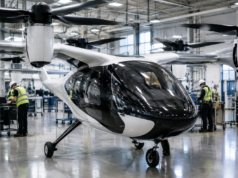
HIGHLIGHTS
- Joby Aviation reports 144% YoY revenue growth in Q3 2026, driven by record Blade air taxi passenger volumes across metropolitan markets
- eVTOL certifications advancing with FAA and other aviation authorities, enabling path to expanded operations and next-generation service deployments
- Manufacturing capabilities expanded to support commercial-scale production, validating Joby’s ability to meet growing demand while maintaining premium service quality
Joby Aviation has delivered exceptional third-quarter 2026 results, marking a pivotal moment for the personal air mobility industry. The company reported a stunning 144% year-over-year revenue surge, fueled primarily by record passenger volumes on its Blade air taxi services. This milestone signals growing market acceptance of eVTOL technology and validates the commercial viability of urban air mobility operations at scale.
Record Revenue Growth and Blade Operations
The 144% revenue increase represents Joby Aviation’s most impressive financial performance to date, underscoring the accelerating adoption of air taxi services in markets where the company operates. Blade passenger volume hit all-time highs during the quarter, with demand outpacing initial projections and demonstrating strong consumer appetite for premium urban mobility solutions. This growth trajectory suggests that the air mobility market has moved beyond early-adopter phases into mainstream commercial viability.
Blade’s expansion across multiple metropolitan areas has been instrumental in driving these results. The service’s convenience factor—combining speed, reliability, and premium positioning—continues to attract both corporate and leisure passengers willing to pay premium fares for time-saving benefits. Operational efficiency improvements have also enhanced margins while maintaining service quality, contributing meaningfully to the company’s bottom line.
Looking at year-to-date comparisons, Joby’s Q3 performance positions the company as a leader in the commercialization race. While competitors focus heavily on certification pathways, Joby has already begun monetizing operations, creating a revenue baseline that strengthens investor confidence and provides capital for ongoing development and expansion initiatives.
eVTOL Certification Progress
Parallel to its commercial success, Joby Aviation continues advancing critical certifications required for expanded operations. The company’s eVTOL aircraft has been undergoing rigorous testing and regulatory review processes with aviation authorities, particularly the FAA, to ensure compliance with evolving airworthiness standards. These certification milestones are essential prerequisites for scaling operations beyond current markets and enabling next-generation service deployments.
The regulatory environment for eVTOL aircraft has matured considerably through 2026, with established certification frameworks now guiding manufacturers toward type certification. Joby’s progress in this domain represents tangible proof that novel aircraft designs can meet stringent safety and performance requirements established by world-class aviation regulators. Each certification milestone removes uncertainty and de-risks the company’s long-term growth strategy.
Industry observers note that Joby’s dual-track approach—simultaneously operating commercial services while pursuing advanced certifications—positions the company uniquely within the competitive landscape. This strategy provides real-world operational data that informs certification processes while generating revenue that funds development of next-generation platforms and expanded fleet capacity.
Manufacturing Capabilities and Scale
Joby’s manufacturing infrastructure has been strengthened to support the company’s aggressive growth targets. The company has invested significantly in production facilities designed to scale aircraft manufacturing from limited prototypes to commercial volumes capable of serving global markets. These manufacturing investments reflect management’s confidence in sustained demand and the viability of eVTOL as a transportation category.
Supply chain optimization and strategic partnerships have enhanced production efficiency, allowing Joby to meet rising demand while maintaining quality standards demanded by premium customers and regulators. The company’s manufacturing facilities incorporate advanced automation and quality control systems designed to achieve consistent performance across the aircraft fleet. This manufacturing prowess will be critical as Joby pursues geographic and operational expansion.
The intersection of record operational demand and expanded manufacturing capacity creates a compelling growth narrative. As supply constraints ease and production volumes increase, Joby should be positioned to capitalize on growing market interest in air taxi services across major metropolitan areas globally. Analysts highlight manufacturing scalability as a key differentiator that validates the company’s competitive positioning.
Market Implications and Industry Impact
Joby Aviation’s Q3 2026 results carry significance extending beyond the company’s individual performance, offering concrete evidence that urban air mobility is transitioning from speculative future technology to present-day commercial reality. The company’s revenue growth and passenger volume achievements provide a template for how other eVTOL developers might approach market entry and expansion strategies. This success narrative helps attract additional capital, talent, and stakeholder confidence to the broader air mobility ecosystem.
The competitive landscape continues intensifying, with multiple companies pursuing different strategic approaches to commercialization. Joby’s early-mover advantage in passenger operations has yielded first-mover benefits—establishing brand recognition, gathering operational insights, and building regulatory relationships that newer entrants must now replicate. However, the company faces increasing competition from well-funded rivals pursuing parallel development and certification pathways.
Longer-term implications of Joby’s Q3 success include potential acceleration of infrastructure investments in vertiport development, pilot training programs, and maintenance facilities required to support expanding air taxi fleets. Urban planning authorities in major markets are increasingly incorporating air mobility into transportation strategies, and strong commercial evidence of viability should accelerate these adoption timelines. Consumer awareness and acceptance continue building as more passengers experience air taxi services firsthand.
Key Developments and Future Outlook
- Joby’s 144% year-over-year revenue growth demonstrates viable commercial demand for eVTOL air taxi services at meaningful scale
- Record Blade passenger volumes indicate strong market acceptance among premium urban commuters and travelers willing to pay for time-saving air mobility solutions
- Advancing eVTOL certifications and expanded manufacturing capabilities position Joby to capitalize on growing demand and accelerate fleet expansion globally
Joby Aviation’s Q3 2026 results validate the long-held promise that personal air mobility represents a genuine transportation category with substantial commercial potential. The convergence of record revenue growth, strong passenger demand, advancing certifications, and expanded manufacturing capabilities creates multiple positive catalysts for continued expansion. As the company moves through late 2026 and into 2027, execution on growth initiatives while maintaining service quality and safety standards will be critical to sustaining momentum. The broader industry should study Joby’s success formula—balancing near-term commercialization with long-term technology advancement—as a viable blueprint for viable eVTOL marketplace development.