HIGHLIGHTS
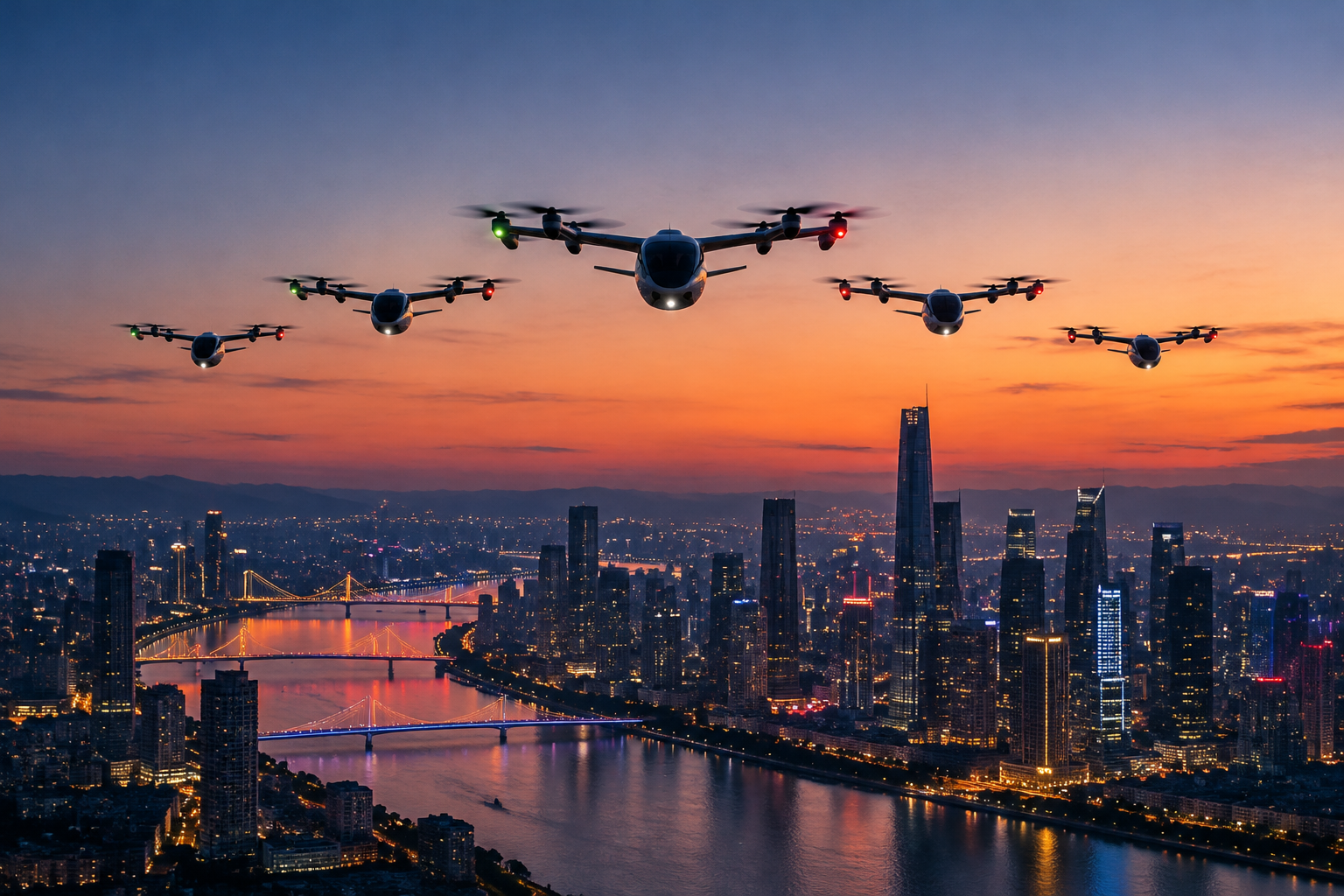
- AutoFlight completed the first fully automatic five-aircraft formation flight, a breakthrough in autonomous eVTOL coordination technology
- The achievement demonstrates advanced collision avoidance, real-time communication, and sensor fusion capabilities essential for commercial operations
- AutoFlight’s milestone strengthens China’s competitive position in the global eVTOL market and informs regulatory standards worldwide
Chinese eVTOL manufacturer AutoFlight has achieved a significant milestone in autonomous aviation technology by successfully completing a fully automatic formation flight involving five aircraft. This coordinated demonstration represents a major step forward for the emerging urban air mobility sector and underscores China’s growing competitiveness in electric vertical takeoff and landing (eVTOL) development. The autonomous formation flight showcases the technical maturity required for commercial operations and highlights AutoFlight’s position as a leading innovator in the personal air mobility space.
AutoFlight’s Path to Formation Flight Innovation
AutoFlight, headquartered in Hangzhou, has established itself as one of China’s most ambitious eVTOL developers. The company has been consistently pushing the boundaries of autonomous flight technology and multi-aircraft coordination systems. Their focus on fully autonomous operations distinguishes them from many competitors who are still relying on piloted or semi-autonomous configurations for initial commercial deployments.
The company’s commitment to advancing formation flight capabilities demonstrates a forward-thinking approach to scaling urban air mobility operations. Formation flying can significantly improve operational efficiency, reduce energy consumption per aircraft, and optimize airspace utilization—critical factors for the economic viability of commercial eVTOL services in densely populated urban environments.
AutoFlight’s successful five-aircraft formation represents the culmination of years of research, development, and rigorous testing protocols. The achievement reflects the company’s sophisticated understanding of autonomous systems, collision avoidance algorithms, and real-time aircraft coordination technologies.
Technical Challenges in Multi-Aircraft Autonomous Coordination
Executing a fully automatic formation flight with five aircraft simultaneously presents extraordinary technical challenges. Each vehicle must maintain precise spatial relationships with its neighboring aircraft while monitoring complex navigation systems, airspace regulations, and safety protocols. The autonomous systems must dynamically adjust flight paths in real time to maintain formation integrity while accounting for wind conditions, sensor data, and environmental variables.
One of the most critical components of formation flight is collision avoidance. The system must predict potential conflicts seconds in advance and execute corrective maneuvers that maintain formation cohesion while preventing dangerous interactions. Advanced machine learning algorithms, LiDAR systems, and sophisticated sensor fusion technologies enable this level of autonomous precision and safety assurance.
Communication protocols between aircraft are equally vital. The formation flight system requires ultra-reliable, low-latency data exchange between all vehicles to ensure coordinated movement and immediate response to any anomalies or system changes. AutoFlight’s successful demonstration suggests the company has developed robust redundancy measures and fail-safe protocols that could set standards for industry-wide autonomous operations.
Implications for Urban Air Mobility Operations
The successful formation flight by AutoFlight has profound implications for how eVTOL services might scale in urban environments. Formation flying could enable operators to move multiple passengers simultaneously while optimizing fuel consumption and reducing overall operational costs. This capability becomes increasingly valuable as cities develop dedicated air corridors and urban air mobility networks expand beyond initial point-to-point routes.
Regulatory authorities worldwide are closely monitoring advancements in autonomous eVTOL technologies. Demonstrations like AutoFlight’s formation flight provide critical data about the feasibility and safety of autonomous multi-aircraft operations, informing the development of certification standards and operational guidelines. Successful autonomous flights increase regulatory confidence in eVTOL platforms and accelerate the timeline toward commercial certification.
The achievement also signals strong momentum in China’s ambitions to lead the global eVTOL market. As competition intensifies between manufacturers in the United States, Europe, and Asia, technological milestones like autonomous formation flight demonstrations become key differentiators that attract investment, partnerships, and regulatory attention.
The Competitive Landscape and Global eVTOL Race
AutoFlight’s accomplishment places the company at the forefront of autonomous eVTOL innovation, competing with manufacturers worldwide who are pursuing their own advanced autonomy capabilities. Companies like Joby Aviation, Lilium, and others are also exploring autonomous technologies, but few have publicly demonstrated multi-aircraft coordinated flight at this scale.
China’s focus on eVTOL development extends beyond individual companies. The Chinese government has made urban air mobility a strategic priority, with significant investment in research infrastructure, testing facilities, and regulatory frameworks. AutoFlight’s formation flight achievement reflects this broader national commitment and positions China as a serious contender in shaping the future of aerial transportation.
International collaboration and technology sharing may accelerate as the industry matures. AutoFlight’s innovations could influence global standards for autonomous eVTOL operations, creating opportunities for partnerships with manufacturers, airlines, and infrastructure providers worldwide. The company’s technical achievements may also attract acquisition interest from larger aviation conglomerates or aerospace companies seeking to rapidly advance their eVTOL capabilities.
Key Takeaways from AutoFlight’s Formation Flight Achievement
- AutoFlight successfully completed a fully autonomous five-aircraft formation flight, demonstrating mature autonomous coordination technology critical for commercial eVTOL operations
- The achievement establishes new technical benchmarks for collision avoidance, real-time communication, and sensor fusion capabilities in autonomous aviation systems
- AutoFlight’s milestone strengthens China’s competitive position in the global eVTOL market and provides valuable data for regulatory development of autonomous urban air mobility standards
AutoFlight’s successful autonomous formation flight represents a pivotal moment in the evolution of urban air mobility technology. By demonstrating that five aircraft can operate in coordinated flight without human intervention, the company has validated critical technical capabilities required for scaled, efficient eVTOL operations. As regulatory frameworks mature and commercial services begin deployment in cities worldwide, innovations like AutoFlight’s autonomous coordination will become increasingly essential for enabling safe, efficient, and economically viable urban air transportation networks. The achievement underscores the rapid advancement of autonomous aviation technology and reinforces the growing confidence that electric vertical takeoff and landing vehicles will play a transformative role in future urban mobility ecosystems.