HIGHLIGHTS
- EHang’s EH216-EK is purpose-built for firefighting missions, eliminating pilot exposure to extreme fire zone conditions through autonomous operation and remote supervision
- Advanced thermal imaging and flame detection sensors provide real-time command center situational awareness for informed emergency response decision-making
- Operating costs dramatically lower than traditional helicopters, making regular deployment and training exercises economically feasible for municipal fire departments
EHang Holdings, China’s leading autonomous aircraft manufacturer, has unveiled the EH216-EK, a groundbreaking firefighting eVTOL (electric vertical takeoff and landing) aircraft designed specifically for emergency response operations. This specialized variant represents a significant evolution in the company’s EH216 platform and marks a major milestone in deploying advanced air mobility technology for critical infrastructure and disaster management applications. The EH216-EK addresses long-standing limitations in traditional firefighting operations, offering rapid response capabilities, reduced risk to personnel, and unprecedented access to difficult-to-reach emergency scenarios.
Purpose-Built Design for Fire Response Operations
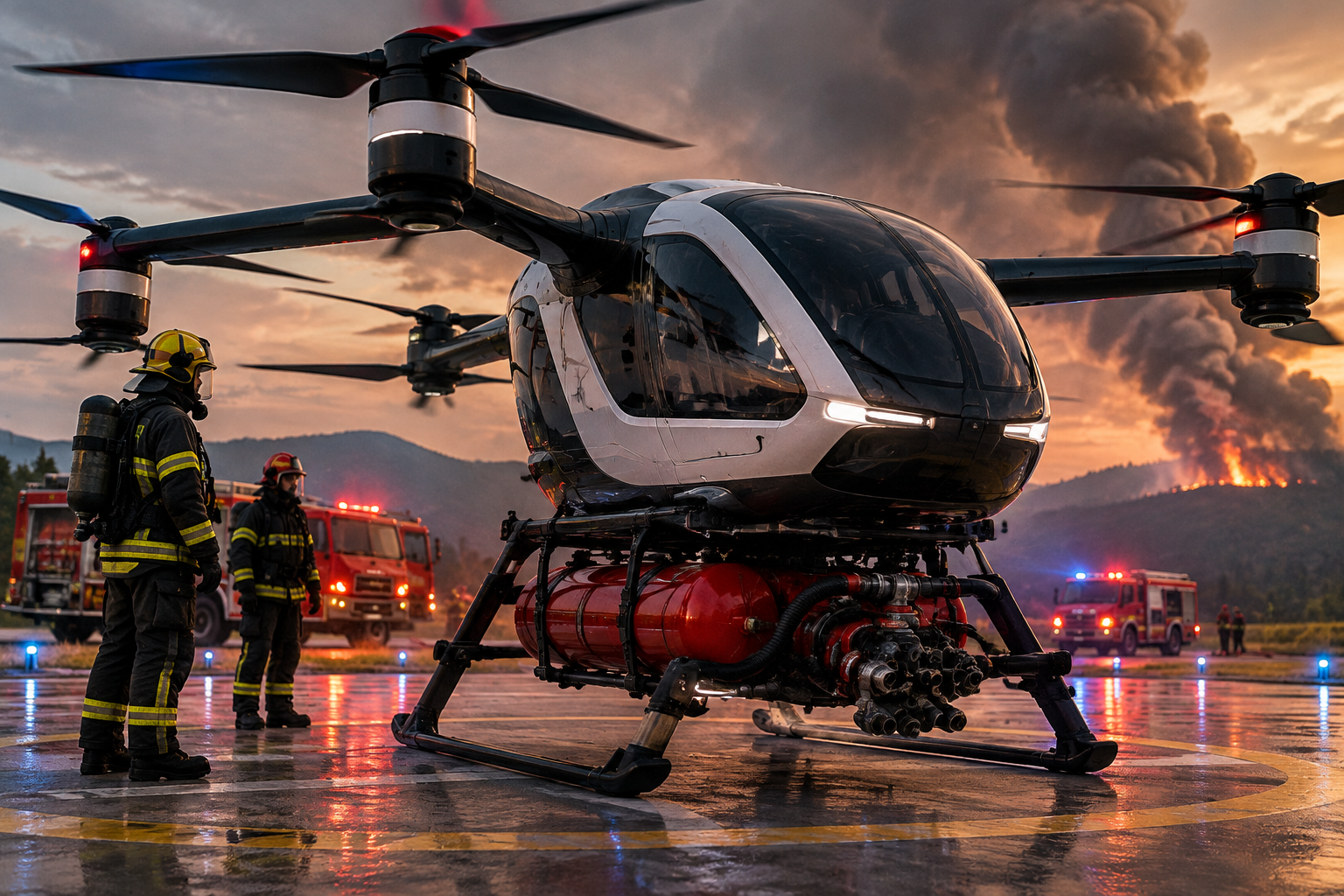
The EH216-EK has been engineered from the ground up to meet the demanding requirements of firefighting missions in complex urban and rural environments. Unlike the passenger-focused variants of the EH216 platform, this specialized version incorporates fire suppression systems, enhanced sensor arrays, and optimized weight distribution to accommodate firefighting payloads. The aircraft’s autonomous flight capabilities allow emergency response teams to deploy it rapidly to active fire zones without exposing pilots to dangerous conditions, fundamentally changing how first responders can approach aerial fire management.
The design philosophy behind the EH216-EK prioritizes both functionality and safety for ground-based personnel and bystanders. The vehicle maintains the parent platform’s proven reliability and 16-rotor configuration, which provides exceptional stability and control precision—critical factors when operating near active fire zones. Enhanced redundancy systems ensure that the aircraft can continue operating reliably even in challenging environmental conditions, including smoke, heat signatures, and variable wind patterns common during firefighting operations.
EHang’s development team incorporated feedback from emergency management professionals and fire departments across Asia to ensure that the EH216-EK meets real-world operational needs. The result is an aircraft that bridges the gap between traditional helicopter-based fire suppression and ground-based firefighting equipment, offering flexibility and rapid deployment capabilities that neither category can independently provide.
Technological Capabilities and Autonomy Features
The EH216-EK leverages EHang’s advanced autonomous flight technology, enabling missions with minimal human intervention once programmed and launched. The aircraft is equipped with sophisticated sensor systems including thermal imaging, real-time flame detection, and environmental monitoring capabilities that provide firefighters with critical situational awareness. These sensors feed data directly to command centers, allowing incident commanders to make informed decisions about resource allocation and operational strategy in real time.
Autonomous navigation systems allow the EH216-EK to fly pre-programmed routes to active fire zones, avoiding obstacles and adapting to changing conditions automatically. This capability is particularly valuable during initial response phases when rapid deployment is essential and detailed route planning may not be available. The aircraft can operate in GPS-denied or degraded conditions by utilizing computer vision and advanced mapping systems, ensuring reliable performance even in areas where traditional navigation aids may be compromised by dense smoke or electromagnetic interference.
The fire suppression payload integration represents a significant technical achievement, requiring careful engineering to manage weight distribution, battery performance, and aerodynamic stability. The EH216-EK can carry specialized fire retardant compounds, water-based suppressants, or foam solutions depending on the specific fire type and operational requirements. This modularity allows emergency agencies to customize payloads based on regional hazard profiles and operational priorities.
Operational Advantages Over Traditional Methods
The deployment of the EH216-EK offers transformative operational advantages compared to conventional firefighting approaches. Traditional helicopter-based fire suppression requires extensive pilot training, higher operational costs per flight hour, and significant coordination with aviation authorities. The EH216-EK, operating autonomously or under remote supervision, can achieve rapid response times with dramatically lower operational overhead. For urban fires in densely populated areas, this eVTOL provides an alternative that minimizes airspace congestion and reduces noise pollution compared to larger manned helicopters.
Personnel safety represents one of the most compelling advantages of autonomous firefighting aircraft. Deploying the EH216-EK eliminates the exposure of pilots and crew members to extreme temperatures, smoke inhalation, and the structural hazards associated with operating near active fire zones. Emergency responders on the ground can safely operate the aircraft from command centers located at a distance from immediate danger, reducing overall operational risk while maintaining full situational awareness and control authority.
The cost-efficiency of eVTOL-based firefighting operations extends across multiple dimensions. Electric propulsion eliminates expensive fuel consumption, maintenance requirements are significantly lower than traditional aircraft, and the autonomous capabilities reduce the need for highly specialized pilot certification. These factors combine to make regular deployment and training exercises more economically feasible for municipal fire departments and regional emergency services, ultimately improving preparedness and response capabilities.
Regional Impact and Market Expansion Potential
The unveiling of the EH216-EK comes at a pivotal moment for EHang’s expansion across Asia’s rapidly growing air mobility ecosystem. China’s regulatory environment has become increasingly supportive of autonomous aircraft applications, particularly for critical infrastructure and emergency services. This regulatory tailwind enables EHang to accelerate real-world deployment and gather operational data that can inform future system improvements and feature enhancements for the firefighting variant.
Asian countries face unique firefighting challenges, including monsoon seasons, dense urban centers interspersed with rural areas, and rapidly expanding wildland-urban interfaces. The EH216-EK is exceptionally well-positioned to address these regional needs. Countries like Japan, South Korea, and Southeast Asian nations are increasingly interested in next-generation emergency response technologies, creating substantial market opportunities for specialized eVTOL applications. EHang’s early mover advantage in this space could establish the company as the dominant supplier for firefighting air mobility solutions across the entire Asia-Pacific region.
Partnership opportunities with government agencies, municipal authorities, and private emergency response providers represent significant growth vectors for this platform. As regulatory frameworks mature and real-world operational success builds confidence, adoption is likely to accelerate. Insurance companies and risk management organizations may also drive adoption by incentivizing the deployment of advanced firefighting capabilities that reduce property damage and improve response outcomes.
Key Operational Takeaways
- The EH216-EK eliminates pilot exposure to extreme fire zone conditions through autonomous operation and remote supervision capabilities
- Advanced sensor integration including thermal imaging and flame detection provides command centers with real-time situational awareness for informed decision-making
- Significantly lower operational costs compared to traditional helicopter-based fire suppression enable broader deployment and regular training exercises
EHang’s EH216-EK firefighting eVTOL represents a watershed moment in the convergence of autonomous aircraft technology and critical infrastructure applications. By addressing genuine operational challenges faced by fire departments and emergency services, this platform demonstrates that eVTOL technology extends far beyond passenger transportation. The successful deployment of the EH216-EK will serve as a proof point for autonomous aircraft applications across emergency management, potentially accelerating regulatory acceptance and investment in adjacent specialized eVTOL categories. As this platform enters real-world service, it will generate invaluable operational data that informs the next generation of purpose-built autonomous aircraft for critical applications.