HIGHLIGHTS
- Air India, SkyDrive, and Suzuki sign landmark MoU to explore medical air logistics delivery across India using eVTOL aircraft technology.
- Feasibility study will assess the viability of rapid healthcare supply distribution and emergency medical transportation via electric vertical takeoff and landing vehicles.
- Strategic partnership combines Air India’s aviation expertise, SkyDrive’s eVTOL innovation, and Suzuki’s manufacturing capabilities to advance India’s personal air mobility sector.
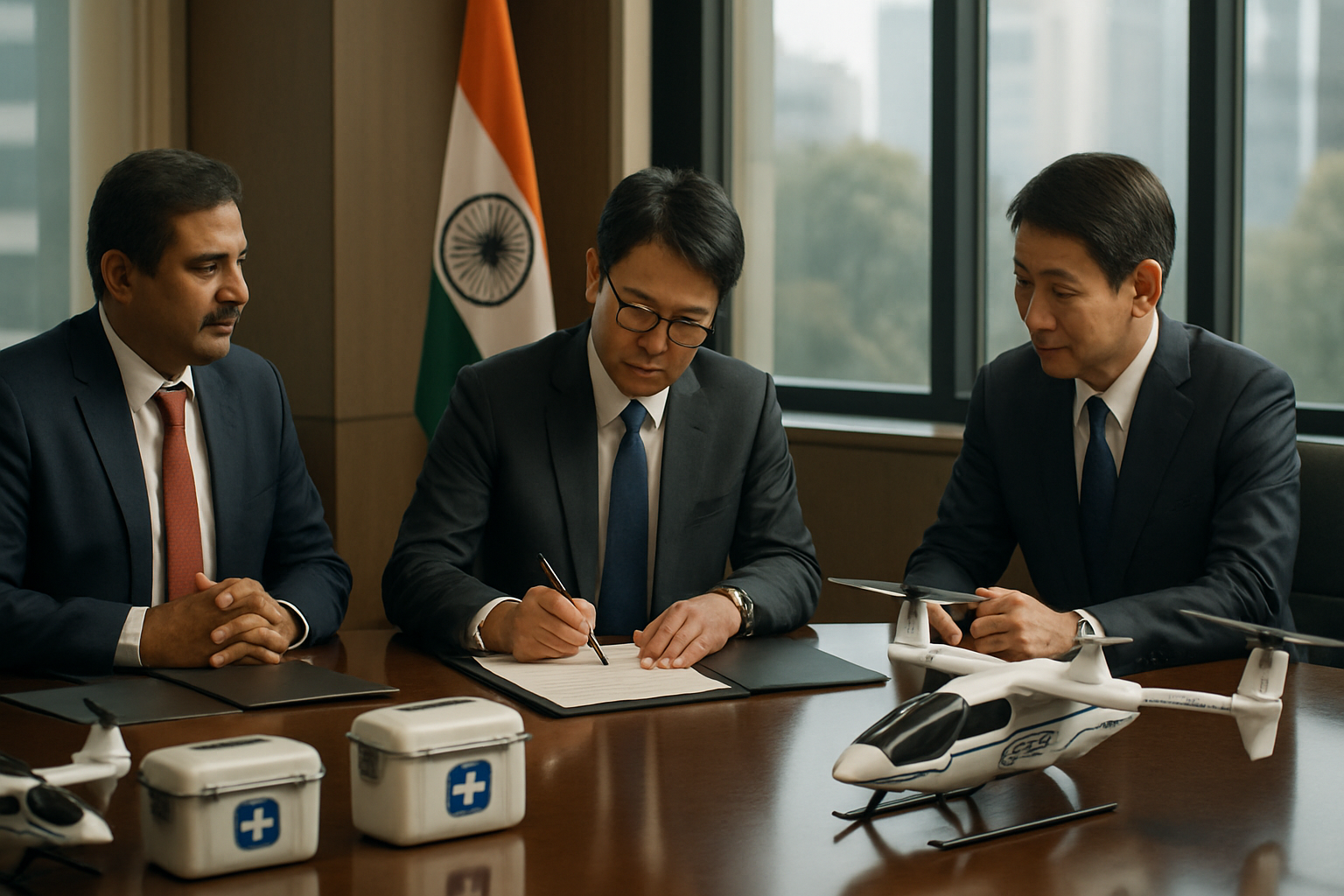
In a significant milestone for India’s emerging personal air mobility sector, Air India, SkyDrive, and Suzuki Motor Corporation have announced a strategic Memorandum of Understanding (MoU) to conduct a joint feasibility study on medical air logistics. This landmark collaboration signals growing momentum in the adoption of electric vertical takeoff and landing (eVTOL) aircraft for critical healthcare delivery applications across the Indian subcontinent.
Strategic Alliance Unites Aviation, Technology, and Manufacturing
The partnership represents a convergence of three distinct yet complementary sectors. Air India brings decades of aviation expertise and established infrastructure across India’s transportation network. SkyDrive contributes cutting-edge eVTOL technology and innovation capabilities, while Suzuki Motor Corporation leverages its manufacturing prowess and supply chain efficiency to scale production and logistics operations. This tri-partite approach creates a robust foundation for transforming emergency medical supply delivery in India.
Air India’s involvement underscores the aviation industry’s confidence in eVTOL technology as a legitimate complement to traditional air transport. The airline’s participation lends credibility to the feasibility study and positions SkyDrive’s aircraft within a regulated, established aviation framework. Suzuki’s participation demonstrates how automotive and manufacturing giants are pivoting toward next-generation mobility solutions.
By combining these three entities’ strengths, the partnership aims to create an integrated ecosystem capable of rapidly deploying medical supplies, organ transplants, blood products, and emergency medications across India’s challenging geography. The collaboration will explore regulatory pathways, operational infrastructure, and market viability for sustained, scalable medical air logistics services.
Medical Air Logistics: Addressing India’s Healthcare Challenges
India’s vast geography, coupled with limited ground transportation infrastructure in remote regions, creates critical bottlenecks in emergency healthcare delivery. Every hour matters in medical emergencies—whether rapid transport of lifesaving medications, blood supplies, or organs for transplantation. Traditional road and rail networks cannot guarantee the speed necessary for time-critical medical interventions in rural and semi-urban areas.
eVTOL aircraft present a paradigm-shifting solution. These electric vertical takeoff vehicles can operate from distributed landing zones without requiring traditional airport infrastructure, enabling point-to-point medical logistics across previously underserved regions. A feasibility study examining routes, demand patterns, regulatory compliance, and operational costs will determine whether medical air logistics can become a sustainable, scalable service model across Indian healthcare networks.
The feasibility study will likely examine several critical dimensions: identifying high-priority medical logistics corridors between major hospitals and rural health centers, assessing demand for time-critical medical supply delivery, evaluating cost structures relative to existing delivery methods, and mapping regulatory and infrastructure requirements. Such analysis will provide the foundation for potential commercial deployment once regulatory frameworks mature.
SkyDrive’s eVTOL Technology in Healthcare Applications
SkyDrive, a Japanese innovator in autonomous eVTOL aircraft, has positioned itself at the forefront of urban air mobility for cargo and emergency transport applications. The company’s technology emphasizes safety, reliability, and operational efficiency—precisely the attributes demanded in medical logistics. SkyDrive’s aircraft are designed for autonomous operations with minimal pilot intervention, reducing operational costs while improving consistency and safety profiles critical for healthcare deployments.
The feasibility study will likely leverage SkyDrive’s proprietary technology to establish baseline performance metrics for medical air logistics. Key parameters will include payload capacity for medical supplies, flight range between major medical hubs, turnaround times for repeated daily missions, energy consumption and charging infrastructure requirements, and integration with existing hospital logistics systems. These technical specifications will inform the commercial viability assessment.
SkyDrive’s involvement also signals international confidence in India’s potential as an eVTOL deployment market. As regulatory frameworks evolve globally, early-stage feasibility studies like this one position companies to move swiftly from concept to commercial operations once approvals materialize. SkyDrive’s participation in the Indian medical logistics initiative strengthens its portfolio of real-world applications beyond urban transport.
Regulatory and Infrastructure Implications
This MoU carries significant implications for India’s regulatory environment governing eVTOL aircraft and urban air mobility. While the civil aviation authority has begun developing frameworks for unmanned and autonomous aircraft, the deployment of eVTOL vehicles for critical healthcare applications remains largely uncharted territory in Indian regulations. The feasibility study will likely highlight regulatory gaps and opportunities, providing policymakers with data-driven recommendations for enabling medical air logistics while maintaining safety and security standards.
Infrastructure requirements extend beyond aircraft technology to encompassing charging stations, landing pads at hospitals, maintenance facilities, and integration with hospital information systems. The study will assess the capital investment required to establish a functional medical air logistics network and identify mechanisms for sharing infrastructure across multiple operators. Early coordination among stakeholders can prevent siloed development and maximize network efficiency.
Suzuki’s manufacturing capabilities suggest potential domestic production of eVTOL aircraft or components, which would strengthen India’s aerospace industrial base and reduce dependency on imported technology. A successful feasibility study may catalyze investment in manufacturing infrastructure, creating employment opportunities and positioning India as a regional hub for eVTOL production and innovation.
Market Opportunity and Competitive Landscape
India’s healthcare sector represents one of the world’s largest markets by population served, yet remains fragmented across urban centers, semi-urban towns, and remote rural areas. The disparity in medical infrastructure creates persistent inequities in healthcare access. Medical air logistics powered by eVTOL aircraft offers a scalable solution to compress these disparities by accelerating the movement of critical supplies across the country’s diverse geography.
The feasibility study also positions India competitively within the global eVTOL marketplace. Several countries—including the United States, Singapore, and Japan—are advancing medical air logistics initiatives. India’s partnership demonstrates its serious commitment to adopting next-generation mobility technologies, potentially attracting additional investment and innovation from global eVTOL companies seeking deployment opportunities in large, emerging markets.
Commercially, the market for medical air logistics extends beyond emergency supply distribution to encompassing organ transport networks, specialty medication delivery, diagnostic sample transport, and personnel mobility for specialized medical teams. The feasibility study will likely model revenue potential across multiple use cases, identifying which segments offer the strongest early commercial viability for pilot deployment programs.
Key Takeaways from the Air India-SkyDrive-Suzuki Initiative
- Multi-sector partnership combines established aviation expertise, cutting-edge eVTOL technology, and manufacturing capabilities to advance medical air logistics in India
- Feasibility study addresses India’s critical healthcare delivery challenges by evaluating eVTOL aircraft suitability for rapid medical supply and organ transport across diverse geographies
- Initiative carries significant implications for regulatory development, infrastructure investment, and domestic aerospace manufacturing capabilities in India’s eVTOL sector
The Air India, SkyDrive, and Suzuki MoU represents far more than a single corporate collaboration—it exemplifies the maturation of eVTOL technology from speculative concept toward practical implementation in mission-critical applications. As the feasibility study progresses, it will generate crucial data regarding the technical, operational, regulatory, and commercial viability of medical air logistics in India. Success in this initiative could accelerate the adoption of eVTOL aircraft across South Asia’s broader healthcare and logistics sectors, establishing a blueprint for other emerging markets seeking to leverage advanced air mobility for social impact.