HIGHLIGHTS
- Florida police deploy $148,000 Jetson ONE eVTOL for aerial patrol, marking one of the first operational deployments by U.S. law enforcement.
- Electric propulsion enables quiet, runway-free operations and dramatically lower costs than traditional police helicopters, expanding aerial surveillance access to mid-sized agencies.
- Successful police deployment could accelerate FAA eVTOL certification and inspire rapid adoption across emergency services, border patrol, and government agencies nationwide.
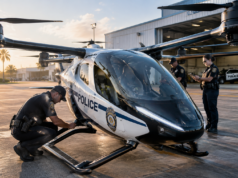
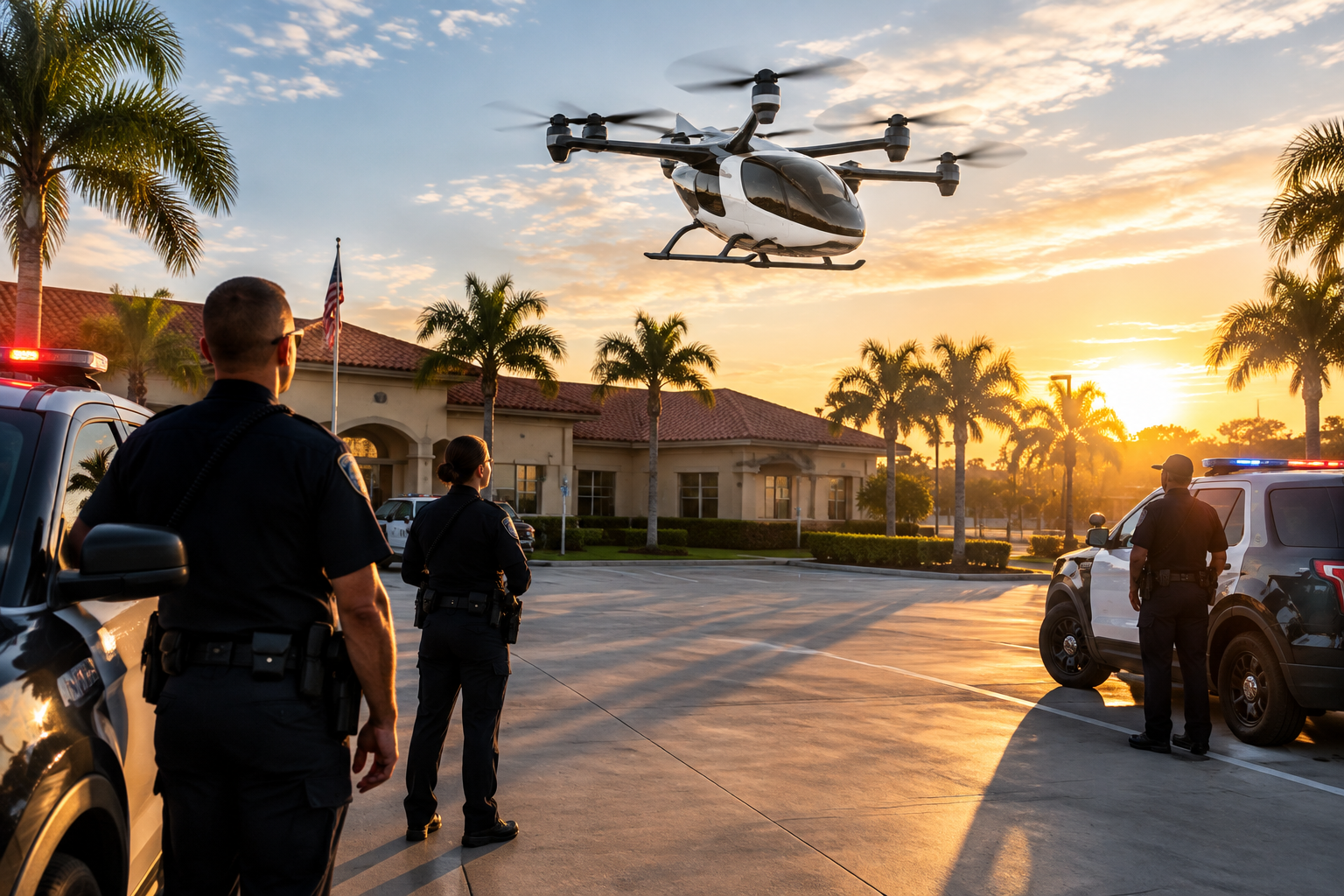
In a landmark moment for law enforcement innovation, Florida police have unveiled a $148,000 Jetson ONE eVTOL aircraft as a flying patrol vehicle, signaling a dramatic shift in how police departments may approach aerial surveillance, emergency response, and community safety. This deployment represents one of the first operational uses of an electric vertical takeoff and landing aircraft by a U.S. police agency, demonstrating the growing viability of personal air mobility solutions beyond commercial and consumer markets. The Jetson ONE, developed by Swedish manufacturer Jetson, brings cutting-edge autonomous and piloted flight capabilities to frontline law enforcement operations.
The Jetson ONE: Redefining Police Aerial Capabilities
The Jetson ONE is a single-occupant eVTOL aircraft designed for rapid, agile aerial operations in urban and suburban environments. With its compact frame, electric propulsion system, and hovering capabilities, the aircraft can reach speeds of up to 63 mph and operate at altitudes suitable for patrol and surveillance missions. Unlike traditional police helicopters, which require significant infrastructure, specialized pilots, and substantial operational costs, the Jetson ONE offers a more accessible and affordable platform for law enforcement agencies exploring aerial mobility solutions.
The aircraft’s electric drivetrain eliminates the noise pollution associated with conventional helicopters, a critical advantage for community relations and urban deployment scenarios. The quiet operation allows police to conduct surveillance without alerting suspects or disturbing residential areas—a capability that could prove invaluable for search and rescue operations, traffic monitoring, and incident response. The Jetson ONE’s battery-powered system also reduces the environmental footprint of police operations while lowering long-term fuel and maintenance costs.
Florida’s police department selected the Jetson ONE after careful evaluation of emerging eVTOL platforms capable of supporting law enforcement missions. The $148,000 price point represents a significant investment for a police department, yet it remains substantially cheaper than acquiring and maintaining traditional police helicopters, which can cost $5 million to $10 million or more over their operational lifetime. This cost advantage opens the door for smaller and mid-sized police departments to access aerial patrol capabilities previously reserved for large metropolitan agencies.
Strategic Applications in Florida Law Enforcement
Florida’s unique geography—featuring dense urban corridors, vast waterways, and sprawling suburban communities—makes it an ideal testing ground for eVTOL patrol applications. The Jetson ONE can rapidly respond to emergency calls in areas where ground vehicles face traffic congestion or difficult terrain, potentially shaving critical minutes off response times during search and rescue operations, active threat situations, or traffic incidents on major highways.
The aircraft’s vertical takeoff and landing capabilities mean it requires no runway, allowing deployment from police stations, parking areas, or improvised landing zones closer to incident scenes. This flexibility enhances operational efficiency and enables rapid repositioning during multi-incident scenarios. Additionally, the Jetson ONE’s compact design allows it to navigate urban airspace more safely than larger aircraft, reducing the risk of airspace conflicts with commercial flights and other aerial operations.
Surveillance and reconnaissance represent another key application for Florida law enforcement. The aircraft can serve as an aerial platform for observing traffic patterns, monitoring large public events, or providing real-time situational awareness during emergency response operations. Body-mounted cameras or sensor packages could eventually enable live video feeds to command centers, giving incident commanders a bird’s-eye view of developing situations and enabling more informed tactical decisions.
Regulatory Hurdles and Certification Pathways
The deployment of the Jetson ONE by Florida police underscores the evolving regulatory landscape surrounding eVTOL aircraft in the United States. The Federal Aviation Administration (FAA) has been actively working with manufacturers and operators to establish certification standards for electric vertical takeoff aircraft, balancing innovation with safety and airspace management concerns. Law enforcement agencies represent a unique regulatory category, as they operate under different protocols than commercial operators and must coordinate with the FAA on airspace access and operational parameters.
Florida’s initiative likely required coordination with the FAA’s Special Federal Aviation Regulation (SFAR) processes or experimental airworthiness certificates to enable the Jetson ONE’s operational deployment. These regulatory pathways allow agencies to conduct real-world testing of new aircraft while maintaining safety oversight. As more police departments express interest in eVTOL platforms, the FAA will need to develop streamlined certification and operational approval processes that enable faster deployment while ensuring public safety and airspace integration.
The success of Florida’s program could influence the FAA’s approach to eVTOL certification and inspire other federal, state, and local agencies to develop their own operational frameworks. Evidence of safe, effective police operations with eVTOL aircraft would strengthen the regulatory case for broader commercial adoption and help establish industry best practices for personal air mobility in complex urban environments.
The Broader eVTOL Industry Implications
Florida’s police deployment of the Jetson ONE represents a validation moment for the eVTOL industry, which has long emphasized public safety, emergency services, and professional applications as key market segments. For Jetson and other manufacturers, police adoption signals growing confidence in the reliability and operational viability of electric vertical takeoff platforms. Such endorsements from established institutions like law enforcement agencies carry significant weight in accelerating market adoption and attracting investment to the sector.
The deployment also demonstrates the practical versatility of eVTOL aircraft beyond the consumer market. While much attention has focused on future urban air mobility networks for passenger transport, personal air mobility platforms like the Jetson ONE are finding immediate value in specialized professional applications. This trajectory mirrors the evolution of drones, which began in military and commercial surveying applications before expanding into consumer markets and diverse service sectors.
Other police departments, emergency services, and government agencies are likely observing Florida’s program with keen interest. If the deployment proves operationally successful and cost-effective, it could catalyze a wave of police eVTOL adoption nationwide. This expansion would drive demand for aircraft, support infrastructure, training programs, and regulatory expertise—accelerating the maturation of the eVTOL ecosystem as a whole. The success of law enforcement applications could also pave the way for eVTOL deployment in other government functions, including border patrol, environmental monitoring, and emergency management.
Challenges and Implementation Considerations
Despite the promise, deploying eVTOL aircraft in police operations presents significant operational and logistical challenges. Pilot training and certification requirements are still evolving, and police departments must develop specialized protocols for eVTOL maintenance, charging infrastructure, and operational scheduling. The Jetson ONE’s battery-powered system requires regular charging, which could limit operational duration and availability compared to conventional helicopters—a constraint that must be carefully managed in operational planning.
Weather limitations represent another consideration. eVTOL aircraft typically have more restrictive wind speed and weather operating limits than traditional helicopters, potentially constraining deployment options during severe weather events—precisely when police agencies most need aerial capabilities. Florida’s subtropical climate, with frequent thunderstorms and hurricane activity, will test the practical operational limits of the Jetson ONE deployment.
Integration with existing police command, control, and communication systems also presents implementation challenges. The Jetson ONE must be networked with dispatch centers, evidence collection systems, and inter-agency coordination platforms to maximize its operational value. Training officers to effectively use real-time aerial data, ensuring cybersecurity of aerial platforms, and establishing rules of engagement for eVTOL operations will require substantial institutional development effort from Florida police leadership.
Key Takeaways from This Deployment
- Florida police’s $148,000 Jetson ONE represents one of the first operational eVTOL deployments by U.S. law enforcement, validating electric aircraft for professional emergency response applications.
- The aircraft’s quiet electric propulsion, zero-runway capability, and lower operational costs compared to traditional helicopters could reshape how police departments approach aerial patrol and surveillance.
- Successful police deployment of eVTOL technology could accelerate FAA certification pathways and inspire adoption across emergency services, border patrol, and other government agencies.
Florida’s deployment of the Jetson ONE marks a pivotal moment in the evolution of personal air mobility from concept to operational reality. By placing an eVTOL aircraft in the hands of frontline law enforcement, Florida police are gathering real-world performance data, testing operational workflows, and building the institutional knowledge necessary for broader adoption of aerial mobility platforms. As other police departments and government agencies watch this initiative closely, the success or challenges encountered will likely shape the trajectory of eVTOL technology across the public sector and accelerate the integration of electric vertical takeoff aircraft into the fabric of modern emergency response and public safety operations. The Jetson ONE isn’t just a new tool for Florida police—it’s a test case for the future of personal air mobility in professional services.