HIGHLIGHTS
- Tesla’s flying car threatens Archer Aviation’s first-mover advantage in commercial eVTOL taxi operations with superior manufacturing scale and cost structure
- Regulatory timelines accelerate dramatically, favoring companies that can align with FAA certification frameworks and build vertiport infrastructure fastest
- Industry consolidation and profitability pressures intensify—eVTOL startups must achieve significant revenue within 24-36 months or face capital starvation
The personal air mobility landscape has shifted dramatically with Tesla’s announcement of a fully functional flying car prototype. This development poses a significant competitive challenge to Archer Aviation, which has positioned itself as the leading provider of electric vertical takeoff and landing (eVTOL) aircraft for urban air mobility and taxi services. As the industry matures, Tesla’s entry marks a pivotal moment where consumer expectations, regulatory frameworks, and market dynamics will determine which companies lead the future of transportation.
Tesla’s Flying Car: A Game-Changer for Urban Mobility
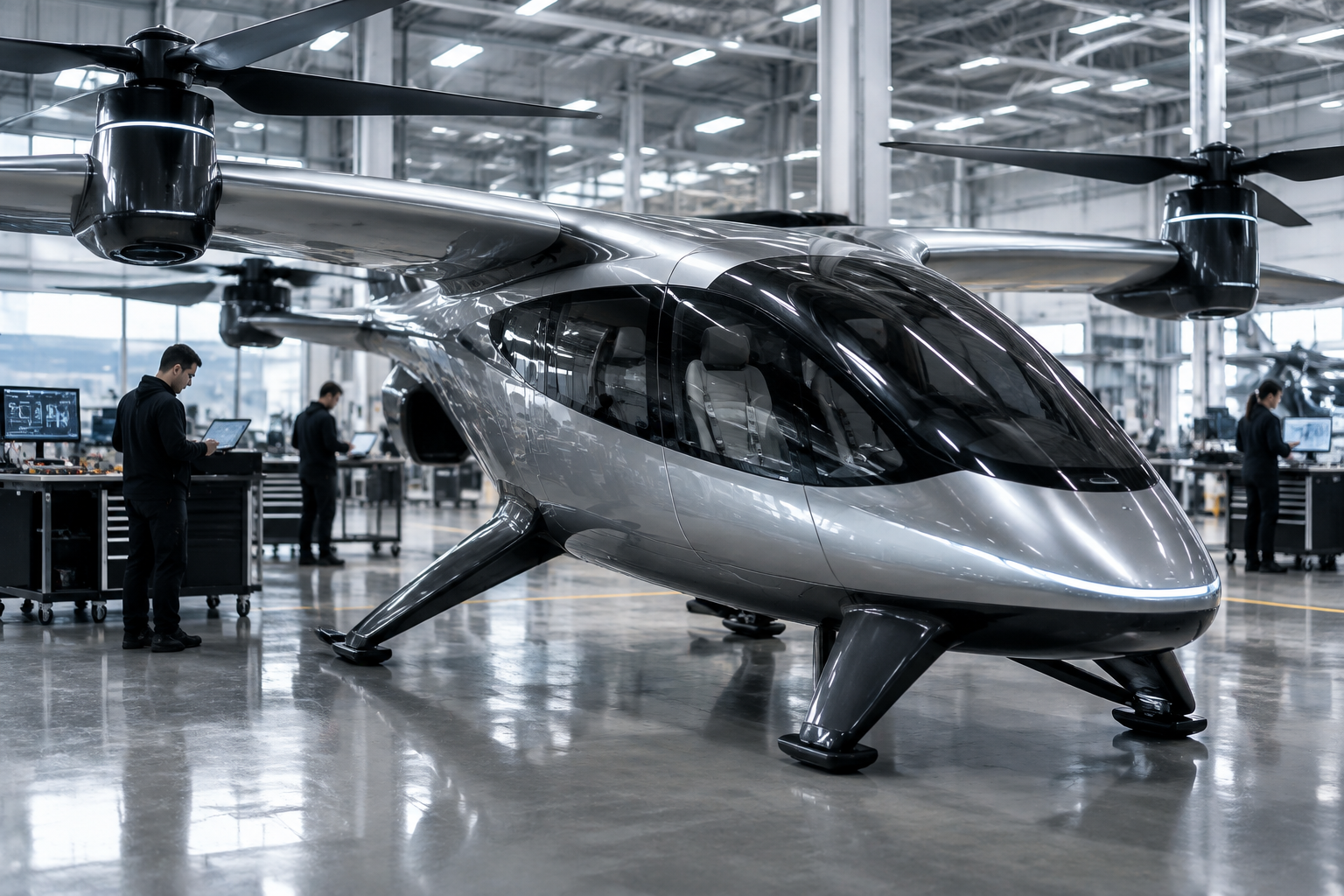
Tesla’s flying car represents a convergence of the company’s expertise in electric powertrains, autonomous systems, and battery technology with the emerging eVTOL sector. Unlike traditional drone designs, Tesla’s prototype is engineered to carry passengers as a fully autonomous or semi-autonomous aircraft, integrating the company’s Autopilot technology and advanced battery management systems. This positions Tesla not merely as another eVTOL manufacturer, but as a company capable of leveraging its massive production capabilities and brand recognition to scale aircraft production at unprecedented levels.
The timing of Tesla’s announcement cannot be overstated. As urban air mobility begins transitioning from experimental phases to commercial deployment, having a household-name automaker enter the market signals to regulators, investors, and consumers that eVTOL technology is approaching mainstream viability. Tesla’s involvement also attracts capital and engineering talent to the sector at a scale previously unseen, accelerating innovation across materials science, battery density, and autonomous flight systems.
Critics argue that Tesla’s traditional automotive manufacturing expertise does not directly translate to aircraft certification and safety protocols. However, the company’s track record of rapid iteration, software integration, and scaling production suggests that these challenges, while formidable, are not insurmountable. Tesla’s Gigafactory model could revolutionize eVTOL aircraft production, driving unit costs down significantly within three to five years.
Archer Aviation’s Market Position Under Pressure
Archer Aviation has built its reputation as an early mover in the eVTOL taxi space, securing partnerships with ride-sharing platforms and committing to commercial operations in major metropolitan areas by 2025-2026. The company’s Midnight aircraft design is optimized specifically for urban air taxi operations, with focus on noise reduction, regulatory compliance, and passenger comfort. Archer’s go-to-market strategy centers on building relationships with municipal governments and aviation authorities before competitors saturate the market.
Tesla’s entry threatens Archer’s first-mover advantage in several ways. First, Tesla’s manufacturing scale and cost structure could enable it to offer competitive pricing that Archer cannot match, particularly if unit costs drop through mass production. Second, Tesla’s brand loyalty and direct consumer relationships create a natural distribution channel for consumer-focused air mobility services, particularly if the company develops a consumer-grade flying taxi service in parallel with its commercial offerings.
However, Archer’s specialized focus on the eVTOL taxi market provides defensive advantages. The company has invested heavily in regulatory relationships, pilot training programs, and operational infrastructure tailored to air taxi services. Archer’s partnerships with existing ride-sharing platforms and its optimized aircraft design for point-to-point urban transit give it operational advantages that a general manufacturer like Tesla would need years to replicate. The question is whether these advantages can be sustained against a competitor with vastly superior financial resources and manufacturing scale.
Regulatory and Infrastructure Implications
Tesla’s flying car announcement accelerates the regulatory timeline for eVTOL aircraft certification and urban airspace management. The Federal Aviation Administration (FAA) and international aviation authorities now face pressure to establish clear pathways for commercial eVTOL operations, battery safety standards, and airspace integration protocols. Tesla’s resources and political influence will likely shape these regulatory frameworks in ways that favor the company’s approach to autonomous systems and minimal pilot oversight.
This regulatory acceleration is a double-edged sword for Archer. On one hand, faster regulatory approval benefits all eVTOL operators by bringing revenue-generating commercial services online sooner. On the other hand, if regulatory frameworks are written to accommodate Tesla’s technological approach (particularly regarding autonomous flight capabilities), companies like Archer that emphasize pilot-controlled operations may face competitive disadvantages or costly retroactive compliance measures.
Infrastructure development represents another critical battleground. eVTOL taxi services require vertiport networks, charging infrastructure, and maintenance facilities. Archer has begun building these assets and securing vertiport real estate in key markets. Tesla’s resources could enable it to build a nationwide or global network far more rapidly, potentially saturating premium locations before Archer completes its infrastructure buildout. The company with the most extensive and strategically positioned vertiport network will enjoy a substantial competitive moat.
Market Consolidation and the Path to Profitability
Tesla’s entry virtually guarantees industry consolidation. Smaller eVTOL startups will face pressure to differentiate, partner with larger players, or exit the market entirely. Companies like Joby Aviation, EHang Holdings, and others will need to identify niches where they can compete against Tesla’s scale or Archer’s first-mover positioning. Some may focus on regional markets, niche use cases (cargo delivery, emergency medical transport), or specialized technologies where they maintain genuine differentiation.
The race to profitability will intensify dramatically. Prior to Tesla’s announcement, the eVTOL sector could sustain multiple unprofitable companies on venture capital and public market enthusiasm. Tesla’s involvement raises investor expectations for near-term path to profitability and genuine market traction. Companies unable to achieve significant commercial revenue within 24-36 months will face severe capital constraints and potential insolvency.
Archer’s advantage lies in its potential to achieve revenue and profitability through taxi operations before Tesla establishes a competitive service offering. If Archer can launch commercial air taxi services in 2-3 cities with significant passenger volume and positive unit economics, the company creates a moat of operational experience and revenue that partially insulates it from Tesla’s competitive entry. First-mover profitability provides credibility with regulators, investors, and consumers that technical capability alone cannot match.
Consumer Adoption and Long-Term Viability
Tesla’s flying car announcement will significantly accelerate consumer awareness and demand for personal air mobility services. For decades, flying cars remained the province of science fiction and concept vehicles. Tesla’s claim of a functional prototype transforms public perception from fantasy to near-future inevitability. This mindset shift will drive consumer adoption rates for eVTOL taxi services far higher than previous industry projections.
However, consumer adoption depends critically on pricing, safety perception, and service reliability. Early adopters will likely be affluent travelers willing to pay premium fares ($100-300 per trip) for convenience and novelty. The mass market for air mobility will only materialize if costs decline to competitive levels with premium ground transportation ($30-80 per trip in most markets). Tesla’s manufacturing expertise may enable this cost reduction faster than competitors, but substantial technology improvements and scale efficiencies are required.
Safety perception will determine whether eVTOL services achieve mainstream adoption or remain niche luxury offerings. A single high-profile accident involving a Tesla flying car or Archer aircraft could set back industry development by years. Both companies are investing heavily in redundancy, autonomous safety systems, and pilot training to prevent such incidents. The regulatory approval process will include rigorous safety requirements, but public confidence ultimately rests on demonstrated operational track records.
Key Industry Takeaways
- Tesla’s flying car entry accelerates market consolidation and raises investor expectations for profitability timelines across the eVTOL sector
- Archer’s first-mover advantage in commercial air taxi operations and regulatory partnerships provides defensive positioning, but cannot offset Tesla’s manufacturing scale and cost advantages long-term
- Market winners will be determined by vertiport network infrastructure, operational safety track records, and ability to achieve profitable unit economics within 24-36 months
Tesla’s flying car represents a watershed moment for personal air mobility. The technology is no longer speculative or experimental—it is entering the phase of commercialization and competitive deployment. For Archer Aviation, this means the window to establish market dominance and operational credibility has narrowed significantly. The company must accelerate its commercial launch timeline, expand its vertiport network aggressively, and achieve sustainable profitability before Tesla marshals its resources toward full-scale eVTOL taxi service deployment. The next 24-36 months will determine whether Archer remains the industry leader or becomes a niche player in a market dominated by Tesla’s scale and resources.