HIGHLIGHTS
- Indiana Attorney General Todd Rokita intervenes to protect the state’s interests in FAA eVTOL regulatory proceedings
- State-level involvement signals growing recognition that eVTOL regulations require consideration of regional economic and operational priorities
- FAA’s framework for urban air mobility continues to evolve as federal and state authorities collaborate on certification and safety standards
In a significant development for the emerging urban air mobility industry, Indiana Attorney General Todd Rokita has announced his office’s intervention in eVTOL regulatory proceedings, taking action to protect the state’s interests as the Federal Aviation Administration (FAA) continues to shape the framework governing electric vertical takeoff and landing aircraft. This move reflects a broader shift in how states are engaging with federal aviation policy—moving from passive observation to active participation in crafting rules that will define the future of air transportation.
The Stakes of State Intervention in Federal Aviation Policy
For decades, aviation regulation has been almost exclusively the domain of the federal government, with the FAA holding near-total authority over airspace management, aircraft certification, and operational standards. However, as eVTOL technology matures and commercial operations draw closer to reality, states are recognizing that the regulatory framework being developed will have profound local consequences. Indiana’s decision to intervene through its Attorney General represents a strategic recognition that state-level economic interests, workforce development, and infrastructure planning are inextricably linked to how federal eVTOL rules ultimately take shape.
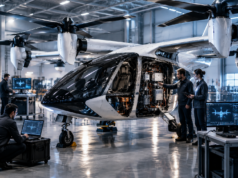
The FAA’s regulatory framework for eVTOL operations encompasses multiple complex dimensions: certification of novel aircraft designs, pilot training and medical certification requirements, airspace integration protocols, and safety oversight mechanisms. Each of these elements carries implications for how eVTOL services might function within Indiana’s airspace and which companies might establish operations, maintenance facilities, or manufacturing centers within state borders. By intervening in regulatory proceedings, Attorney General Rokita signals that Indiana intends to have a voice in determining how these rules evolve rather than accepting them as fait accompli from Washington.
This approach aligns with broader trends in federalism where states have increasingly asserted their roles in emerging technology policy domains. From cryptocurrency regulation to autonomous vehicle testing, states recognize that federal frameworks, while important, often require state-level nuance and adaptation to reflect regional conditions, economic priorities, and public preferences. The eVTOL space is proving no different, with multiple states now exploring how they might create favorable conditions for air mobility companies while ensuring public safety and community acceptance.
FAA’s Evolving Role in Urban Air Mobility Governance
The FAA, established in 1958, has undergone significant institutional transformation to address the realities of twenty-first-century aviation. Traditional FAA responsibilities centered on commercial airline operations, with most regulations written to govern high-altitude, long-distance flights by large aircraft. The emergence of eVTOL technology—designed for low-altitude, short-distance urban flights typically covering 30-50 miles—has forced the agency to rethink fundamental assumptions about aircraft operations, pilot qualifications, and airspace management.
The FAA has been developing what it calls the “Part 135 lite” framework, a modified regulatory pathway designed specifically for eVTOL operators. This framework acknowledges that electric vertical aircraft inherently differ from traditional helicopters and fixed-wing aircraft in ways that may justify different safety requirements, operational restrictions, and certification timelines. However, the agency has also been cautious about moving too quickly, emphasizing that public safety and community trust are non-negotiable prerequisites for any commercial eVTOL service approval.
State interventions like Indiana’s essentially add another layer of scrutiny and consideration to this already complex regulatory development process. While this might seem to complicate FAA proceedings, it can also provide valuable input about how regulations will function in practice. State Attorneys General bring expertise in state infrastructure, labor law, environmental protection, and public safety that federal regulators might not fully appreciate without direct state input. Indiana’s intervention could surface questions about how eVTOL operations might interface with state-regulated healthcare transport, emergency services coordination, or environmental monitoring requirements.
Indiana’s Strategic Position in the Emerging eVTOL Ecosystem
Indiana occupies a strategically important position within the North American eVTOL landscape. The state is centrally located within the Midwest’s major metropolitan corridor, with Indianapolis serving as a hub connecting Chicago, Detroit, Cleveland, and St. Louis. These mid-range distances (100-300 miles) fall within the optimal operating window for future eVTOL networks, making Indiana geography particularly relevant for regional air mobility planning. Additionally, Indiana has existing strengths in advanced manufacturing, automotive supply chains, and aerospace component production—industries that could easily transition capabilities toward eVTOL manufacturing and maintenance.
Attorney General Rokita’s intervention likely reflects recognition that Indiana has tangible economic interests in how eVTOL regulations ultimately develop. If the FAA’s framework is structured in ways that discourage operations or maintenance facilities within certain geographies, Indiana could miss opportunities to attract eVTOL companies and capture related economic benefits. Conversely, if regulations are designed with sufficient flexibility, Indiana’s existing industrial base could position the state to become a significant player in the emerging air mobility economy. By intervening now, the state ensures its voice shapes the rules that will determine these outcomes.
The state’s agricultural and emergency services sectors also have potential stakes in eVTOL regulatory policy. Rural Indiana could eventually benefit from eVTOL services for time-sensitive medical transport, emergency response coordination, or agricultural monitoring—applications that would require regulatory certainty and integration with state emergency management systems. By participating in federal regulatory proceedings, Indiana can advocate for frameworks that facilitate these potentially beneficial use cases while maintaining appropriate safety oversight.
Collaborative Federalism in Emerging Technology Regulation
Indiana’s intervention in FAA eVTOL proceedings exemplifies what legal scholars call “collaborative federalism”—a regulatory approach where federal and state authorities work together to develop policy frameworks that accommodate both national standards and local variation. Rather than federal regulators unilaterally dictating rules from Washington, collaborative federalism creates formal mechanisms for states to participate in policy development, ensuring that regulations reflect diverse perspectives and can be effectively implemented across different state and local contexts.
The eVTOL sector is particularly well-suited to collaborative federalism because the technology’s most significant impacts will occur at the state and local level. While the FAA must ensure national airspace safety and establish baseline aircraft certification standards, states and municipalities will ultimately determine where eVTOL services operate, which communities benefit from air mobility infrastructure, how noise and environmental impacts are managed, and how local emergency services coordinate with commercial air mobility operators. These are inherently local decisions that benefit from state and community input during the federal rule-making process.
Looking forward, we can expect to see more state-level interventions in eVTOL regulatory proceedings. New York, California, Texas, and other states with significant technology sectors and major metropolitan areas will likely follow Indiana’s lead, each bringing their own regional priorities and concerns to FAA consideration. This increase in state participation should ultimately produce more robust, more implementable regulations—ones that account for genuine regional differences while maintaining the national safety standards essential to a functioning airspace system.
The challenge for federal regulators will be managing this increased state engagement without allowing the rule-making process to become paralyzed by conflicting regional demands. The FAA will need to balance deference to state interests against the imperative to establish clear, nationally consistent standards that allow eVTOL operators to function across state lines. Legal scholars and policy experts generally believe this balance is achievable, particularly if federal regulators proactively solicit state input early in the rule-making process rather than requiring states to intervene reactively after federal proposals emerge.
Key Considerations for Stakeholders
- Federal-state coordination on eVTOL regulations represents a critical opportunity to create implementable frameworks that account for regional variation while maintaining national safety standards and airspace integrity
- States with existing advanced manufacturing and aerospace supply chains, like Indiana, have concrete economic interests in advocating for eVTOL regulatory frameworks that facilitate regional industry development and job creation
- The success of collaborative federalism in eVTOL regulation may establish precedents and institutional practices that shape how emerging technologies (autonomous vehicles, AI regulation, etc.) are governed across federal and state systems going forward
As the eVTOL industry continues its transition from research and development toward commercial operations, regulatory clarity and stakeholder consensus will become increasingly important. Attorney General Rokita’s intervention on Indiana’s behalf represents exactly the kind of constructive state engagement that can help produce regulations capable of supporting both innovation and safety. The coming months and years will reveal whether federal and state authorities can maintain productive collaboration as eVTOL regulation moves from policy discussion toward implementation—and what implications this federal-state partnership might have for how America governs other emerging technologies.