HIGHLIGHTS
- Naidu’s meeting with Nalwa Aero marks a major government endorsement for India’s first indigenous eVTOL aircraft development program
- India’s massive urban population and traffic congestion create ideal market conditions for rapid eVTOL commercialization within 3-5 years
- Government-backed regulatory prioritization enables Nalwa Aero to establish indigenous manufacturing and operations infrastructure ahead of foreign competitors
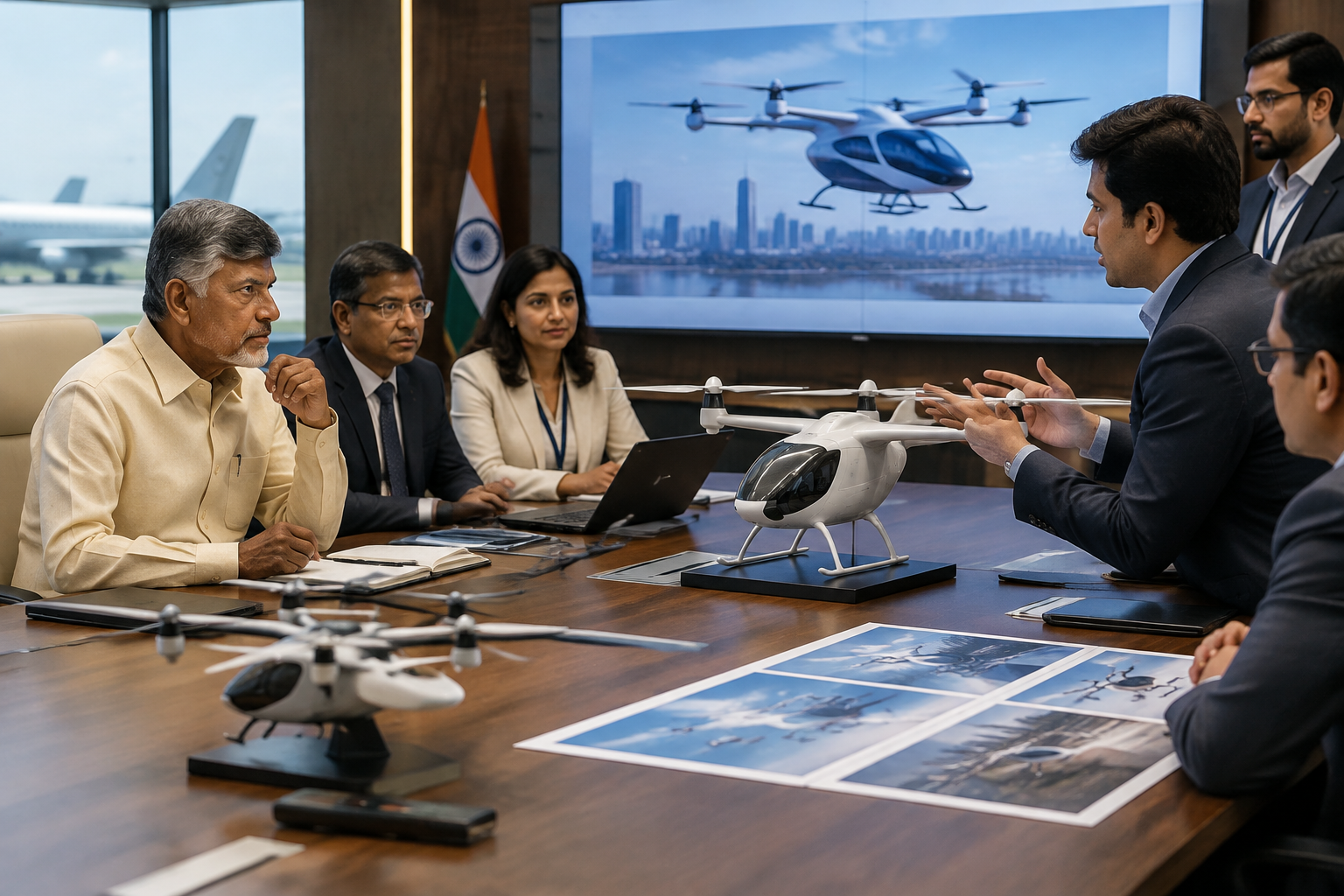
In a significant show of support for India’s emerging electric vertical takeoff and landing (eVTOL) sector, a high-profile government meeting between political leader Naidu and the Nalwa Aero team underscores the country’s commitment to developing indigenous urban air mobility solutions. The October 2026 meeting represents a pivotal moment for the startup as it progresses toward commercializing India’s homegrown eVTOL aircraft, positioning the nation as a key player in the global personal air mobility revolution.
India’s Growing eVTOL Ambitions
India has emerged as an unexpected but significant hub for electric aviation innovation, with startups and government entities recognizing the potential of urban air mobility to revolutionize transportation in densely populated metropolitan areas. The country’s massive population centers—including Delhi, Mumbai, and Bangalore—present ideal test markets for eVTOL technology, where traffic congestion and infrastructure limitations make aerial solutions particularly appealing. Government backing, as evidenced by Naidu’s engagement with Nalwa Aero, signals a strategic shift toward prioritizing domestically developed aerospace technologies.
The meeting between Naidu and the Nalwa Aero team reflects broader policy initiatives aimed at reducing India’s dependence on foreign aviation technology and fostering a robust domestic aerospace ecosystem. By supporting indigenous eVTOL development, India positions itself to capture significant market share in the projected multi-billion-dollar urban air mobility industry while creating high-skilled jobs in engineering, manufacturing, and operations. This localized approach also ensures that aircraft designs account for India-specific factors such as climate, terrain, and regulatory environment.
International investors and aerospace organizations are increasingly watching India’s eVTOL progress, as successful indigenous development could serve as a blueprint for other emerging economies seeking to participate in the personal air mobility boom. The startup ecosystem in India, particularly in cities like Bangalore and Hyderabad, has proven its capacity to rapidly innovate in complex technological domains. This latest government backing reinforces India’s determination to establish itself as a serious contender in the global race to commercialize eVTOL technology.
Nalwa Aero’s Innovation Journey
Nalwa Aero has positioned itself at the forefront of India’s indigenous eVTOL development, combining innovative engineering with a deep understanding of local operational requirements. The startup’s focus on designing aircraft tailored to the Indian market demonstrates a sophisticated approach to the eVTOL challenge—rather than simply adapting foreign designs, Nalwa Aero is building solutions from the ground up that optimize for Indian airspace, regulatory frameworks, and passenger needs. This bespoke approach to development is a competitive advantage in an industry where one-size-fits-all solutions often miss critical regional considerations.
The company’s technical achievements to date include significant progress in battery technology optimization, electric propulsion system efficiency, and autonomous flight systems designed for dense urban environments. Nalwa Aero’s engineering team comprises specialists in aerospace, electrical systems, and software, reflecting the multidisciplinary expertise required to bring eVTOL aircraft to market. The startup’s partnerships with Indian research institutions and technology providers further strengthen its technical foundation and ensure access to cutting-edge innovations in electric propulsion and materials science.
By securing high-level government attention, Nalwa Aero has validated its technical roadmap and secured a clear pathway to regulatory approval and commercialization. Government support typically translates into preferential consideration for airspace access, favorable regulatory timelines, and potential funding through innovation initiatives. This endorsement positions Nalwa Aero to move rapidly from prototype development to pre-commercial operations, potentially enabling India to beat competing nations to market with a fully functional indigenous eVTOL service.
Government Support and Regulatory Framework
The Naidu-Nalwa Aero meeting illustrates India’s shift toward proactive government engagement with private aerospace innovators, a departure from historically cautious regulatory approaches. India’s Directorate General of Civil Aviation (DGCA) has begun developing comprehensive regulatory frameworks for eVTOL operations, including airworthiness standards, pilot certification requirements, and operational procedures for urban environments. This regulatory work, conducted in consultation with industry leaders like Nalwa Aero, ensures that the emerging regulatory environment supports innovation while maintaining rigorous safety standards.
Government backing extends beyond symbolic endorsement; it typically includes commitments to streamline certification processes, provide capital support through public funding mechanisms, and establish priority corridors for commercial eVTOL operations in major metropolitan areas. India’s National Civil Aviation Policy has explicitly identified urban air mobility as a strategic priority, with explicit goals to develop indigenous manufacturing capabilities and establish India as a regional hub for eVTOL operations. This policy framework creates an enabling environment for startups like Nalwa Aero to scale operations rapidly once aircraft certification is achieved.
The regulatory support for indigenous eVTOL development also reflects India’s broader “Make in India” initiative, which seeks to position the country as a global manufacturing and innovation hub across multiple technology sectors. By prioritizing domestic aerospace innovation, India reduces dependency on foreign aircraft imports and establishes domestic supply chains for critical components such as batteries, electric motors, and avionics systems. This industrial strategy has long-term implications for India’s economic competitiveness and technological sovereignty in the aviation sector.
Commercial Potential and Urban Air Mobility Market
India’s urban air mobility market represents one of the most significant untapped opportunities in the global eVTOL sector, driven by India’s enormous population density, chronic traffic congestion in major cities, and rapid economic growth among urban middle-class consumers. Preliminary market analyses suggest that Indian cities could absorb tens of thousands of eVTOL aircraft once commercial services launch, with applications ranging from premium air taxi services to emergency medical transport and cargo delivery. The potential revenue from Indian eVTOL operations could dwarf markets in smaller developed nations, making India a critical battleground for eVTOL companies seeking global scale.
Nalwa Aero’s indigenous development strategy positions the company to capture disproportionate market share in India’s eVTOL market, given the preference among Indian operators and passengers for domestically manufactured aircraft with locally optimized support infrastructure. As the first Indian company to successfully commercialize an eVTOL service, Nalwa Aero would establish brand recognition and operational expertise that would prove difficult for foreign competitors to overcome. The company’s early mover advantage in a market expected to grow exponentially over the next decade could establish it as a dominant regional player and a serious competitor in global markets.
Commercial operations in India could commence within the next three to five years, depending on regulatory timelines and technical milestones. Initial services are likely to focus on high-value air taxi routes connecting major business and residential districts in tier-one cities such as Delhi, Mumbai, Bangalore, and Hyderabad. The success of Nalwa Aero’s operations would catalyze investment in complementary services and infrastructure, including charging networks, vertiports, and maintenance facilities, creating a complete ecosystem for urban air mobility in India.
Key Takeaways
- Government backing from Naidu validates Nalwa Aero’s technical roadmap and accelerates India’s pathway to indigenous eVTOL commercialization
- India’s massive urban population centers and chronic traffic congestion create ideal market conditions for early-stage eVTOL operations and rapid service scaling
- Regulatory prioritization of domestic aerospace innovation positions India to establish a complete indigenous eVTOL manufacturing and operations ecosystem
The meeting between Naidu and Nalwa Aero represents far more than a symbolic endorsement—it marks a critical inflection point in India’s aerospace evolution. As Nalwa Aero advances development of its indigenous eVTOL aircraft with government support, India is positioning itself to become a major player in the global personal air mobility revolution. The convergence of technological capability, regulatory support, massive market opportunity, and strategic government backing creates a uniquely favorable environment for Nalwa Aero to succeed in commercializing eVTOL services. India’s ultimate success in this domain will depend on navigating complex technical and operational challenges, but the momentum is clearly shifting in favor of indigenous innovation and market-leading ambitions.