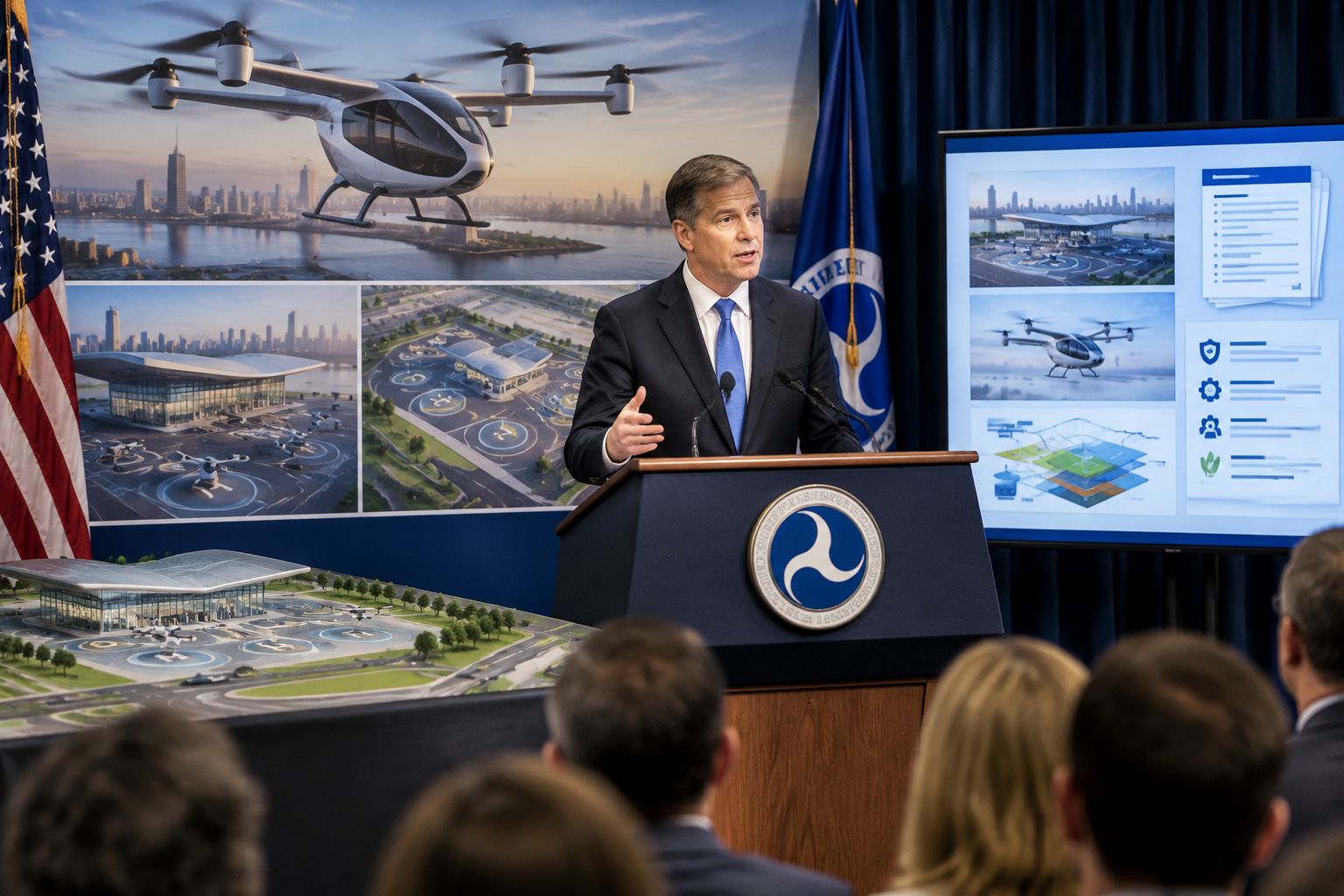
HIGHLIGHTS
- Trump’s Transportation Secretary Sean Duffy announces major DOT milestone accelerating eVTOL certification and commercial deployment across U.S. airspace
- Comprehensive regulatory framework removes bottlenecks for manufacturers like Joby and Archer Aviation, establishing clear pathways for pilot licensing and vertiport infrastructure
- Early regulatory leadership positions American eVTOL companies competitively against Europe and China while unlocking potential for tens of thousands of new jobs
The personal air mobility sector has entered a critical phase under the Trump administration, with Transportation Secretary Sean P. Duffy spearheading efforts to accelerate eVTOL development and regulatory approval processes. On October 30, 2026, Duffy’s department announced a significant milestone that signals the administration’s commitment to modernizing U.S. aviation infrastructure and positioning America as a global leader in electric vertical takeoff and landing aircraft technology. This move represents a watershed moment for an industry that has been gaining momentum but facing regulatory hurdles.
The Administration’s eVTOL Initiative
Under Secretary Duffy’s leadership, the Department of Transportation has prioritized creating a pathway for commercial eVTOL operations across American airspace. The Trump administration’s approach emphasizes deregulation and streamlined certification processes, contrasting with the more cautious stance of previous years. This strategic shift aims to unlock innovation in urban air mobility while maintaining necessary safety standards.
The DOT’s initiative recognizes eVTOL aircraft as essential infrastructure for 21st-century transportation, particularly in congested urban areas where traditional ground transportation has reached capacity limits. By working with the FAA, Duffy’s department is establishing frameworks that allow manufacturers to test and deploy aircraft more rapidly than previously possible. This acceleration is expected to bring commercial air taxi services to major U.S. cities within the next few years.
Secretary Duffy has articulated a vision where eVTOL technology becomes seamlessly integrated into the National Airspace System, creating new job opportunities and economic growth. The administration’s position emphasizes that regulatory innovation should not compromise safety but rather enhance it through technology-driven oversight and real-time monitoring capabilities.
Regulatory Framework and Industry Impact
The milestone announcement from the DOT includes a comprehensive regulatory roadmap designed to guide manufacturers through certification processes. This framework addresses critical areas including pilot licensing requirements, airspace management, and vertiport infrastructure standards. By establishing clear guidelines, the administration removes much of the uncertainty that has plagued eVTOL developers.
Industry leaders have responded positively to Duffy’s initiatives, viewing them as a catalyst for accelerating investment in electric aircraft development. Companies like Joby Aviation, Archer Aviation, and other eVTOL manufacturers now have greater clarity on regulatory expectations and timelines for commercial operations. The reduced regulatory burden is expected to lower development costs and enable faster market entry for leading candidates.
The framework also addresses infrastructure challenges, including the development of vertiports and charging networks necessary for widespread eVTOL deployment. The administration is working with private investors and local governments to create a coordinated approach to infrastructure development, recognizing that regulatory approval alone is insufficient without the physical infrastructure to support operations.
Urban Air Mobility and Economic Opportunities
The DOT’s eVTOL agenda extends beyond aircraft certification to encompass broader urban air mobility ecosystem development. Secretary Duffy’s department is facilitating conversations between manufacturers, airport operators, city planners, and private investors to create integrated air mobility solutions. These discussions focus on how eVTOL services can complement existing transportation networks rather than compete with them.
Economic projections suggest that a mature eVTOL industry could create tens of thousands of jobs across manufacturing, operations, maintenance, and supporting services. The administration’s support signals confidence that American companies will lead this emerging sector, positioning the U.S. competitively against international rivals like China and Europe. Early adoption of favorable regulations could ensure American manufacturers maintain technological and market leadership.
Cities including Los Angeles, New York, and Miami are already planning eVTOL demonstrations for major events, with the regulatory pathway now clarified. These initial operations will serve as proof-of-concept demonstrations, building public confidence and generating valuable operational data. The success of these early deployments will be crucial in determining consumer acceptance and willingness to pay for air mobility services.
International Context and Competitive Advantage
Secretary Duffy’s eVTOL initiative must be understood within the broader global competition for air mobility leadership. Europe has been aggressive in establishing eVTOL regulations through EASA (European Union Aviation Safety Agency), while China actively supports domestic manufacturers. The Trump administration’s deregulatory approach aims to leapfrog traditional processes and establish American technological dominance.
The DOT’s regulatory framework includes provisions for international coordination, recognizing that eVTOL operations will eventually cross international borders. By establishing harmonized standards, American manufacturers can more easily export aircraft to global markets. This approach positions the U.S. as a standard-setter rather than a follower in emerging aviation technology.
Duffy’s department has also prioritized cybersecurity and autonomous operations standards, areas where U.S. expertise is particularly strong. By establishing robust security frameworks early, the administration ensures that emerging eVTOL networks are protected against malicious actors while allowing for future innovation in autonomous flight systems. This balanced approach appeals to both industry innovators and safety-conscious regulators.
Key Takeaways for the eVTOL Sector
- Trump administration removes regulatory bottlenecks, enabling faster eVTOL certification and commercial deployment in major U.S. cities
- Comprehensive DOT framework provides manufacturers clear guidance on pilot licensing, airspace management, and vertiport infrastructure requirements
- Early regulatory leadership positions American eVTOL companies against international competitors while creating thousands of new jobs
Secretary Sean P. Duffy’s October 2026 eVTOL milestone represents a critical inflection point for personal air mobility in the United States. By establishing a clear regulatory pathway and demonstrating government commitment to the sector’s success, the Trump administration has shifted the narrative from “if” eVTOL services will arrive to “when” they will launch. This fundamentally changes investment calculus, encouraging venture capital and corporate funding to flow toward the most promising manufacturers. As the regulatory framework takes shape and early demonstration flights proceed, the vision of seamless urban air mobility transitions from speculation to reality. The next 18-24 months will be decisive in determining which American companies emerge as global leaders and which cities become early hubs for air taxi services.