HIGHLIGHTS
- FAA issues its first Special Airworthiness Certificate to an eVTOL aircraft, authorizing controlled operational testing and real-world flight data collection under defined restrictions.
- The certificate establishes baseline safety, design, and operational standards—including battery redundancy, pilot qualifications, and noise limits—that will inform Part 27 final certification and future eVTOL approvals.
- This regulatory milestone accelerates urban air mobility commercialization by validating the FAA framework, reducing investor uncertainty, spurring vertiport infrastructure development, and influencing international eVTOL standards.
In a historic regulatory milestone, the Federal Aviation Administration (FAA) has issued its first Special Airworthiness Certificate to an electric vertical takeoff and landing (eVTOL) aircraft, marking a pivotal moment for the personal air mobility industry. This groundbreaking certification represents years of collaboration between manufacturers, regulators, and aviation stakeholders to establish safety and operational standards for a new class of aircraft. The issuance signals that eVTOL technology has matured sufficiently to enter the regulatory pathway toward commercial operations, even as the industry continues advancing toward production-ready platforms.
Breaking Down the Special Airworthiness Certificate
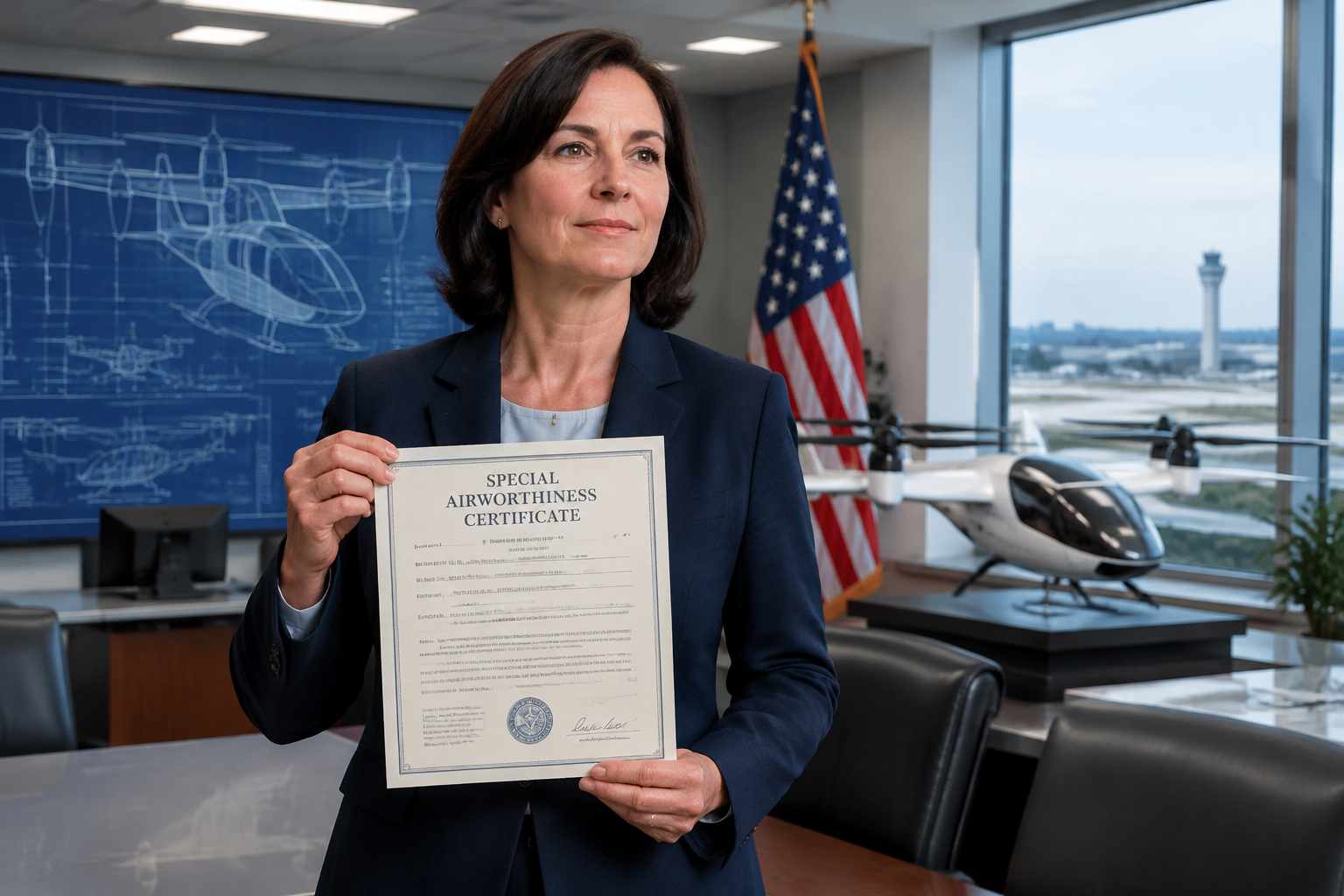
A Special Airworthiness Certificate is a provisional approval issued by the FAA that permits an aircraft to operate under restricted conditions while still in development, testing, or final certification phases. Unlike a standard airworthiness certificate—which represents full compliance with all FAA certification standards—the Special Certificate allows manufacturers to conduct operational testing, demonstrate safety protocols, and gather real-world performance data within defined boundaries. This certificate category was previously reserved for experimental and developmental fixed-wing and rotorcraft programs, but its extension to eVTOL represents official recognition that these aircraft represent a legitimate new aviation category.
The Special Airworthiness Certificate establishes baseline safety requirements for the eVTOL platform, including design standards, pilot qualifications, operational altitude restrictions, and geographic boundaries for flight testing. These conditions ensure that while the aircraft is still under development, operations remain controlled, predictable, and transparent to regulators. The certificate holder must also maintain detailed records of all flights, system performance, and any anomalies encountered, creating a comprehensive data repository that informs future certifications and industry-wide standards.
This approval differs significantly from the proposed Part 27 certification standards that the FAA is developing specifically for small electric rotorcraft. While Part 27 will establish final, permanent airworthiness standards for commercial eVTOL operations, the Special Certificate serves as an intermediate step, allowing manufacturers to demonstrate compliance and validate safety claims before pursuing full certification. The tiered approach reflects the FAA’s commitment to balancing innovation with rigorous safety oversight.
Industry Impact and Pathway to Commercialization
The FAA’s issuance of the first Special Airworthiness Certificate to an eVTOL manufacturer represents validation that the regulatory framework for urban air mobility is functional and actionable. For years, the industry faced uncertainty about certification timelines, safety requirements, and operational protocols. This approval provides clear evidence that the FAA has developed competency in evaluating eVTOL platforms and establishes a demonstrable pathway for other manufacturers pursuing certification. Companies like Joby Aviation, Lilium, Archer Aviation, and others now have a real-world example of what FAA approval can look like and what standards they must meet.
The certificate holder gains significant competitive advantages, including the legal authority to conduct operational flights, accumulate flight hours under FAA supervision, and refine systems based on real-world performance data. This operational testing phase is critical for identifying edge cases, validating safety systems, and optimizing battery management, propulsion efficiency, and autonomous systems—factors that cannot be fully understood through ground-based simulation alone. The data collected during this phase will directly inform final certification standards and become invaluable evidence in future Part 27 certification applications.
Beyond the individual manufacturer, this approval signals to investors, regulators, and the public that eVTOL commercialization is transitioning from theoretical to tangible. Insurance providers, airport operators, and city planners can now develop real operational protocols based on existing certification precedents. The approval also strengthens the FAA’s institutional knowledge, allowing the agency to refine its regulatory approach and establish best practices that will accelerate approvals for subsequent manufacturers. This creates a virtuous cycle where each successful certification reduces regulatory uncertainty for the next.
Technical Standards and Safety Requirements
The Special Airworthiness Certificate imposes rigorous technical and operational standards that reflect the unique characteristics of eVTOL aircraft. These aircraft must demonstrate redundancy in critical systems including propulsion, battery management, and flight control—a requirement that eVTOL manufacturers have been designing toward, but now faces formal FAA validation. Battery safety is particularly scrutinized, as thermal runaway, rapid discharge, and failure mode management represent novel challenges distinct from traditional aviation propulsion systems. The certificate establishes baseline energy density, charging protocols, and failure containment requirements that guide future design iterations.
Pilot qualification standards embedded in the Special Certificate address the hybrid nature of eVTOL operations, which blend rotorcraft handling characteristics with novel autonomous systems and urban low-altitude flight profiles. The certificate may establish requirements for specific training, proficiency checks, and simulator-based evaluation before pilots can conduct controlled flights. These standards recognize that eVTOL operations differ fundamentally from conventional helicopter or fixed-wing aircraft, requiring specialized knowledge of distributed electric propulsion, battery management feedback, and urban congestion scenarios.
Noise and emissions standards are also integral to the Special Certificate conditions, even at the developmental stage. Urban air mobility only succeeds if operations remain compatible with city environments, meaning noise levels must be significantly lower than conventional rotorcraft. The FAA likely includes performance targets for sound level limits and emissions certifications, establishing benchmarks that subsequent certification standards will formalize. These environmental requirements reflect recognition that regulatory approval extends beyond mere airworthiness to encompass community acceptance and environmental responsibility.
Roadmap to Full Certification and Commercial Service
The Special Airworthiness Certificate represents the beginning of a multi-year pathway toward full FAA certification and commercial operations. Following the development and testing phase authorized under the Special Certificate, the certificate holder will pursue formal type certification under the eventually finalized Part 27 standards. This process involves comprehensive testing, validation of all systems under normal and emergency conditions, and demonstration of compliance with published certification standards. The timeline for full certification typically spans two to four years, depending on the complexity of the design and the maturity of supporting infrastructure.
Parallel to type certification, manufacturers must establish supply chain relationships, manufacturing facilities, and maintenance protocols that meet aviation standards. The FAA’s Special Certificate accelerates this timeline by allowing real operational data collection and enabling manufacturers to refine designs based on actual flight performance rather than theoretical projections. Each flight hour accumulated under the Special Certificate generates performance metrics that become evidence supporting full certification applications, reducing the need for expensive ground-based testing and simulation. This creates efficiency gains that benefit individual manufacturers and the industry as a whole.
The path to commercial service requires more than aircraft certification. Operators must obtain air operator certificates, establish maintenance and pilot training programs, and secure operational approvals from local aviation authorities. The FAA will likely establish dedicated operational rules for eVTOL commercial service, potentially within a new Part 135 section or as amendments to existing rotorcraft regulations. These operational rules will address air traffic integration, flight corridors in urban airspace, emergency procedures, and crew resource management protocols specific to eVTOL operations. The Special Airworthiness Certificate holder’s operational experience directly informs development of these standards.
Broader Implications for Urban Air Mobility Ecosystem
The FAA’s issuance of the first Special Airworthiness Certificate reverberates throughout the urban air mobility ecosystem, affecting infrastructure planning, investment decisions, and regulatory harmonization efforts globally. City governments and airport operators worldwide now have evidence that regulatory frameworks can support eVTOL operations, encouraging investment in vertiport infrastructure, ground support systems, and traffic management integration. The certificate validates business models that have relied on regulatory approval as a contingent event, strengthening investor confidence and attracting capital from venture funds and traditional aviation investors.
International aviation authorities are likely to reference the FAA’s Special Certificate standards as they develop their own eVTOL regulatory frameworks. The European Union Aviation Safety Agency (EASA), Civil Aviation Authority of Singapore, and other major regulators monitor FAA proceedings closely, and successful eVTOL certification in the United States accelerates parallel standardization efforts abroad. This creates harmonization benefits—manufacturers pursuing multiple national certifications face fewer incompatible requirements and can pursue simultaneous approvals with greater efficiency. However, divergent standards could fragment the market, making regulatory alignment critical to global commerce in eVTOL systems.
The certification also legitimizes technological approaches and design philosophies that manufacturers have pursued speculatively. Companies that invested in distributed electric propulsion, redundant battery systems, and autonomous flight-control architectures now possess regulatory validation that these approaches satisfy FAA safety criteria. This encourages continued innovation in these technology domains and attracts engineers and researchers to work on problems that have clear regulatory pathways and commercial viability. Over time, this concentrates innovation around validated technical approaches, accelerating industry-wide maturation.
Key Takeaways from FAA’s Historic eVTOL Approval
- The FAA’s first Special Airworthiness Certificate for an eVTOL aircraft formally validates the regulatory framework for urban air mobility, enabling manufacturers to conduct controlled operational testing and accumulate real-world performance data essential to full certification.
- The approval establishes baseline safety, design, and operational standards for eVTOL aircraft—including battery redundancy, pilot qualification requirements, and noise/emissions limits—that will inform Part 27 final certification standards and subsequent manufacturer approvals.
- This milestone accelerates the commercial timeline for urban air mobility by reducing regulatory uncertainty, attracting investor capital, encouraging vertiport infrastructure development, and influencing international aviation regulators developing their own eVTOL certification standards.
The FAA’s issuance of the first Special Airworthiness Certificate to an eVTOL aircraft marks the moment when personal air mobility transitions from developmental aspiration to regulated reality. The approval validates decades of research, engineering, and advocacy while establishing clear standards that guide industry development. As the certificate holder conducts operational flights and refines systems based on real-world performance, the broader industry advances toward full certification, commercial operations, and the eventual integration of eVTOL aircraft into urban transportation networks worldwide. This regulatory milestone will be remembered as the pivotal moment when the dream of practical, safe, and sustainable urban air mobility became a regulated certainty.