HIGHLIGHTS
- Florida university police deploy Jetson ONE eVTOL aircraft at $148K—making aerial operations accessible to mid-sized agencies
- FAA regulatory approval and operational authorization validate eVTOL technology maturity for real-world law enforcement missions
- Police adoption sets precedent for institutional buyer confidence, likely accelerating eVTOL adoption across emergency services and public sector
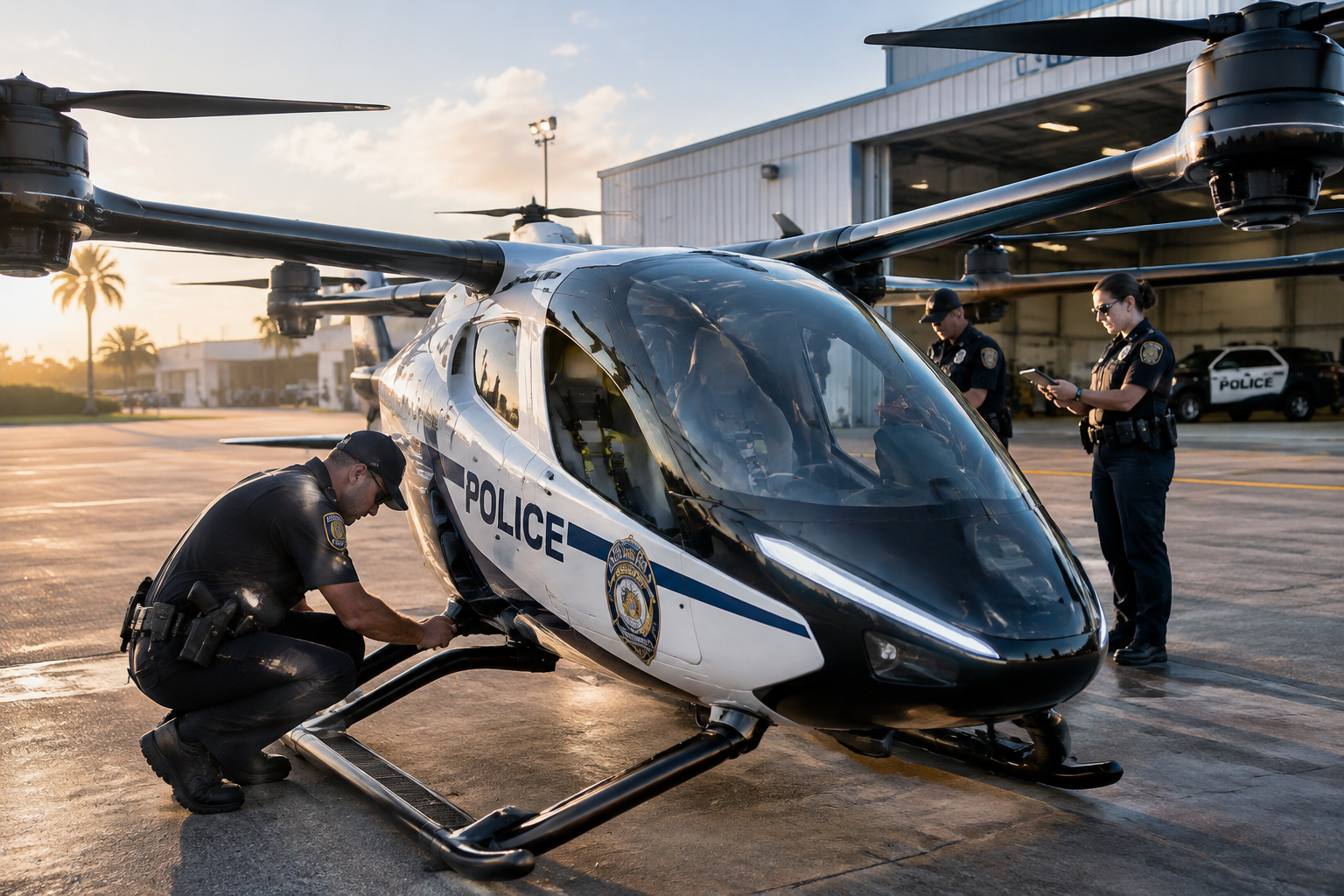
Florida law enforcement has taken a significant step into the future of public safety by deploying the Jetson ONE eVTOL aircraft for aerial patrol operations. A Florida university police department has integrated this cutting-edge $148,000 flying patrol vehicle into its operations, marking a turning point in how law enforcement agencies are adopting personal air mobility technology for real-world applications beyond experimental trials.
The Jetson ONE: A Game-Changer for Law Enforcement
The Jetson ONE represents a new category of electric vertical takeoff and landing aircraft designed for single-occupant operations. Manufactured by Jetson, this eVTOL aircraft combines advanced aviation technology with the compact, practical form factor needed for law enforcement deployment. The aircraft’s $148,000 price point makes it accessible to police departments seeking to modernize their patrol capabilities without the massive infrastructure investments required by traditional helicopters.
This particular deployment in Florida demonstrates that eVTOL technology has transitioned from concept demonstrations to genuine operational implementation. The university police department’s decision to invest in the Jetson ONE indicates growing confidence in the reliability, safety, and regulatory approval of commercial eVTOL platforms for law enforcement missions. The aircraft’s electric propulsion system offers silent operation advantages, enabling surveillance and rapid response capabilities with minimal noise disruption to the surrounding community.
The integration of the Jetson ONE into police operations also signals broader market acceptance of eVTOL technology. When government agencies commit resources and authorize deployment of new aviation platforms, it validates years of development and regulatory navigation by manufacturers. This Florida deployment serves as a proof-of-concept that will likely influence other law enforcement agencies nationwide to evaluate similar platforms for their own fleet modernization initiatives.
Operational Advantages for Modern Policing
The deployment of eVTOL aircraft in law enforcement offers distinct operational advantages over traditional patrol methods. The Jetson ONE’s vertical takeoff and landing capability eliminates the need for extended runways or specialized landing infrastructure, allowing rapid deployment from police headquarters or mobile staging areas. This agility enables faster response times to incidents, aerial reconnaissance of emergency situations, and enhanced situational awareness for ground-based officers.
The electric propulsion system provides significant operational benefits beyond environmental considerations. Silent operation allows law enforcement to conduct surveillance and approach incidents without alerting suspects or creating unnecessary alarm among civilians. The aircraft’s low operating costs compared to fuel-powered helicopters make sustained patrols and frequent deployments economically viable for university and regional police budgets. Extended battery life and rapid charging capabilities ensure the fleet remains mission-ready throughout operational periods.
Safety features built into the Jetson ONE, including redundant systems, automated stability controls, and advanced navigation technology, make it well-suited for law enforcement operations in populated areas. The aircraft can maintain precise altitude and position control, reducing pilot workload and enabling officers to focus on their primary surveillance and observation missions. Integration with existing police communication and data systems allows seamless information sharing between aerial and ground units in real time.
Regulatory Pathway and Certification Success
The authorization for Florida police to deploy the Jetson ONE represents successful navigation of complex federal aviation regulations. The Federal Aviation Administration has established frameworks for commercial eVTOL operations, and manufacturers like Jetson have achieved the necessary certifications and approvals for their platforms. This regulatory success demonstrates that advanced air mobility technology can meet stringent safety and operational standards required by government agencies.
The approval process for deploying eVTOL aircraft in law enforcement involves comprehensive evaluation of safety protocols, pilot training requirements, operational limitations, and integration with existing airspace management systems. Florida’s university police department underwent this vetting process and received authorization to operate the Jetson ONE, providing template documentation and lessons learned that will accelerate adoption by other agencies. The regulatory pathway is now clearer for municipalities and police departments evaluating similar technology investments.
Successful certifications and operational deployments like the Florida case strengthen the foundation for broader eVTOL integration into public services. Each new approved use case—whether law enforcement, search and rescue, emergency medical services, or disaster response—expands the operational envelope and increases regulatory confidence in the technology. This cumulative validation process accelerates the timeline toward mainstream adoption of personal air mobility across multiple sectors.
Market Implications and Industry Growth
The $148,000 price point of the Jetson ONE positions eVTOL aircraft as economically viable alternatives to traditional aerial platforms for specialized applications. For context, law enforcement helicopter programs often involve multi-million dollar acquisition and operational costs, making them accessible only to large urban departments. The Jetson ONE’s cost structure enables mid-sized municipalities and specialized agencies like university police to participate in aerial policing and emergency response operations previously limited to well-funded departments.
This deployment signals growing commercial viability of the eVTOL market beyond ride-sharing and passenger transport applications. Law enforcement, emergency services, and industrial inspection represent substantial addressable markets where eVTOL technology offers tangible operational advantages and economic benefits. Manufacturers like Jetson are expanding their addressable market by demonstrating successful applications and building confidence among institutional buyers accustomed to traditional aviation platforms.
The Florida deployment also highlights the importance of use-case-specific marketing and regulatory strategy for eVTOL manufacturers. Rather than positioning their aircraft solely as futuristic consumer transportation, companies are identifying high-value professional applications where performance characteristics and cost structure create compelling value propositions. This market segmentation approach accelerates adoption among early institutional adopters who have clear operational requirements and established procurement processes.
Future Implications for Police Departments Nationwide
As news of the Florida police deployment spreads throughout law enforcement communities, other departments will likely evaluate similar platforms for their operations. The successful integration of the Jetson ONE into a real-world police operation provides case study evidence that addresses common concerns about reliability, regulatory compliance, and operational integration. Departments considering eVTOL investments can point to this deployment as proof that the technology is mission-ready and government-approved.
The deployment establishes eVTOL aircraft as part of the emerging landscape of law enforcement modernization. Agencies seeking to enhance their capabilities, reduce operational costs, and adopt sustainable technologies will increasingly consider electric vertical takeoff platforms as standard options in their equipment procurement processes. Training programs, operational protocols, and integration frameworks will develop around eVTOL deployments, creating institutional knowledge and standardized practices across agencies.
This Florida initiative represents a watershed moment in the adoption curve for personal air mobility technology. When government agencies responsible for public safety commit resources to deploying emerging aviation platforms, it validates the maturity and reliability of the technology in the eyes of conservative institutional buyers. The ripple effects will likely extend far beyond law enforcement, as other public service sectors gain confidence in eVTOL platforms based on the operational success demonstrated by police deployment cases.
Key Takeaways from the Florida Police Deployment
- The Jetson ONE eVTOL aircraft at $148,000 represents an economically viable aerial platform for law enforcement agencies, expanding access to aerial operations beyond well-funded departments
- Successful regulatory approval and operational deployment demonstrate that eVTOL technology has matured beyond experimental phases into mission-ready systems for professional applications
- Police adoption of eVTOL aircraft establishes a high-value use case that will likely accelerate institutional buyer confidence and expansion of personal air mobility across multiple public service sectors
The integration of the Jetson ONE into Florida police operations marks a pivotal moment in the evolution of personal air mobility technology. This deployment transforms eVTOL aircraft from promising concepts into operational reality, demonstrating that electric vertical takeoff platforms can meet the rigorous demands of law enforcement while offering compelling economic and operational advantages. As other agencies take notice of this successful implementation, the market for specialized eVTOL applications will accelerate, driving innovation, regulatory development, and widespread adoption across public service sectors. The future of advanced air mobility is no longer theoretical—it is now patrolling the skies over Florida.