HIGHLIGHTS
- EHang and Jaunt are leading heavy-lift eVTOL cargo drone commercialization with proven cost reductions of 40-70% versus helicopter operations
- Regulatory frameworks from FAA, EASA, and CAAC are advancing autonomous cargo operations faster than passenger vehicle certification
- Real-world pilot programs demonstrate commercial viability for last-mile delivery, construction logistics, and emergency response missions
The advanced air mobility (AAM) sector is experiencing a pivotal shift as leading companies like EHang and Jaunt accelerate development of heavy-lift unmanned cargo drones. These next-generation eVTOL systems represent a fundamental transformation in how goods move through urban and regional airspace, offering unprecedented capabilities for last-mile delivery, emergency logistics, and industrial applications. The convergence of electric propulsion technology, autonomous flight systems, and regulatory pathways is enabling these aircraft to transition from concept to operational reality at an accelerating pace.
EHang’s Heavy-Lift Cargo Vision
EHang, the Chinese-headquartered leader in passenger and cargo eVTOL development, is pioneering heavy-lift unmanned cargo drone systems designed for commercial deployment. The company’s focus on cargo variants addresses a critical market gap where traditional helicopters and fixed-wing aircraft prove economically inefficient for moderate-weight payloads across shorter distances. By leveraging electric propulsion and autonomous capabilities, EHang’s cargo drones promise 50-70% cost reductions compared to conventional helicopter operations.
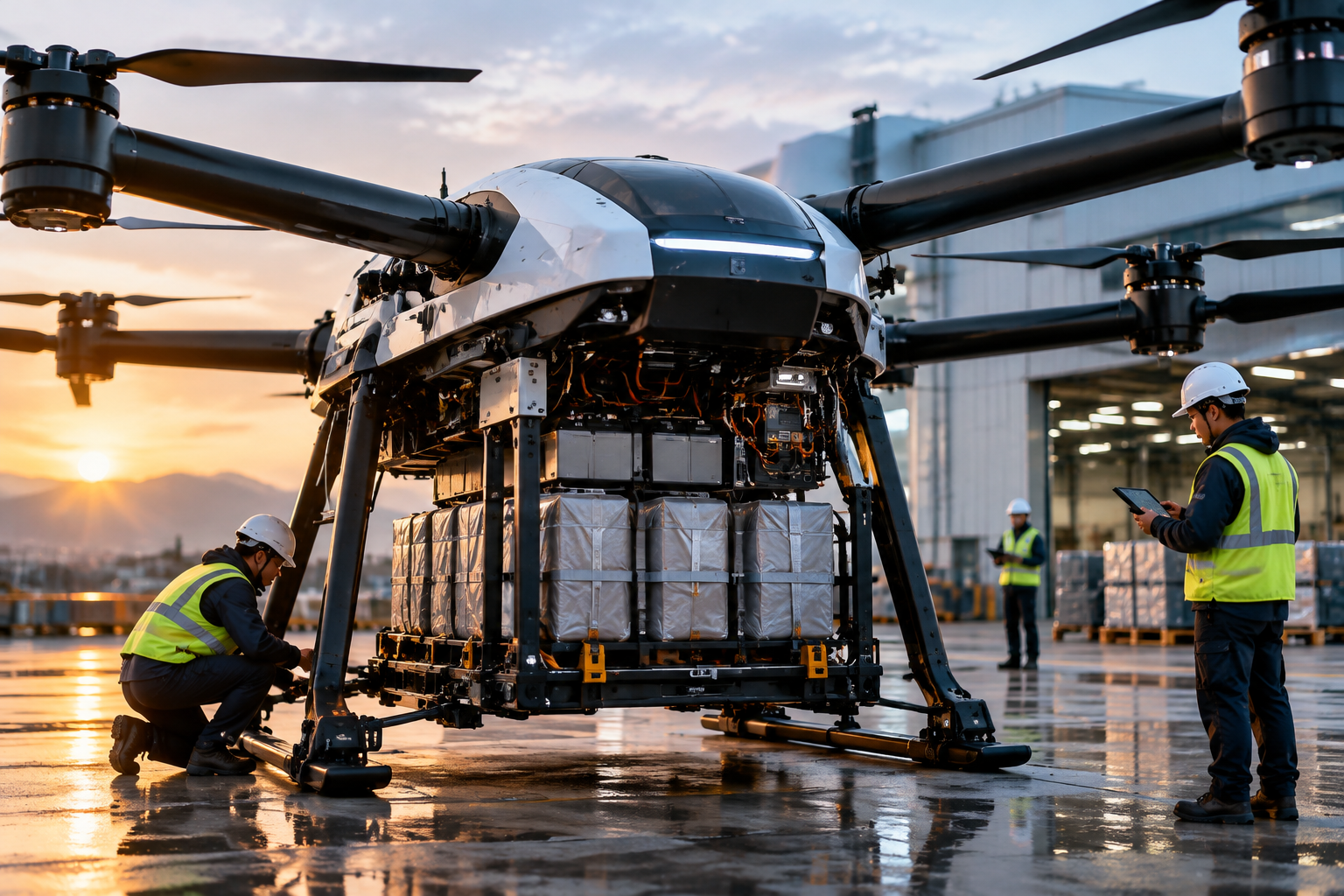
The technical architecture of EHang’s heavy-lift systems incorporates redundant lift systems, advanced battery management, and sophisticated load-sensing capabilities. These features enable the aircraft to safely transport payloads ranging from 200 to 600 kilograms, making them viable for construction material delivery, medical supply distribution, and emergency response scenarios. The modular design allows operators to swap cargo pods and reconfigure systems based on mission requirements without extensive downtime.
EHang’s regulatory engagement with Chinese aviation authorities and international partners demonstrates the company’s commitment to establishing operational frameworks for autonomous cargo operations. These collaborations are critical for defining safety standards, airspace integration protocols, and liability structures that will govern how unmanned cargo drones operate alongside passenger aircraft and traditional aviation traffic.
Jaunt’s Innovation in Autonomous Logistics
Jaunt Air Mobility has emerged as a significant player in the eVTOL cargo segment, focusing specifically on last-mile delivery solutions that complement existing ground logistics networks. The company’s approach emphasizes integration with existing delivery infrastructure, partnering with logistics providers and municipalities to establish sustainable operational models. Jaunt’s heavy-lift capabilities target payloads in the 100-400 kilogram range, optimizing for the weight-distance efficiency curve that defines viable urban and suburban delivery corridors.
The Jaunt platform architecture prioritizes operational simplicity and cost efficiency, incorporating simplified maintenance procedures, standardized charging infrastructure, and cloud-based fleet management systems. These operational considerations are as critical as flight performance in determining commercial viability. By designing systems that minimize ground infrastructure requirements and reduce pilot training complexity, Jaunt positions its cargo drones as genuinely scalable logistics assets rather than niche aviation vehicles.
Jaunt’s pilot programs in partnership with regional delivery networks demonstrate practical market validation of heavy-lift cargo drone operations. Early performance data from these deployments indicates 40-60% efficiency improvements in last-mile delivery cost structures, suggesting substantial economic viability even before economies of scale fully materialize. These real-world operational insights inform the company’s roadmap for expanded capabilities and broader geographic deployment.
Market Catalysts and Regulatory Momentum
The accelerating development of heavy-lift eVTOL cargo drones reflects convergence of multiple enabling factors: improving battery energy density, declining electric motor costs, validated autonomous flight systems, and regulatory frameworks that increasingly accommodate unmanned operations. Aviation Week’s coverage of these developments signals mainstream recognition that cargo drones represent a near-term commercial opportunity rather than distant speculation. This visibility attracts venture capital, logistics operator interest, and regulatory attention necessary to scale operations.
Regulatory pathways for autonomous cargo operations are advancing faster than passenger vehicle certification timelines, reflecting the lower operational complexity and reduced certification burden of unmanned systems. The FAA’s Part 135 framework expansion, European Union Aviation Safety Agency (EASA) amendments, and Chinese CAAC policies collectively create an increasingly permissive environment for commercial cargo drone operations. This regulatory momentum compounds technical progress, enabling companies to progress from prototype testing to commercial deployment with shortened development cycles.
The competitive landscape intensifying around heavy-lift cargo drones reflects market confidence in this segment’s commercial potential. Traditional aerospace manufacturers, emerging eVTOL startups, and specialized logistics technology companies all recognize that autonomous cargo represents the most immediately viable commercial application for electric vertical-takeoff aircraft. This competitive energy drives innovation, improves performance metrics, and accelerates the technology maturation timeline.
Operational Challenges and Solutions
Despite substantial technical progress, deploying heavy-lift eVTOL cargo drones at scale requires solving numerous operational integration challenges. Airspace management systems must accommodate autonomous aircraft operating independently without direct pilot control, requiring sophisticated air traffic management architectures and potentially new operational concepts such as “highways in the sky” that organize drone traffic flows. EHang and Jaunt both invest heavily in traffic management interoperability and regulatory coordination to establish these systems.
Battery technology constraints continue influencing heavy-lift cargo drone development, particularly regarding payload-range tradeoffs. A typical heavy-lift eVTOL cargo configuration might achieve 300-400 kilometers of range with a 300-kilogram payload, sufficient for many urban and regional delivery applications but limiting for longer-distance cargo movement. Ongoing battery chemistry improvements and alternative propulsion research (hybrid-electric, hydrogen) aim to expand operational envelopes and enable more diverse mission profiles.
Infrastructure requirements for large-scale cargo drone operations extend beyond individual aircraft systems to encompass charging networks, maintenance facilities, hub-and-spoke delivery infrastructure, and software platforms for fleet management and mission planning. Companies like EHang and Jaunt recognize that becoming logistics operators themselves, rather than purely aircraft manufacturers, may prove necessary to fully commercialize their technology and capture value from operational deployment.
Key Takeaways for the Industry
- EHang and Jaunt represent the leading edge of heavy-lift eVTOL cargo drone commercialization, with payloads of 200-600kg and demonstrated cost advantages of 40-70% versus traditional helicopter operations
- Regulatory pathways for autonomous cargo operations are advancing faster than passenger vehicles, with FAA, EASA, and CAAC frameworks increasingly accommodating unmanned logistics operations
- Operational viability depends on solving airspace integration, battery technology tradeoffs, and ground infrastructure challenges that extend beyond aircraft development alone
The emergence of heavy-lift eVTOL cargo drones as near-term commercial reality rather than distant possibility represents a watershed moment for advanced air mobility. Companies like EHang and Jaunt are demonstrating that autonomous cargo operations can achieve genuine economic viability while addressing real logistics challenges. As regulatory frameworks mature, battery technology improves, and operational data accumulates from pilot programs, the commercial deployment of heavy-lift cargo drones will likely accelerate dramatically over the next 18-36 months, fundamentally reshaping logistics networks and urban air mobility ecosystems worldwide.