HIGHLIGHTS
- Archer Aviation targets first Midnight transition flight before December 2026, validating a critical shift from hover to forward flight mode that demonstrates aircraft maturity.
- Year-end milestones include battery validation, autopilot certification, and structural verification—all essential components of the FAA Type Certification pathway for commercial passenger operations.
- Successful execution would accelerate customer commitments and position Archer competitively as the eVTOL market moves from development toward commercial deployment in 2027-2028.
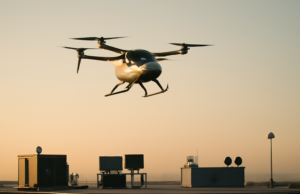
Archer Aviation is racing against the calendar to achieve several critical development milestones before the end of 2026, with the most high-profile goal being the first transition flight of its Midnight eVTOL aircraft. The California-based manufacturer has outlined an ambitious roadmap that underscores its commitment to bringing electric vertical takeoff and landing technology closer to commercial reality, positioning the Midnight as a game-changing vehicle for urban air mobility.
The Midnight’s Design Philosophy and Capabilities
The Archer Midnight represents a generational leap in eVTOL design, engineered specifically to meet the demands of commercial air taxi operations in dense urban environments. The aircraft features a sleek, passenger-optimized fuselage with six-seat capacity, designed to offer both comfort and safety during short-haul regional flights. Its electric propulsion system promises quiet, zero-emission operations that align with regulatory trends favoring sustainable aviation technologies.
Unlike earlier experimental aircraft, the Midnight integrates advanced manufacturing techniques and proven electrical architectures to reduce development risk. Archer’s engineering team has focused on redundancy and fail-safe systems to meet Federal Aviation Administration (FAA) certification standards for commercial passenger operations. The aircraft’s hybrid-electric configuration offers extended range compared to fully battery-powered competitors, addressing a critical bottleneck in eVTOL viability.
The Midnight’s transition capabilities—shifting smoothly from vertical hovering to horizontal forward flight—represent one of aviation’s most complex engineering challenges. This seamless mode transition is essential for efficiency during the cruise phase of urban air mobility routes, where aircraft must cover meaningful distances while consuming minimal energy. Archer’s upcoming transition flight will validate that years of simulation and ground testing translate into reliable real-world performance.
Year-End Testing and Certification Milestones
Archer’s decision to target a first transition flight before December 31, 2026, reflects confidence in its aircraft development and ongoing ground test programs. This milestone carries enormous symbolic weight within the eVTOL industry, as successful transition flights have historically proven to be inflection points that validate fundamental aircraft design assumptions. Meeting this deadline would position Archer ahead of several international competitors still in earlier testing phases.
Beyond the transition flight, Archer is pursuing concurrent progress on other critical fronts: battery performance validation under diverse environmental conditions, autopilot system certification, noise compliance demonstration, and structural integrity verification under maximum operating loads. Each of these workstreams contributes to the comprehensive safety case required for FAA Type Certification, the regulatory green light needed before commercial passenger operations can begin.
The timing of these year-end milestones also reflects market realities. Several operators have expressed interest in Midnight aircraft for launch services in 2027-2028, particularly for airport ground transportation and point-to-point commute routes in congested metropolitan areas. Demonstrating hardware maturity before year-end strengthens customer confidence and supports pre-production funding conversations with both strategic investors and potential operators.
Commercial Pathway and Operator Partnerships
Archer has been actively cultivating relationships with air taxi operators, helicopter services, and regional carriers interested in eventually operating Midnight aircraft. These partnerships are not merely commercial arrangements; they provide critical feedback on payload requirements, range expectations, noise tolerance thresholds, and operational flexibility demands. Operators’ real-world insights directly influence aircraft design decisions and certification strategies.
The company has also been engaging with airspace regulators and urban air mobility planners across North America and Europe to ensure the Midnight aligns with emerging infrastructure and traffic management systems. As cities prepare to accommodate routine eVTOL operations, aircraft that can integrate seamlessly into these frameworks will enjoy significant competitive advantages. Archer’s proactive regulatory engagement suggests the Midnight was designed with certification and operational approval pathways in mind from the outset.
Pre-orders and letters of intent from customers—while not financial commitments—indicate substantial market appetite for the Midnight’s characteristics and pricing model. Archer’s ability to translate these early commitments into binding purchase agreements and initial delivery schedules will depend heavily on successful execution of 2026 milestones. A successful year-end transition flight could serve as the catalyst for accelerating customer contracts.
Industry Context and Competitive Landscape
The eVTOL sector has experienced significant maturation over the past three years, with several programs transitioning from research and development to advanced certification phases. Joby Aviation, Lilium, and others have pursued traditional piloted eVTOL designs targeting similar markets, while regulatory frameworks in the U.S., Europe, and Asia have begun taking shape. Archer’s 2026 milestones must be evaluated within this increasingly competitive context, where technical superiority alone no longer guarantees commercial success.
Regulatory momentum remains encouraging but uncertain. The FAA has issued Special Conditions and Means of Compliance guidance that establishes pathways for eVTOL certification, yet each manufacturer must work through unique design and operational scenarios. Recent certification activities involving other programs have revealed unexpected complexity in areas such as emergency vertical descent procedures and passenger egress during unconventional attitudes. Archer’s transition flight will provide real-world data that may influence broader regulatory thinking.
Supply chain and manufacturing readiness represent less-discussed but equally critical challenges. Even if Archer validates the Midnight’s flight envelope in 2026, ramping production to commercially meaningful volumes requires secured battery supplies, qualified component suppliers, and manufacturing facility certifications. Companies that demonstrate integrated supply chain readiness alongside aircraft maturity will be positioned to capture market share when commercial operations eventually launch.
Technical Challenges and Risk Factors
Transition flight testing carries inherent risk, particularly during the first attempt when unexpected aerodynamic or propulsion system behaviors can emerge despite comprehensive pre-flight analysis. The community of engineers supporting Archer’s program will be watching closely to identify any anomalies, controllability concerns, or system interactions that require redesign before subsequent test flights. One successful transition flight is rarely sufficient to validate an entire operational envelope—iterative testing typically extends over months or years.
Battery performance and thermal management during transition maneuvers remain areas of particular scrutiny. Electric propulsion systems must deliver peak power during hover, cruise, and the energy-intensive transition between these regimes. If actual power consumption during transition exceeds predictions, battery weight may need to increase, reducing payload capacity or range—tradeoffs that could diminish the Midnight’s commercial attractiveness relative to competing designs.
Weather dependency represents another consideration. eVTOL transition flights typically occur under tightly controlled conditions—clear skies, calm winds, narrow temperature bands. Demonstrating that the Midnight can transition reliably across a wider range of environmental conditions remains a longer-term validation objective. Archer’s near-term focus on a single successful transition flight is appropriate, but operators will eventually demand evidence of robustness across diverse real-world scenarios.
Key Takeaways
- Archer Aviation targets its first Midnight transition flight before year-end 2026, validating the aircraft’s core design and advancing the timeline toward FAA Type Certification for commercial passenger operations.
- Beyond this flagship milestone, Archer is pursuing concurrent battery validation, autopilot certification, and structural verification—collectively building the comprehensive safety case required for regulatory approval.
- Successful execution of year-end milestones would strengthen customer confidence, support binding purchase commitments from operators, and position Archer competitively within an increasingly mature eVTOL market.
Archer Aviation’s pursuit of critical year-end milestones reflects the company’s strategic confidence in the Midnight platform and its commercial potential within the emerging urban air mobility ecosystem. The transition flight represents far more than a single test event—it symbolizes the maturation of electric aircraft technology and the approaching reality of practical, sustainable short-haul aviation. As 2026 progresses, the industry will be watching closely to see whether Archer’s ambitions translate into demonstrable technical achievement. Success would accelerate the entire sector’s pathway toward meaningful commercial operations, while delays could reshape competitive dynamics and investor confidence across the eVTOL landscape.