HIGHLIGHTS
- Air India, SkyDrive, and Suzuki Motor Corporation join forces to develop and operate electric vertical takeoff and landing (eVTOL) aircraft in India’s fast-growing urban air mobility market.
- This strategic partnership combines Air India’s aviation expertise, SkyDrive’s eVTOL technology platform, and Suzuki’s manufacturing capabilities to accelerate commercial deployment.
- The MoU signals India’s commitment to modernizing urban transportation and positions the country as a key hub for next-generation personal air mobility solutions in the Asia-Pacific region.
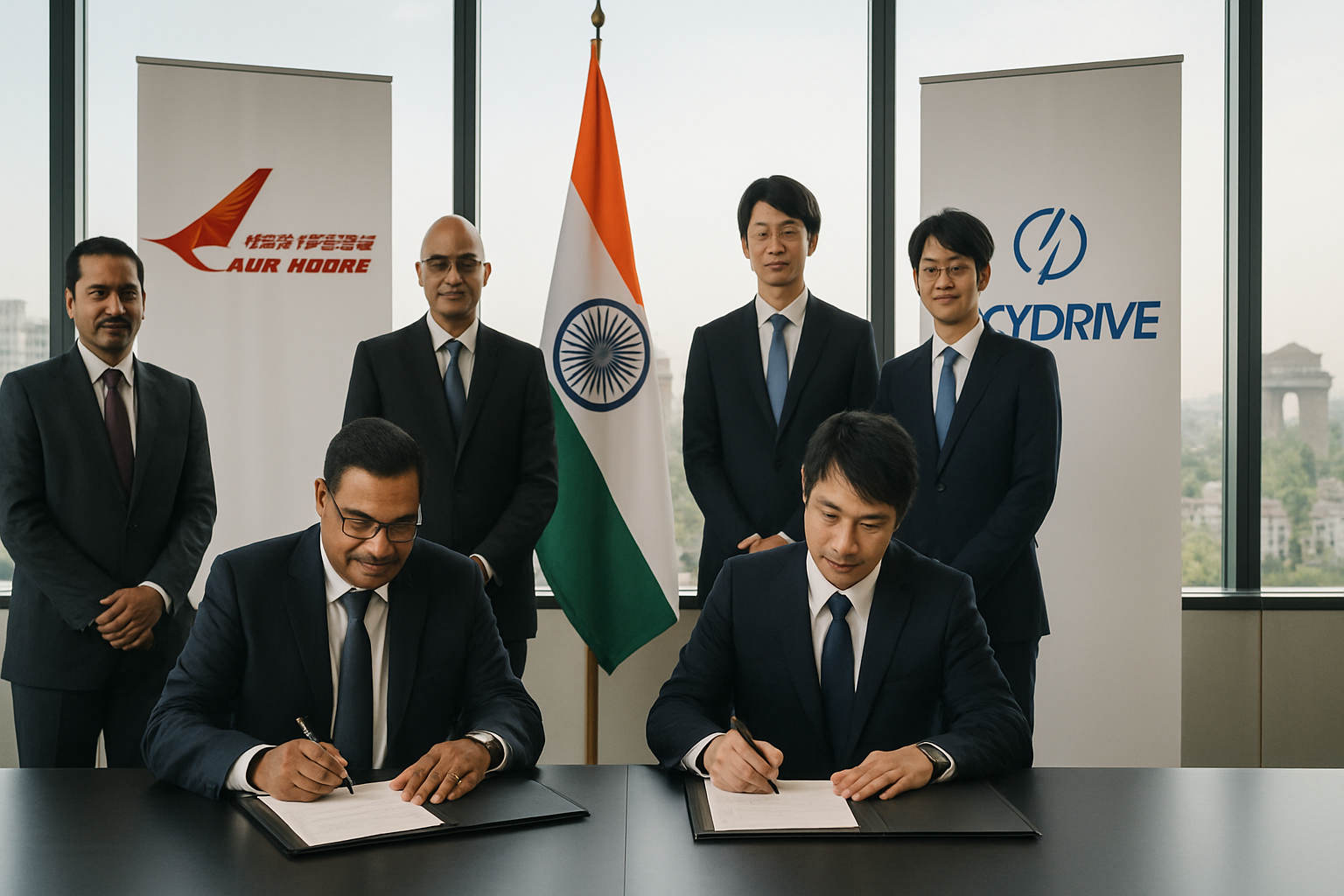
In a landmark development for India’s aerospace and mobility sectors, Air India, Japanese eVTOL pioneer SkyDrive, and automotive manufacturer Suzuki Motor Corporation have signed a Memorandum of Understanding (MoU) to collaborate on electric vertical takeoff and landing aircraft operations. The agreement, announced in July 2026, represents a significant step forward in establishing India as a regional leader in urban air mobility (UAM) and demonstrates the growing momentum behind electric aviation technology adoption across Asia.
Strategic Partnership: Three Industry Leaders Unite
The collaboration brings together three powerhouses from distinct yet complementary industries. Air India, India’s national carrier and one of Asia’s oldest and most respected airlines, provides established aviation infrastructure, regulatory relationships, and operational expertise spanning decades. SkyDrive, a Tokyo-based company at the forefront of eVTOL aircraft development, contributes cutting-edge electric propulsion technology and autonomous flight capabilities honed through years of research and development. Suzuki Motor Corporation adds critical manufacturing scale, supply chain management, and mechanical engineering prowess developed through decades of automotive production.
This tri-partite arrangement is strategically designed to create synergies across the entire eVTOL value chain—from aircraft design and certification to production and commercial operations. By pooling resources and expertise, the three companies aim to accelerate the development timeline for India-ready eVTOL platforms while establishing regulatory frameworks and operational protocols tailored to Indian airspace and urban environments.
The partnership underscores a broader industry trend where traditional aviation players are increasingly collaborating with specialized eVTOL manufacturers to enter the urban air mobility market. Air India’s involvement signals confidence from the legacy aviation sector in electric vertical takeoff technology, a critical validation point that encourages other carriers and investors to pursue similar initiatives across the region.
India’s Urban Air Mobility Opportunity
India represents one of the world’s most promising markets for urban air mobility solutions. With a population exceeding 1.4 billion people, rapid urbanization, and notorious traffic congestion in major metropolitan areas like Delhi, Mumbai, Bangalore, and Hyderabad, the demand for alternative transportation solutions is acute and growing. eVTOL aircraft offer a viable path to reducing ground transportation bottlenecks while simultaneously lowering emissions in high-density urban corridors where conventional air transport has limited applicability.
The Indian government has actively supported the emergence of UAM ecosystems, including the development of regulatory frameworks and infrastructure investments aimed at facilitating safe and efficient electric aviation operations. This supportive policy environment, combined with a large addressable market and a thriving startup ecosystem, makes India an ideal testing ground and eventual deployment hub for next-generation air mobility solutions. The Air India-SkyDrive-Suzuki partnership capitalizes on these favorable conditions while positioning India to become a manufacturing and operations center for eVTOL technology serving not only domestic markets but also neighboring Asian countries.
Beyond passenger transport, India’s eVTOL sector has potential applications in emergency medical services, cargo delivery, and executive transport—each segment representing distinct revenue opportunities. The MoU establishes a framework for exploring these diverse use cases while maintaining focus on urban passenger mobility, the largest and most economically viable segment in the near to medium term.
SkyDrive’s Technology and Track Record
SkyDrive has established itself as one of the world’s most technically advanced eVTOL developers, with multiple successful flight test campaigns and a clearly defined path to commercial certification. The company’s aircraft designs emphasize safety, efficiency, and scalability—critical factors for commercial deployment in complex urban airspace environments. SkyDrive’s involvement in this partnership brings proven engineering capabilities and a development roadmap grounded in real-world flight testing and regulatory engagement.
The Japanese company’s participation also reflects Asia’s growing prominence in eVTOL development. While the United States and Europe have historically dominated aerospace innovation, Asian companies and governments have invested heavily in electric aviation technology, recognizing the sector’s transformative potential for addressing regional mobility challenges. SkyDrive’s collaboration with Air India and Suzuki exemplifies this trend and strengthens Japan’s position as a regional innovation leader in next-generation transportation.
Through this partnership, SkyDrive gains direct access to India’s massive market opportunity while leveraging Suzuki’s manufacturing expertise and Air India’s operational networks. For a technology company like SkyDrive, such partnerships de-risk the path to commercialization by providing capital resources, manufacturing scale, and market access—three factors critical to transforming academic research and prototype development into profitable, scalable operations.
Suzuki’s Manufacturing Advantage
Suzuki Motor Corporation’s inclusion in this partnership is strategically significant for scaling eVTOL production. The company operates some of India’s most efficient and cost-effective manufacturing facilities, with deep expertise in precision engineering, supply chain optimization, and automotive-grade quality control. These capabilities are directly transferable to eVTOL aircraft production, where manufacturing efficiency and quality standards are paramount for both safety and profitability.
Suzuki’s manufacturing footprint in India provides immediate logistical advantages, including proximity to suppliers, skilled labor pools, and regulatory bodies. The company’s experience navigating India’s complex business environment and government relations positions it as an ideal partner for establishing domestic eVTOL manufacturing capacity. This localization of production has broader economic benefits, including job creation, technology transfer, and supply chain development that extends throughout India’s industrial sectors.
Furthermore, Suzuki’s commitment to electrification across its automotive portfolio demonstrates the company’s strategic alignment with sustainable transportation solutions. The eVTOL partnership represents a natural extension of Suzuki’s broader electric mobility strategy, allowing the company to participate in a high-growth, high-margin market segment while contributing to global decarbonization objectives.
Market Implications and Competitive Dynamics
The Air India-SkyDrive-Suzuki partnership intensifies competition in the global eVTOL market, particularly in Asia where multiple manufacturers and operators are simultaneously pursuing certification and commercialization. This MoU signals to investors and competitors that major institutional players are making substantial long-term commitments to urban air mobility, validating the sector’s fundamental market thesis. As legacy aviation and automotive companies increasingly join startup-led eVTOL developers, market consolidation and strategic alignment become inevitable features of the industry landscape.
For other regional carriers and manufacturers, the announcement may accelerate timeline pressures to develop or acquire eVTOL capabilities before market leadership positions solidify. Similarly, competing eVTOL manufacturers may face pressure to secure comparable strategic partnerships with major operators and supply chain partners. This competitive dynamic, while challenging, ultimately accelerates technology maturation and commercial deployment—beneficial outcomes for consumers and society broadly.
The partnership also demonstrates the importance of regional collaboration in developing regulated, safe, and efficient eVTOL ecosystems. By pooling expertise across aviation operations, technology development, and manufacturing, the three companies can navigate regulatory pathways more efficiently and create operational frameworks suitable for Indian airspace and urban environments. This collaborative model may serve as a template for other regions pursuing urban air mobility development.
Key Takeaways: What This Partnership Means for eVTOL Development
- Institutional validation: Major established companies committing significant resources to eVTOL commercialization reduces sector risk perception and attracts broader capital investment
- Manufacturing readiness: Suzuki’s production capabilities enable faster scaling from prototype to commercial aircraft, critical for establishing sustainable, profitable operations
- Regional market access: Air India’s networks and Suzuki’s India presence position the partnership to capture early-mover advantages in the world’s largest emerging eVTOL market
The Memorandum of Understanding signed by Air India, SkyDrive, and Suzuki represents a watershed moment for urban air mobility in Asia and India specifically. By combining aviation expertise, cutting-edge technology, and manufacturing capability, the three companies have created a formidable partnership capable of navigating the complex regulatory, technical, and operational challenges inherent to eVTOL commercialization. As this partnership progresses from agreement to operational implementation, the global eVTOL community should closely monitor outcomes, lessons learned, and technological milestones achieved—insights that will inform development efforts across other regions pursuing urban air mobility leadership.