HIGHLIGHTS
- Electric air taxis are purpose-built for airport commutes, not general personal transportation—a focused approach that makes certification and deployment realistic by 2027-2028.
- A 20-40km airport commute taking 45-90 minutes by ground transportation could be completed in 6-10 minutes by electric air taxi at competitive premium fares.
- Operating costs for electric aircraft are 60-70% lower than helicopter services, enabling scalable operations while producing zero direct emissions.
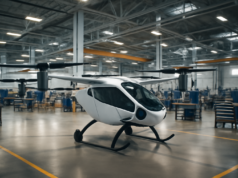
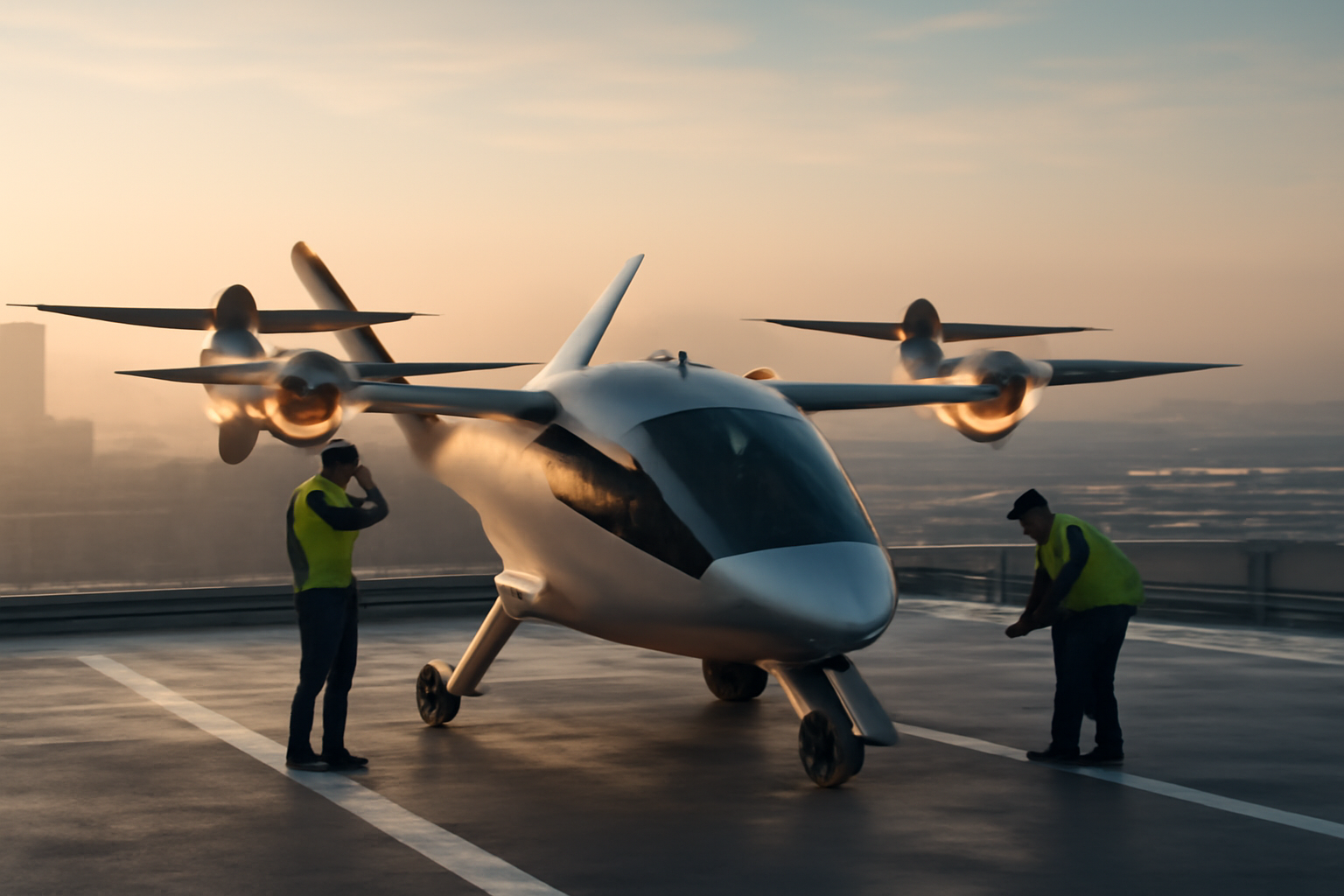
Electric vertical takeoff and landing aircraft (eVTOLs) are capturing the imagination of urban planners and commuters alike, but there’s a critical distinction that often gets lost in the hype: electric air taxis are not flying cars, nor are they trying to be. Instead, they represent a focused, practical solution to one of modern cities’ most pressing problems—getting people to the airport quickly and reliably. As the technology matures and regulatory frameworks solidify, electric air taxis could fundamentally transform how we think about airport commutes and urban transportation networks.
The Distinction: Air Taxis vs. Flying Cars
The term “flying car” conjures images of personal vehicles that seamlessly transition between road and sky, navigating traffic in three dimensions. Electric air taxis, by contrast, are purpose-built aircraft designed for specific routes between fixed points—typically city centers and major airports. This focused approach is not a limitation; it’s a competitive advantage that makes the technology viable much sooner than an all-purpose flying vehicle would be.
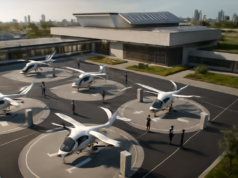
Flying cars would require solving complex problems like autonomous airspace management, infrastructure for millions of rooftop landing zones, and regulations governing personal aerial navigation. Electric air taxis bypass many of these challenges by operating on established routes with dedicated vertiports and centralized traffic management systems. This simplification allows developers to concentrate on perfecting battery technology, aircraft safety, and passenger comfort rather than solving the entire urban air mobility puzzle at once.
Understanding this distinction is crucial for assessing the realistic timeline for adoption. While flying cars remain decades away, electric air taxis are rapidly approaching certification and commercial deployment. Companies like Joby Aviation, Lilium, and Archer have attracted billions in funding based on this more pragmatic vision of urban air mobility.
The Airport Connection: A Perfect Use Case
Airport commutes represent an ideal market for electric air taxi services. Most major cities have at least one airport located 20-40 kilometers from downtown business districts. Ground transportation—whether taxis, rideshares, or public transit—consumes 45 minutes to two hours for many travelers, especially during peak hours. This distance-to-time ratio makes electric air taxis economically competitive with existing services while dramatically reducing travel time.
A flight that takes 6-10 minutes by air could eliminate up to an hour-and-a-half of commute time compared to ground transportation. For business travelers and premium passengers willing to pay a premium fare, the time savings justify the cost. Early pricing estimates suggest air taxi fares comparable to executive car services or premium rideshare options—expensive but not prohibitively so for frequent travelers.
The airport connection also provides regulatory and operational advantages. Airports are highly controlled environments with existing security infrastructure, trained ground crews, and established procedures for managing aircraft traffic. Unlike dispersed citywide operations, a system connecting downtown vertiports to a single airport terminal can be implemented and scaled incrementally, allowing operators to prove safety and efficiency before expanding to additional routes.
Technology and Timeline: The Reality Check
Battery technology has been the primary bottleneck for electric aircraft, but recent advances are accelerating practical deployment. Modern lithium-ion batteries now achieve energy densities that support electric aircraft carrying 4-6 passengers for 15-20 minutes of flight time—precisely what’s needed for airport commutes. Companies are simultaneously developing advanced battery chemistries and hybrid-electric systems that could extend range without sacrificing efficiency.
Regulatory approval represents the second major hurdle. The FAA, EASA, and equivalent authorities worldwide are actively developing certification standards for eVTOLs. Several manufacturers have received tiltrotor special type certificates and are conducting extensive flight testing. While certification timelines have slipped from earlier optimistic estimates, most industry observers expect initial commercial operations to begin in 2027-2028, with expansion accelerating through the early 2030s.
Infrastructure development is advancing in parallel. Cities including Los Angeles, New York, Singapore, and London are planning vertiport networks, with initial facilities expected to open alongside or shortly before commercial air taxi services. Public-private partnerships are reducing government expenditure while ensuring infrastructure aligns with air taxi operational requirements.
Economic and Environmental Benefits
Electric air taxis produce zero direct emissions, making them significantly cleaner than helicopter services or ground transportation powered by fossil fuels. A journey that would require a 60-minute taxi ride generating 5-10 kilograms of CO2 could instead be accomplished with an eVTOL using electricity that, in regions with renewable energy grids, produces minimal carbon impact. As electricity grids decarbonize, the environmental advantage of air taxis will compound.
Economic efficiency extends beyond passengers. Operators benefit from dramatically lower operating costs compared to conventional helicopters. Electric motors require minimal maintenance, fuel costs are significantly lower than jet fuel, and the simplified mechanical systems reduce downtime. Maintenance labor, the largest cost component in helicopter operations, could be reduced by 60-70% with electric aircraft, translating to lower fares and improved profitability.
Cities benefit from reduced ground-level traffic congestion. If even 10-15% of airport commuters shift to air taxis, the cascading effect on ground transportation reduces congestion, pollution, and infrastructure strain. This efficiency gain could prove as economically significant to municipalities as the direct benefits to passengers and operators.
Challenges and the Path Forward
Noise remains a significant concern, though electric motors are substantially quieter than turbine engines. Early noise testing suggests electric air taxis will meet urban airspace requirements, but vertiports must be strategically located to avoid residential neighborhoods. This planning constraint is driving development of vertiports at airports, heliports, rooftops of commercial buildings, and purpose-built facilities at the urban periphery.
Public acceptance will be crucial for long-term success. Unlike early helicopter services that remained niche and celebrity-focused, air taxi services must achieve scale and middle-class affordability. This requires transparent communication about safety records, environmental benefits, and cost economics. High-profile accidents during development or early commercial operations could trigger public backlash and regulatory constraints that delay broader adoption.
Integration with ground transportation networks is essential for realizing the full efficiency potential. Air taxis work best as part of multimodal journeys—subway to downtown vertiport, air taxi to airport, connecting flight elsewhere. Cities that coordinate vertiport locations, public transit access, and ground transportation will see faster adoption and greater benefits than those treating air taxis as isolated services.
Key Takeaways
- Electric air taxis solve a specific, solvable problem (airport commutes) rather than attempting to replace all ground transportation like flying cars would.
- Regulatory certification and commercial operations are expected to begin in 2027-2028, making electric air taxis a near-term reality rather than distant speculation.
- Airport commute routes reduce travel time by 45-90 minutes while generating lower operating costs and zero direct emissions compared to ground and helicopter alternatives.
Electric air taxis represent not a speculative technology, but a practical evolution of transportation that will reshape urban mobility within the next few years. By narrowing focus to airport commutes and city-to-city routes, the industry has identified genuinely viable use cases that satisfy regulatory requirements, economic constraints, and passenger needs. The transition from concept to commercial reality is now measured in months, not decades, making 2026-2027 a pivotal moment for the electric air mobility revolution.