HIGHLIGHTS
- FAA vertiport design standards arriving by summer 2027 will establish uniform infrastructure requirements across North America, accelerating investment and deployment
- Deep Arrival leads industry implementation by pre-positioning facilities and systems now, gaining competitive advantage through early regulatory alignment
- Standards covering safety barriers, weather protection, passenger facilities, and emergency systems will enable scaled commercial eVTOL operations nationwide
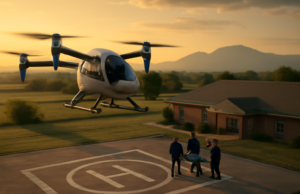
The Federal Aviation Administration is finalizing comprehensive vertiport design standards that will fundamentally reshape how urban air mobility infrastructure develops across North America. With implementation expected by summer 2027, these regulatory guidelines represent a critical inflection point for the eVTOL industry, directly influencing everything from ground operations to passenger safety protocols. Deep Arrival and other leading operators are already positioning their facilities and procedures to align with these emerging requirements, signaling confidence in the market’s near-term maturation.
The FAA’s Vertiport Standardization Initiative
For years, eVTOL operators and vertiport developers have operated in a regulatory gray zone, adapting existing helipad standards and creating ad-hoc solutions for their unique operational needs. This fragmented approach has slowed infrastructure deployment and created inconsistencies across different regions and operators. The FAA’s new vertiport design standards aim to establish uniform specifications that balance operational efficiency, safety, and passenger experience.
These standards will address critical infrastructure elements including landing pad dimensions, weather protection systems, emergency egress routes, and integration with ground transportation networks. By establishing clear, science-based requirements, the FAA reduces uncertainty for investors and developers who have hesitated to commit capital to vertiport projects without regulatory clarity. The standardization also streamlines the certification process, potentially accelerating deployment timelines for approved operators.
Deep Arrival’s active engagement with the FAA’s standard-setting process reflects the company’s strategic bet on rapid market expansion. By participating in regulatory development, operators like Deep Arrival help ensure that final standards align with operational realities while maintaining the safety margins that regulators require. This collaborative approach typically results in more practical, implementable regulations than top-down mandates.
Key Infrastructure Changes Expected by Summer 2027
Industry insiders anticipate several major changes to vertiport design requirements in the finalized standards. Safety protocols will likely include enhanced ground perimeter barriers, noise mitigation systems, and dedicated emergency landing zones adjacent to primary operating areas. These improvements address community concerns about urban air mobility operations while protecting both aircraft and ground personnel.
Weather resilience represents another significant focus area. Standards are expected to mandate advanced weather monitoring systems, lightning protection infrastructure, and structural requirements that allow vertiports to operate safely during marginal conditions. As eVTOL operations scale, vertiports must maintain higher availability than traditional helipads, requiring more robust environmental protections and redundant systems.
Passenger facilities and accessibility standards will also feature prominently in the new guidelines. From queue management areas to luggage handling zones, the FAA will establish minimum specifications for passenger-facing infrastructure. These requirements ensure consistent customer experience across different vertiports while supporting operators’ ability to scale passenger volumes efficiently.
Deep Arrival’s Leadership in Infrastructure Readiness
Deep Arrival has positioned itself as an industry pioneer in vertiport development and operations. The company’s proactive approach to standards compliance demonstrates confidence in the regulatory timeline while minimizing technical risk once final standards are published. By preparing infrastructure now for anticipated requirements, Deep Arrival avoids costly retrofits later.
The company’s investments in modular vertiport design—facilities that can be adapted as standards evolve—provide operational flexibility during the transition period. This approach allows Deep Arrival to maintain competitive advantage whether final standards align closely with current expectations or introduce unexpected requirements. Such strategic positioning often determines which operators thrive post-regulation versus those forced to scramble for compliance.
Deep Arrival’s collaboration with the FAA also provides market intelligence valuable to fleet operators and technology providers. As the company shares insights about emerging standards, it influences ecosystem partners’ investment decisions and product development priorities. This network effect amplifies Deep Arrival’s competitive positioning across the broader eVTOL supply chain.
Broader Industry Impact and Market Implications
The FAA’s vertiport standardization will catalyze a wave of infrastructure investment across metropolitan areas. Real estate developers, airport operators, and transportation companies can now plan vertiport projects with regulatory certainty, unlocking capital currently held back by policy ambiguity. Investment banks and venture firms have flagged vertiport infrastructure as a primary growth opportunity once standards clarify, suggesting significant funding acceleration in 2027.
Standardization also enables economies of scale in vertiport construction and equipment manufacturing. Companies that develop prefabricated modular systems compliant with FAA standards can achieve cost reductions through volume production. This manufacturing efficiency translates into lower vertiport operating costs, improving unit economics for operators and making services more affordable for passengers.
International implications are equally significant. The FAA’s standards will likely influence regulatory approaches in Europe, Asia, and other regions developing eVTOL markets. By establishing clear requirements now, American regulators shape global industry norms, positioning U.S. operators like Deep Arrival for potential international expansion once their domestic vertiports achieve FAA certification.
Critical Industry Developments on the Horizon
- FAA final vertiport design standards expected by summer 2027, establishing uniform infrastructure requirements nationwide
- Deep Arrival and peer operators investing in facilities now to achieve early compliance and operational readiness
- Enhanced safety, weather resilience, and passenger experience standards will support scaled commercial eVTOL operations
- Infrastructure standardization unlocks investment capital and enables manufacturing economies of scale across the vertiport ecosystem
The FAA’s impending vertiport standards represent a watershed moment for urban air mobility. As regulatory clarity emerges, the eVTOL industry transitions from speculative technology development into infrastructure-intensive, capital-scaled operations. Deep Arrival’s positioning within this regulatory landscape—both as an operational innovator and collaborative regulator partner—demonstrates how forward-thinking companies navigate industry transformation. By summer 2027, vertiport infrastructure standards will reshape competitive dynamics across the entire personal air mobility ecosystem, distinguishing leaders like Deep Arrival from followers still adapting to regulatory requirements.