
HIGHLIGHTS
- Florida proposes redirecting $197 million from EV charger funds to build eVTOL vertiports near golf courses, marking a major shift in transportation infrastructure allocation
- Golf course locations strategically target affluent early adopters while leveraging existing security infrastructure and airspace for commercial eVTOL operations launching 2025-2026
- Regulatory approval could set a nationwide precedent for flexible federal transportation funding, enabling billions in reallocation toward air mobility infrastructure across other states
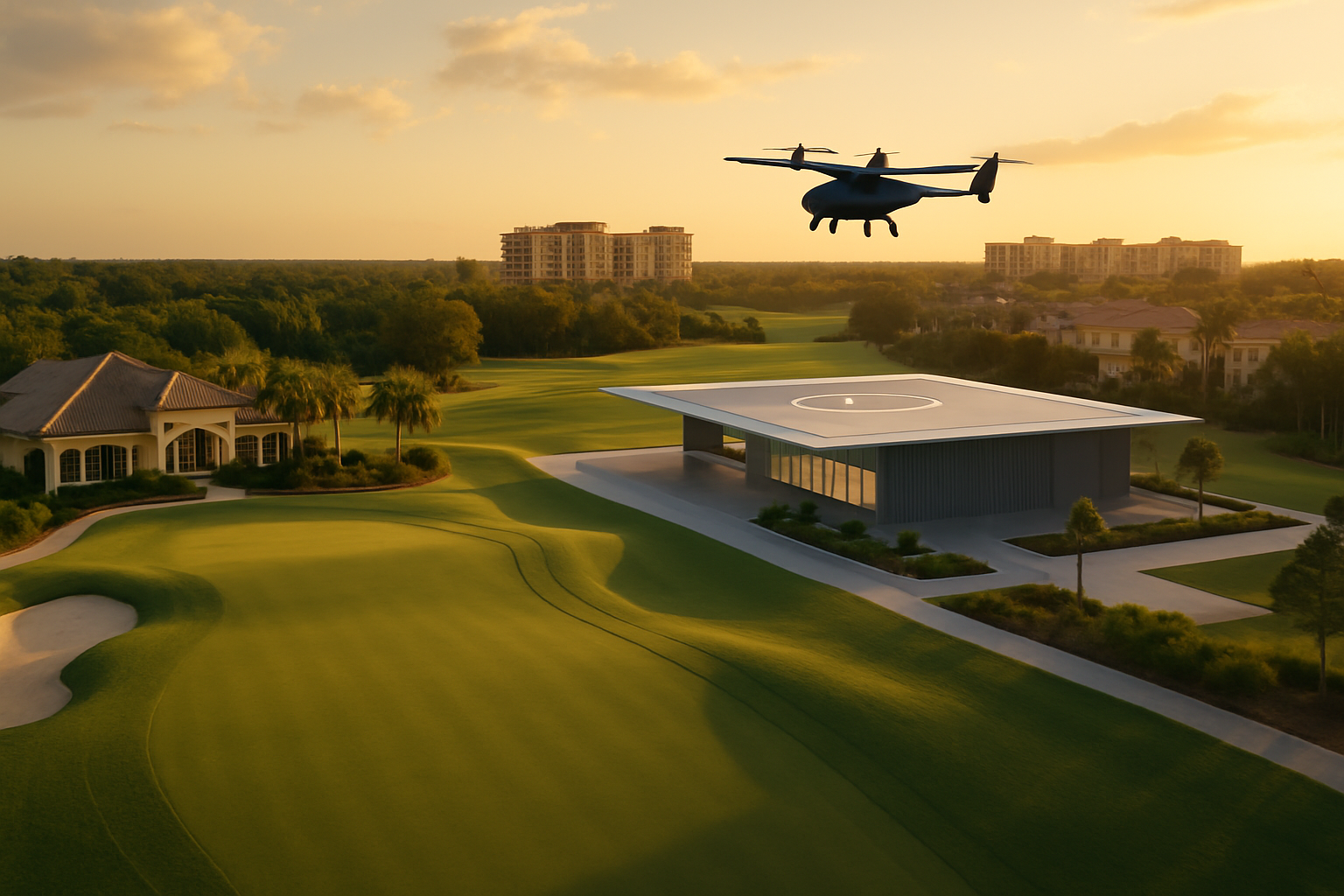
Florida is taking an unconventional approach to urban air mobility infrastructure by proposing to redirect $197 million in electric vehicle charger funding toward the development of flying-car landing pads near golf courses. This bold initiative represents a significant pivot in how states are allocating federal transportation funds, moving beyond traditional ground-based EV charging to prepare for the emerging eVTOL (electric vertical takeoff and landing) industry that is rapidly approaching commercialization.
The $197 Million Reallocation Strategy
The Florida proposal centers on repurposing funds originally earmarked for traditional EV charging infrastructure to build vertiport facilities and landing pads specifically designed for electric vertical takeoff and landing aircraft. This unprecedented move reflects growing recognition that personal air mobility will soon become a transportation reality, requiring infrastructure investment now to support future adoption.
The specific focus on golf courses as vertiport locations is strategically significant. Golf communities in Florida are among the state’s most affluent residential areas, with existing security infrastructure, open spaces suitable for landing pads, and a demographic profile that aligns with early adopters of air mobility services. The locations also offer minimal airspace congestion compared to urban centers, allowing for safer initial operations and testing.
State officials argue that this reallocation makes economic sense, as eVTOL aircraft will fundamentally reduce demand for stationary EV charging infrastructure along highways and in public spaces. By investing in air mobility infrastructure now, Florida positions itself as a leader in the next generation of transportation technology while avoiding stranded assets in ground-based charging systems.
Regulatory and Planning Implications
This proposal must navigate complex federal regulations governing the use of transportation funds. The Federal Highway Administration and Department of Transportation have historically maintained strict guidelines on how state and federal transportation dollars can be deployed, typically restricting spending to road infrastructure, public transit, and established vehicle charging networks. Florida’s request to redirect these funds represents a test case for whether regulators will embrace eVTOL infrastructure as a legitimate transportation investment category.
The planning framework required to support vertiport development is substantially more complex than traditional charging infrastructure. Each landing pad must undergo airspace analysis, environmental review, noise impact assessment, and coordination with the FAA’s Airspace Management System. Golf course locations introduce additional variables, including ensuring operations don’t interfere with active play and addressing community acceptance concerns.
If approved, Florida’s approach could set a precedent for other states looking to invest in eVTOL infrastructure. Texas, California, and New York have all expressed interest in air mobility development, and regulatory approval in Florida could accelerate similar proposals nationwide, effectively redirecting billions in federal transportation funding toward vertiport construction and landing pad infrastructure.
eVTOL Market Development and Timing
The timing of Florida’s proposal aligns with accelerating commercialization of eVTOL services. Multiple manufacturers, including Joby Aviation, Archer Aviation, and Lilium, have active certification programs with the FAA and are targeting commercial operations beginning in 2025-2026. Initial service deployments are expected in major metropolitan areas, but secondary markets and regional hubs will follow rapidly, making vertiport infrastructure a genuine near-term necessity rather than speculative investment.
Personal air mobility operators have identified golf course communities and resort destinations as primary early markets, given the demographics and geographic distribution of these facilities. Florida’s abundant golf communities, combined with the state’s large wealth concentration, make it an ideal testbed for eVTOL services. Having publicly-developed vertiport infrastructure near these communities significantly reduces barriers to entry for air mobility operators.
The proposal also reflects confidence in the business case for eVTOL operations. Unlike speculative investments in emerging technology, this reallocation assumes that commercial eVTOL services will achieve sufficient scale and utilization within the next 5-10 years to justify the infrastructure investment. Transportation planners are treating air mobility as inevitable rather than aspirational.
Community, Environmental, and Economic Considerations
Golf course communities represent a unique constituency for infrastructure development, combining affluent stakeholder bases with established governance structures. These communities can advocate effectively for or against the vertiport proposal, and their support is critical for successful implementation. Early indications suggest receptiveness among developers and community leaders, who see air mobility access as a premium amenity that increases property values and attracts high-net-worth residents.
Environmental considerations are mixed. On one hand, eVTOL aircraft are electric and produce zero operational emissions, supporting Florida’s climate commitments. Concentrated vertiport infrastructure near existing communities is more efficient than distributed charging stations across sprawling highway networks. On the other hand, noise concerns require careful management, particularly in residential golf communities. Modern eVTOL aircraft are significantly quieter than helicopters, but regulatory standards and community expectations around noise are still being established.
The economic impact of vertiport development extends beyond the initial construction investment. Vertiports generate ongoing employment, increase land values in adjacent areas, and position Florida as a premier hub for air mobility operations and tourism. Airlines and air mobility operators will strategically choose bases in regions with developed infrastructure, giving early-investment states and communities significant competitive advantages.
Key Takeaways: Florida’s Air Mobility Investment Framework
- Strategic focus on golf course communities as vertiport locations reduces infrastructure costs while targeting high-value early adopters of eVTOL services
- Funding reallocation from traditional EV charging represents a potential regulatory precedent for transportation funding flexibility nationwide
- Timeline aligns with commercial eVTOL certifications and service launches, positioning Florida to capture first-mover advantages in air mobility infrastructure
Florida’s proposal to redirect $197 million in EV charger funding toward flying-car landing pads represents a forward-thinking approach to emerging transportation infrastructure. By securing landing facilities before commercial eVTOL operations begin, Florida positions itself at the center of personal air mobility adoption. The golf course strategy is particularly innovative, combining affluent demographics with existing infrastructure and security systems. Whether federal regulators approve this creative reallocation will likely determine whether other states can follow suit, potentially transforming how billions in transportation funding are deployed across the United States. The coming months will reveal whether this vision becomes regulatory reality or remains an ambitious plan awaiting bureaucratic approval.