HIGHLIGHTS
- Hybrid-electric aircraft successfully completed its first public demonstration flight in Philadelphia on August 18, 2026, marking a major milestone for commercial urban air mobility deployment
- The aircraft operates on pure electric power for short urban flights while hybrid propulsion extends range and provides safety redundancy for commercial passenger operations
- FAA regulatory oversight of the Philadelphia test validates safety protocols and creates certification pathways, positioning the city as a leading early-adopter hub for eVTOL services
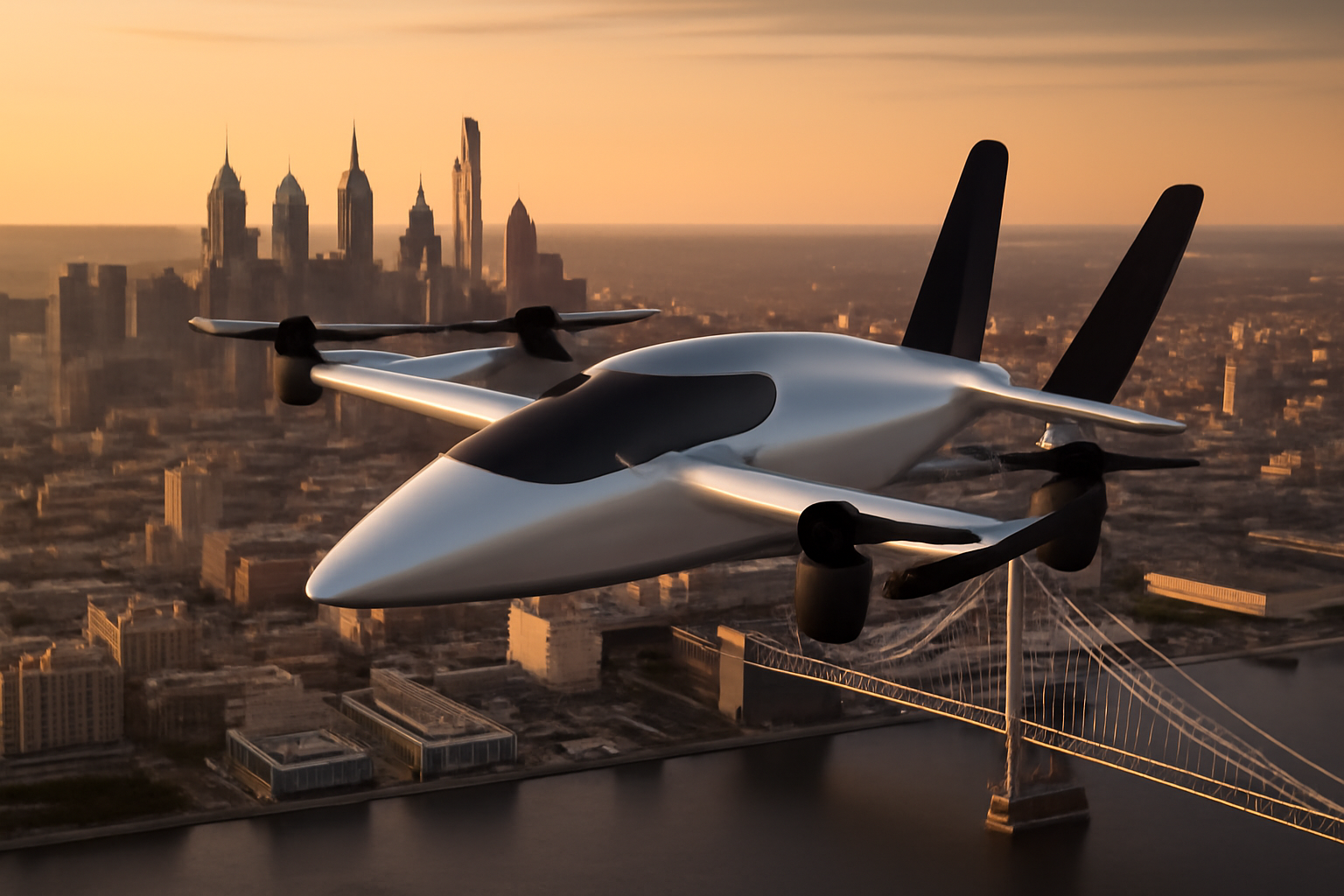
The electric vertical takeoff and landing (eVTOL) industry reached a significant milestone on August 18, 2026, as a hybrid-electric aircraft successfully completed a demonstration flight in Philadelphia. This test flight represents a crucial step forward in bringing practical urban air mobility solutions to American cities, showcasing the viability of hybrid-electric propulsion systems for short-range passenger transport and logistics applications.
Breaking Ground in Philadelphia’s Airspace
Philadelphia served as the launch site for this historic demonstration, selected for its dense urban environment and existing infrastructure. The city’s diverse geography—featuring both waterfront areas and residential neighborhoods—provided an ideal testing ground to validate aircraft performance across varied flight conditions. This public demonstration marked the first time many Philadelphia residents witnessed a hybrid-electric eVTOL in action, generating significant local interest and media coverage.
The test flight was conducted under controlled conditions with full compliance to Federal Aviation Administration (FAA) regulations. Safety protocols and flight corridors were meticulously planned to ensure minimal disruption to existing air traffic while maximizing public observation opportunities. The successful completion of this demonstration validates Philadelphia’s potential as a future urban air mobility hub.
By choosing Philadelphia for this milestone event, the aircraft developer signals confidence in the city’s regulatory environment and infrastructure readiness for advanced air mobility operations. This demonstration flight strengthens Philadelphia’s position among leading American cities preparing for the commercial deployment of eVTOL services in the coming years.
Hybrid-Electric Propulsion: A Practical Advancement
Hybrid-electric propulsion systems represent a pragmatic middle ground between conventional combustion engines and fully electric powertrains. By combining battery electric power with supplementary combustion capability, these aircraft achieve extended range while maintaining the environmental benefits and operational flexibility of electric flight. This dual-power approach allows operators to optimize fuel efficiency and reduce emissions without sacrificing operational coverage.
The hybrid architecture demonstrated in Philadelphia addresses a critical challenge facing the eVTOL industry: battery energy density limitations on longer flights. During short urban hops, the aircraft operates primarily on electric power, producing zero emissions and minimal noise. For longer regional routes or reserves needed in adverse weather, the hybrid system seamlessly transitions to supplementary combustion power, ensuring reliability and safety margins essential for commercial passenger operations.
This propulsion strategy has gained industry traction because it doesn’t require waiting for breakthrough battery technology to achieve commercial viability. Engineers can deploy hybrid-electric systems today using proven components, while battery technology continues advancing. For urban mobility operations with typical flight times under 30 minutes, this represents an ideal near-term solution balancing performance, safety, cost, and environmental responsibility.
Regulatory Validation and Safety Protocols
The successful Philadelphia test flight demonstrates that hybrid-electric eVTOLs can operate safely within existing airspace frameworks. The aircraft completed its demonstration under FAA oversight, with every flight parameter carefully monitored and documented. This regulatory validation provides essential data for streamlining future certification processes and establishing safety standards for commercial hybrid-electric aircraft operations.
Safety considerations dominated the flight planning process, with redundant systems verified at multiple stages. The hybrid propulsion system itself provides inherent safety advantages: if the primary electric motors experience issues, the combustion-based auxiliary power ensures continued flight capability. This redundancy makes hybrid-electric aircraft particularly attractive to safety-conscious operators and regulators overseeing commercial passenger services.
Philadelphia’s test flight contributes valuable real-world performance data to the FAA’s growing knowledge base on eVTOL operations in urban environments. Information gathered from noise levels, vibration signatures, electromagnetic emissions, and operational behavior will inform future certification standards. This collaborative relationship between industry innovators and regulators accelerates the pathway to broader commercial deployment.
Urban Air Mobility’s Commercial Future
Successful demonstration flights like the Philadelphia event bring commercial urban air mobility closer to reality. Airlines, logistics companies, and air taxi operators are closely monitoring hybrid-electric aircraft performance to inform fleet acquisition decisions. The practical validation achieved in Philadelphia suggests that commercial services could launch within the next few years in major metropolitan areas, pending final regulatory clearances and infrastructure development.
Philadelphia itself is well-positioned to become an early adopter of eVTOL services. The city’s existing transportation congestion, coastal geography, and multiple urban centers support diverse air mobility use cases. From time-sensitive medical transport to executive travel and emergency response, Philadelphia offers numerous applications for reliable, rapidly-deployable eVTOL aircraft operating from vertiports under development throughout the region.
The hybrid-electric aircraft tested in Philadelphia represents not science fiction, but near-term reality. With successful demonstration flights, regulatory pathways clearing, and commercial partnerships forming, personal and regional air mobility is transitioning from research phase to deployment phase. The Philadelphia test flight signals that this transformation is accelerating faster than many predicted.
Key Takeaways from the Philadelphia Test Flight
- Hybrid-electric propulsion successfully demonstrated in urban environment, validating extended-range eVTOL operations for commercial deployment within 2-3 years
- FAA regulatory oversight of the flight provides crucial safety data and certification pathways for hybrid-electric aircraft serving American cities
- Philadelphia’s successful demonstration positions the city as a leading hub for urban air mobility services alongside major metropolitan centers
The August 2026 hybrid-electric aircraft demonstration in Philadelphia marks a watershed moment for urban air mobility. This successful test flight transforms eVTOL technology from theoretical possibility into operational reality, proving that practical, safe, environmentally-responsible air transportation can exist within modern cities today. As more demonstrations follow and regulatory frameworks solidify, Philadelphia and other forward-thinking cities will soon welcome commercial eVTOL services, fundamentally reshaping urban transportation networks.