HIGHLIGHTS
- Livonia couple’s successful eVTOL flight proves passenger operations are operationally viable today, marking the shift from innovation to real-world accessibility
- Battery technology and regulatory frameworks have matured sufficiently to support commercial expansion, with multiple operators planning service launches within the next 2-3 years
- eVTOL aircraft eliminate operational emissions and bypass ground congestion, addressing critical urban mobility and environmental sustainability challenges simultaneously
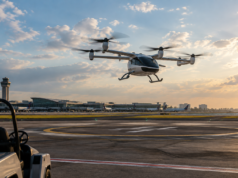
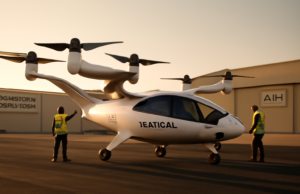
The future of personal air mobility just became reality for one Michigan couple. On a historic flight that captured the essence of a new transportation era, a Livonia husband and wife duo soared above the landscape in an electric vertical takeoff and landing (eVTOL) aircraft, experiencing firsthand what aviation enthusiasts and industry experts have long predicted: the democratization of flight. This milestone moment represents far more than a joyride—it signals the tangible emergence of personal air mobility from the realm of science fiction into everyday possibility.
A New Era of Urban Air Transportation Begins
For decades, the concept of personal flying vehicles has captured human imagination, featured in futuristic films and theoretical discussions at aerospace conferences. What was once purely speculative is now operational. The Livonia couple’s flight marks a significant cultural shift: regular citizens, not just test pilots or industry insiders, are now experiencing electric vertical takeoff and landing technology in practical applications. This democratization of eVTOL flight represents a fundamental change in how we think about transportation and mobility solutions.
The timing of this milestone is particularly significant given the current state of regulatory frameworks and technological maturity. As governments worldwide establish clearer guidelines for urban air mobility, and as manufacturers perfect their aircraft designs, the window between early adoption and mainstream accessibility is rapidly narrowing. The Livonia flight demonstrates that the infrastructure, expertise, and operational readiness for passenger eVTOL services are reaching critical mass.
Urban congestion has long been identified as one of the most pressing challenges facing modern cities. Traditional ground-based transportation systems in metropolitan areas are increasingly overwhelmed, creating bottlenecks that waste time, fuel, and economic productivity. eVTOL aircraft offer a compelling solution: they bypass ground congestion entirely, utilizing the vertical dimension and low-altitude airspace that remains largely underutilized in current transportation networks.
The Technology Behind the Flight
Modern eVTOL aircraft represent the convergence of multiple advanced technologies: electric propulsion systems, advanced battery chemistry, autonomous flight control systems, and lightweight composite materials. The aircraft that carried the Livonia couple incorporates all these elements into a package designed for safety, efficiency, and passenger comfort. Electric motors provide instant torque and precise control, while redundant systems ensure reliability comparable to commercial aircraft standards.
Battery technology has been the critical enabler for eVTOL viability. Recent advances in lithium-ion and solid-state battery chemistry have dramatically improved energy density—the amount of power that can be stored in a given weight. This breakthrough directly translates to increased range, payload capacity, and flight duration. For the Livonia flight, battery performance allowed for a journey that would have been impossible just five years ago, demonstrating how rapidly the technology curve is accelerating.
The environmental implications of electric vertical takeoff and landing aircraft cannot be overstated. By replacing fuel-burning engines with electric motors powered by renewable energy sources, eVTOL flights produce zero operational emissions. When charged from grids increasingly powered by solar, wind, and hydroelectric sources, these aircraft represent a genuinely sustainable solution to urban mobility. The Livonia couple’s flight, therefore, wasn’t just a personal achievement—it was a small but meaningful step toward decarbonizing transportation.
Regulatory Progress and Safety Standards
The Livonia eVTOL flight was made possible by regulatory approvals that represent years of collaborative work between manufacturers, aviation authorities, and safety organizations. The Federal Aviation Administration and equivalent bodies in other countries have been methodically developing certification standards for these novel aircraft. These rigorous standards ensure that eVTOL operations meet the same safety expectations as conventional aviation, protecting both passengers and people on the ground.
Safety protocols for eVTOL flights are comprehensive and continuously refined based on flight data and operational experience. Multiple redundancies in propulsion, control, and navigation systems mean that even in the unlikely event of component failure, the aircraft remains controllable and can land safely. The Livonia couple’s flight proceeded under strict adherence to these established safety protocols, with weather monitoring, flight corridors, and emergency procedures all carefully coordinated.
Public confidence in new transportation technologies is built through transparent demonstration of safety records and rigorous testing protocols. Each successful eVTOL flight, like the one experienced by the Livonia couple, contributes data that regulatory bodies analyze to refine standards and operational procedures. This iterative process of real-world validation combined with regulatory oversight creates the foundation for safe, scalable deployment of personal air mobility systems.
The Path Forward for Personal Air Mobility
The Livonia couple’s flight is not an isolated event but rather one data point in a rapidly accelerating trajectory toward mainstream eVTOL services. Multiple companies globally are advancing toward commercial operations, with several targeting the next few years for launching regular passenger services. Cities from Singapore to Los Angeles are preparing infrastructure and vertiports—specialized landing facilities for electric aircraft—to support this emerging transportation category.
The economic case for eVTOL is becoming increasingly compelling. Operating costs per passenger-mile, when amortized across modern aircraft with higher capacity, approach parity with conventional ground transportation in many scenarios. Insurance frameworks are being established, pilot training programs are being developed, and maintenance procedures are being standardized. The ecosystem necessary to support widespread eVTOL adoption is being systematically built.
Consumer attitudes toward air mobility are shifting rapidly, particularly among younger demographics who view personal aviation as a logical extension of technological progress. The Livonia couple’s willingness to participate in this flight reflects growing public comfort with the technology. As more people experience eVTOL flights firsthand, concerns diminish and enthusiasm grows, creating a positive feedback loop that accelerates adoption and investment in the sector.
Personal Stories Driving the Movement
Behind every technological revolution are the human stories of pioneers willing to embrace new possibilities. The Livonia couple represents millions of people who envision a future where flying above traffic is as routine as driving on a highway. Their flight story has inspired conversations about accessibility, sustainability, and innovation. Media coverage of their experience spreads awareness and normalizes the concept of personal air mobility in the public consciousness.
The emotional experience of flight—the sense of freedom and perspective that comes from leaving the ground—resonates deeply with human psychology. When the Livonia couple soared above their region in an electric aircraft, they weren’t just experiencing a transportation option; they were participating in a paradigm shift in how humanity moves through space. That visceral experience becomes a powerful advocacy tool as they share their journey with family, friends, and broader networks.
Stories like the Livonia flight help bridge the gap between technological possibility and public perception. While engineers and industry professionals understand the capabilities and safety profiles of eVTOL aircraft, general audiences need relatable human narratives to comprehend the significance of these developments. A Michigan couple enjoying a flight over their region is far more compelling and accessible than technical specifications or industry forecasts.
Key Takeaways: The eVTOL Revolution in Motion
- Livonia couple’s successful eVTOL flight demonstrates that personal air mobility is operational today, not a distant future concept, with passenger experience now validated in real-world conditions
- Regulatory frameworks, battery technology, and safety systems have matured sufficiently to support growing passenger operations, with multiple commercial launches planned within the next few years
- Electric vertical takeoff and landing aircraft offer zero-emission transportation solutions to urban congestion while creating a compelling economic case as operational costs approach ground transportation parity
The Livonia couple’s historic flight represents far more than a personal achievement—it is a milestone marker in the transition of personal air mobility from speculative concept to operational reality. As more civilians experience eVTOL flights, regulatory frameworks solidify, and infrastructure develops, the question shifts from “will this work?” to “how quickly will this scale?” The future isn’t just here; it’s accelerating. For the Livonia couple and thousands of others, the sky is no longer a limit—it’s a highway waiting to be explored.