HIGHLIGHTS
- Military drone swarms and AI-driven autonomous systems unveiled at AUSA 2026 are powered by battery and motor innovations that directly accelerate commercial eVTOL development timelines.
- Advanced air-defense systems demonstrated at the conference reveal that commercial urban air mobility platforms must now integrate with military-grade airspace management and threat detection capabilities.
- Defense sector R&D investment in autonomous flight control, sensor fusion, and precision navigation is reshaping regulatory standards that commercial drone and eVTOL operators must meet for FAA certification.
The Association of the United States Army (AUSA) conference concluded its 2026 annual gathering with an impressive showcase of military drone technology, advanced missile systems, and next-generation air-defense weapons. As the defense industry’s premier event, AUSA demonstrated how autonomous vertical takeoff and landing (VTOL) platforms and drone swarms are fundamentally transforming military operations and logistics. The final day’s exhibitions underscored a critical shift: military and commercial air mobility sectors are increasingly converging, with implications for both battlefield doctrine and future urban airspace management.
Military Drones Take Center Stage at AUSA 2026
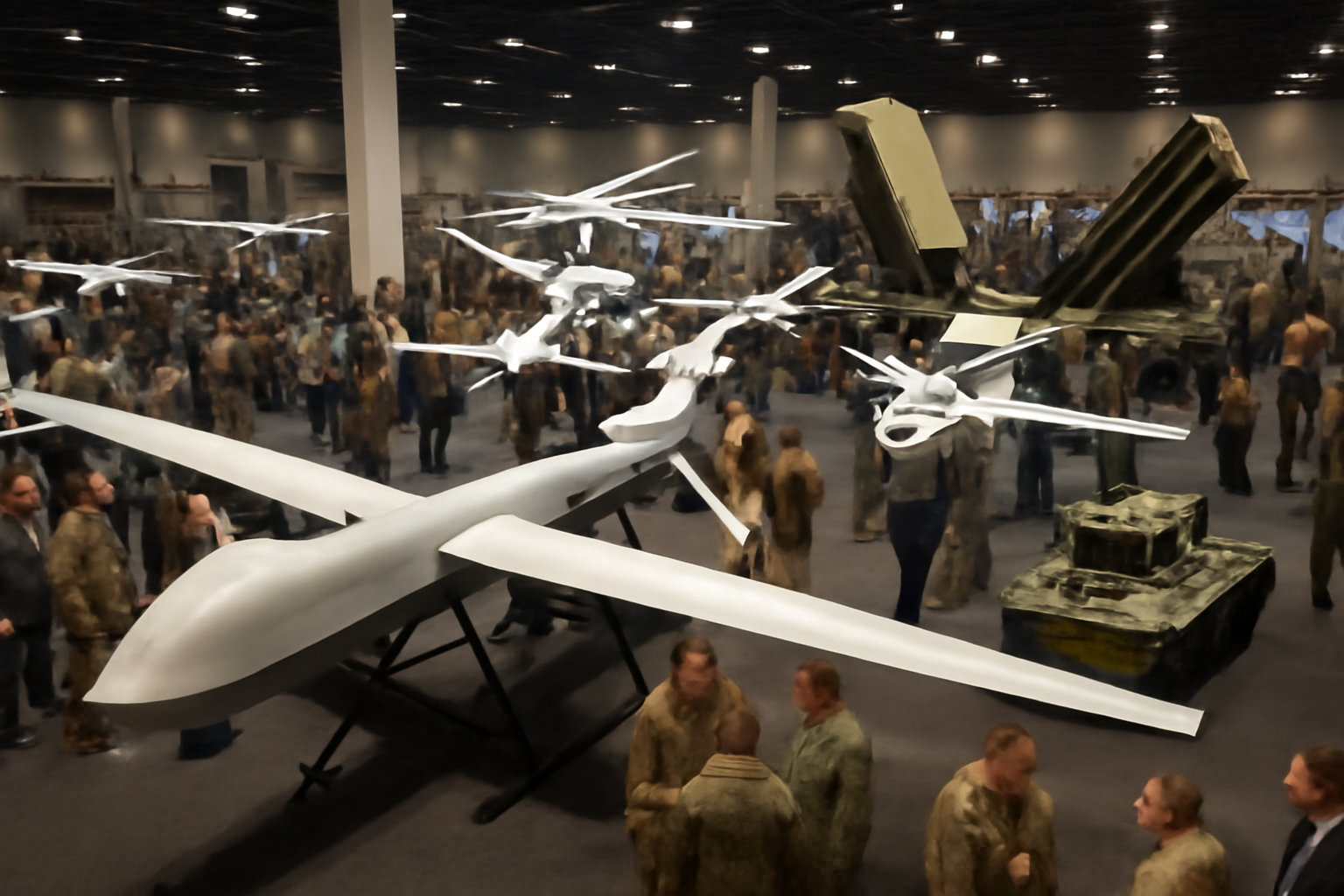
The exhibition floors showcased an unprecedented array of unmanned aerial systems designed for everything from tactical reconnaissance to cargo delivery. Major defense contractors unveiled next-generation drones capable of operating in contested environments, featuring enhanced autonomous capabilities and swarm coordination algorithms. These platforms represent a substantial leap forward in mission endurance, payload capacity, and real-time decision-making without constant human intervention.
Military operators are particularly focused on integrating electric and hybrid-electric powertrains into their drone fleets to reduce acoustic signatures and extend operational range. The shift toward cleaner propulsion directly parallels civilian eVTOL development, creating unexpected synergies between defense procurement and commercial air mobility innovation. AUSA 2026 highlighted how battery technology advances benefiting commercial passenger drones are now enabling lighter, longer-endurance military platforms.
The emphasis on drone swarm technology was particularly notable, with multiple vendors demonstrating coordinated flight formations and distributed decision-making across multiple unmanned systems. These swarm capabilities promise to overwhelm traditional air-defense systems and enable distributed reconnaissance over vast areas. The implications for future air operations—both military and civilian—suggest that centralized air traffic management will give way to more distributed, AI-driven coordination protocols.
Advanced Air-Defense Weapons Systems on Display
As drone proliferation accelerates, the defense industry is racing to develop counter-UAS technologies capable of defeating emerging threats. AUSA’s final day featured multiple air-defense systems leveraging radar, optical sensors, and directed-energy weapons to detect and neutralize unmanned threats. These systems must operate in multi-layered defense architectures protecting critical military installations, command centers, and forward operating bases.
The emergence of sophisticated air-defense networks has direct implications for the commercial eVTOL ecosystem. Future urban air mobility systems will operate within airspace already managed by military air-defense systems, necessitating unprecedented coordination between civilian and defense operators. Geofencing, automatic dependent surveillance-broadcast (ADS-B) transponders, and real-time airspace deconfliction are now essential considerations for any eVTOL platform seeking regulatory approval and operational clearance.
Notably, several exhibitors demonstrated integration between unmanned traffic management (UTM) systems and military air-defense networks. This convergence suggests that the infrastructure supporting future commercial drone operations will likely incorporate military-grade situational awareness and threat-response capabilities. The regulatory pathway for urban air mobility increasingly depends on demonstrating interoperability with existing defense systems.
Missile Technology and Integrated Air Operations
AUSA 2026 also featured extensive displays of next-generation missile systems designed to work in concert with unmanned platforms. Cruise missiles, air-defense missiles, and anti-drone systems were showcased alongside drone deployment infrastructure, illustrating how modern warfare integrates kinetic and unmanned operations into cohesive campaigns. The emphasis on integrated operations suggests that future air mobility strategies—military and civilian—will require seamless coordination across diverse platform types.
The advancement of missile guidance systems, particularly those utilizing artificial intelligence and advanced sensor fusion, mirrors innovations occurring in civilian autonomous vehicle development. Algorithms originally developed for military applications are now being adapted for commercial air mobility, with significant implications for safety, reliability, and operational efficiency. Both sectors are converging on similar technical solutions to persistent challenges in autonomous navigation and threat detection.
One significant trend was the emphasis on loiter-capable munitions and precision-guided systems that can operate with reduced collateral damage. This focus on precision and discrimination aligns with civilian regulatory requirements for urban air mobility platforms, where noise, safety, and environmental impact are paramount. The dual-use nature of advanced propulsion and navigation technologies means that civilian and military innovation cycles increasingly influence one another.
Implications for Commercial Air Mobility’s Future
While AUSA focuses on military applications, the technologies showcased have profound implications for commercial eVTOL operators and drone logistics companies. Military procurement drives battery technology development, motor design optimization, and autonomous flight control systems that subsequently trickle into civilian markets. The defense industry’s massive R&D investment accelerates innovation cycles that benefit commercial air mobility across multiple technical domains.
The integration of drones into military logistics operations provides a real-world testing ground for concepts that urban air mobility companies are attempting to commercialize. Military experiences with autonomous resupply flights, swarm coordination, and distributed operations offer crucial insights into operational scalability, failure modes, and human-machine teaming dynamics. Companies developing commercial cargo drones benefit immensely from lessons learned in defense applications.
AUSA 2026 also highlighted regulatory challenges that both military and civilian air mobility must address. As more unmanned platforms operate in contested airspace, questions of identification, authentication, and collision avoidance become paramount. The standards being developed for military air operations will inevitably influence FAA regulations for commercial eVTOL operators, creating opportunities for companies that can demonstrate interoperability and safety compliance across both domains.
Key Takeaways from AUSA 2026
- Military drone swarm technology and advanced autonomous systems showcase propulsion and AI innovations directly applicable to commercial eVTOL platforms and cargo delivery networks.
- Air-defense systems at AUSA demonstrate the critical need for commercial urban air mobility to integrate with military-grade airspace management and threat detection infrastructure.
- Defense industry R&D in battery technology, motor design, and autonomous flight control accelerates innovation cycles that benefit civilian air mobility companies seeking regulatory approval and operational certification.
The conclusion of AUSA 2026 underscores a pivotal moment for air mobility innovation. Military and commercial sectors are no longer developing in isolation; they are increasingly interdependent, sharing technology, standards, and operational insights. As drones proliferate across both domains, the future of airspace management will require unprecedented coordination between defense operators and civilian service providers. For companies developing eVTOL platforms and autonomous delivery systems, understanding military air operations and defense procurement priorities is now essential to navigating regulatory pathways and securing long-term market viability. The innovations showcased at AUSA will shape not only battlefield tactics but also the cities and regions where commercial air mobility ultimately takes flight.