HIGHLIGHTS
- Musk’s non-functional Roadster paradoxically catalyzed $billions in eVTOL investment by establishing cultural legitimacy for flying vehicles before real companies emerged.
- Legitimate eVTOL developers are building purpose-built aircraft with regulatory pathways, not ground-car hybrids, representing an entirely different engineering approach than the original Roadster concept.
- The Roadster’s indefinite “in-development” status maintained persistent public interest across decades, creating the cultural and economic conditions necessary for commercial urban air mobility to launch 2025–2026.
Elon Musk’s flying Roadster has become one of the most iconic symbols in the electric vehicle and aviation industries—despite never actually achieving sustained flight. Since its dramatic 2015 reveal, the concept has captured imaginations worldwide, but a closer look at its real-world impact reveals something more interesting than the vehicle itself: it has fundamentally shifted how the public and investors perceive personal air mobility. What started as an ambitious dream may ultimately become the catalyst that legitimizes an entire industry of electric vertical takeoff and landing (eVTOL) aircraft.
The Roadster Promise vs. Reality
When Elon Musk first unveiled Tesla’s Roadster with “SpaceX rocket boosters,” he promised a vehicle capable of vertical takeoff and supersonic flight. The concept captivated media outlets and technology enthusiasts, who envisioned a future where personal flying cars replaced ground transportation. However, the engineering challenges proved far more formidable than anticipated, and the project quietly shifted away from actual flight capabilities toward enhanced ground performance instead.
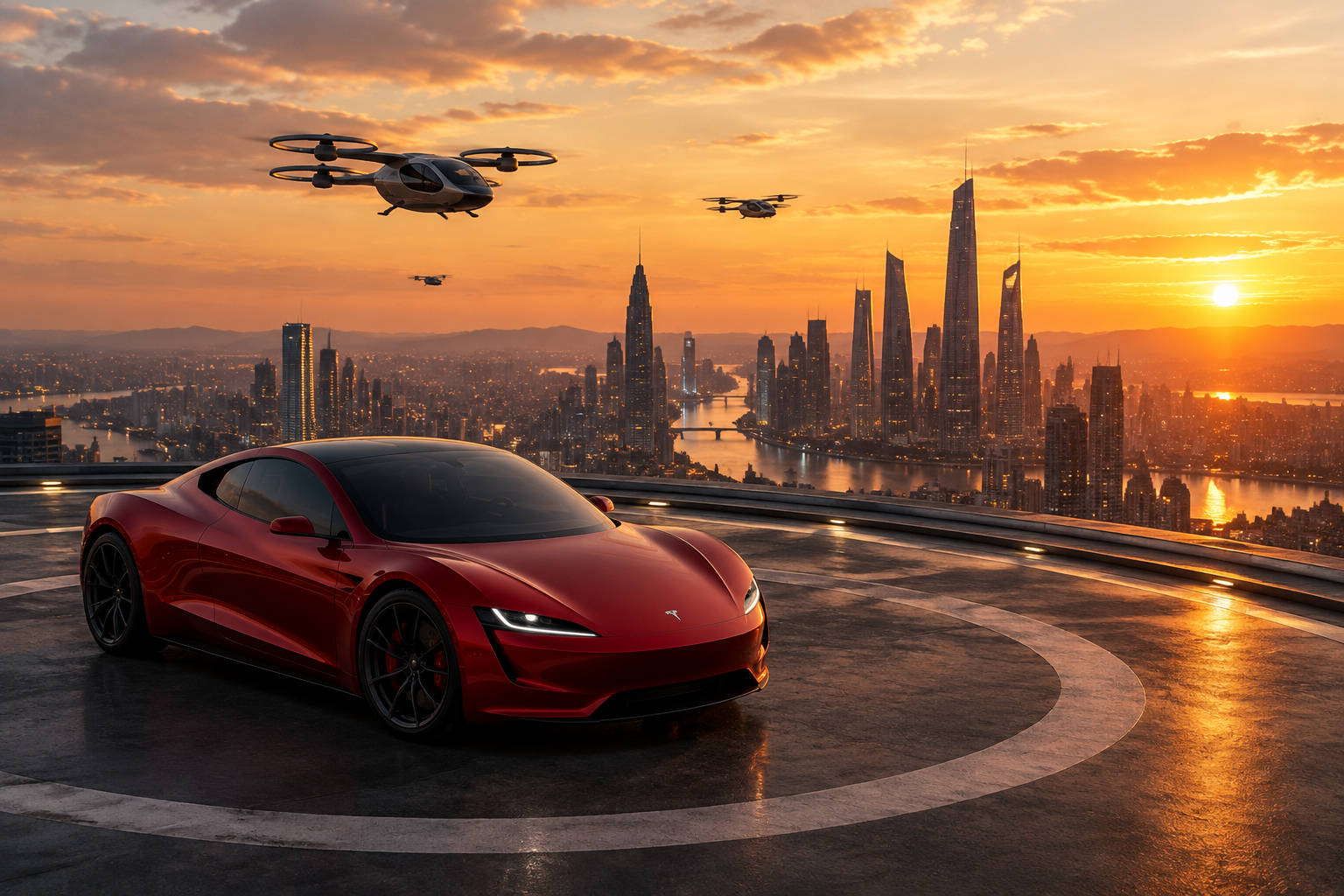
Despite this pivot, the Roadster’s aspirational messaging never truly disappeared from public consciousness. The image of a sleek electric car soaring above city skylines became synonymous with futuristic transportation, creating a cultural touchstone that would define the entire aerial mobility sector for years to come. Musk’s vision, while unfulfilled in its literal sense, established a powerful cultural narrative that flying vehicles were not merely science fiction but inevitable evolution.
The revelation that the Roadster didn’t actually fly might have been a moment of deflation for the industry, but timing proved crucial. By the time the truth emerged, dozens of legitimate eVTOL startups had already attracted billions in venture capital, federal backing, and regulatory attention. The Roadster’s failure to deliver flight capability didn’t kill the dream—it redirected it toward companies with more grounded (yet still ambitious) engineering approaches.
From Concept to Real eVTOL Development
The personal air mobility industry has matured dramatically since the Roadster’s initial announcement. Today, companies like Joby Aviation, Lilium, Archer Aviation, and others are developing certified aircraft with realistic performance specifications, regulatory pathways, and commercial timelines. These vehicles are purpose-built for urban air mobility (UAM) rather than attempting to combine ground and air capabilities in a single platform.
What Musk’s Roadster inadvertently accomplished was creating market awareness and investor appetite for flying vehicle technologies. When venture capitalists and government agencies began evaluating eVTOL startups, they did so within a landscape already primed by years of Roadster coverage and public fascination. The concept, even in its imperfect form, had normalized the idea that personal air vehicles could transition from fantasy to fact within a generation.
The distinction between Musk’s approach and modern eVTOL developers highlights an important evolution: successful flying cars are likely to be purpose-built aircraft, not enhanced sedans. Companies now focus on electric propulsion systems, distributed electric vertical takeoff technology, autonomous flight capabilities, and seamless integration with existing transportation networks. The engineering is fundamentally different from Musk’s vision, but the cultural permission structure—granted partly by the Roadster’s cultural impact—enables their development.
Regulatory and Investment Momentum
The FAA and international aviation authorities have accelerated certification pathways for eVTOL aircraft in recent years, responding to genuine technological progress and demonstrated investor confidence. This regulatory momentum would have been difficult to achieve without the public familiarity and political support generated by high-profile figures like Musk promoting the concept of flying vehicles. Government officials were already comfortable with the idea when serious manufacturers arrived at their doors.
Investment in personal air mobility has reached unprecedented levels, with billions flowing into eVTOL development, charging infrastructure, vertiport construction, and autonomous flight systems. This capital influx accelerated after the Roadster became cultural shorthand for “the flying car future,” making it easier for startups to raise Series A and Series B funding. Investors could reference public awareness of flying vehicles as evidence of market potential, even if that awareness originated from an unfulfilled concept vehicle.
Insurance, manufacturing partnerships, and supply chain development have all benefited from the normalized discourse around flying vehicles. When suppliers began developing specialized batteries, electric motors, and structural materials for eVTOL aircraft, they did so in a market landscape already conditioned by years of mainstream media coverage. The Roadster’s cultural footprint created the economic conditions necessary for genuine innovation to flourish.
The Psychology of Aspirational Technology
Musk’s genius, whether intentional or not, was understanding that public enthusiasm for transformative technology doesn’t require immediate delivery. The Roadster functioned as a cultural artifact that kept flying vehicles in the public imagination, maintaining interest across multiple election cycles, technology trends, and market downturns. This persistent cultural presence proved invaluable to legitimate eVTOL companies seeking to attract talent, capital, and regulatory attention.
The gap between Musk’s promise and actual delivery reveals something important about innovation ecosystems: aspirational visions can accelerate practical progress by reshaping what people believe is possible. Engineers and entrepreneurs working on real eVTOL systems were inspired by the same cultural narratives that captivated the public. The Roadster created a gravitational field of expectation around flying vehicles that attracted the best talent and capital to the sector.
Furthermore, the Roadster’s failure to achieve sustained flight actually enhanced its utility as a strategic concept. By remaining perpetually “just around the corner” rather than succeeding or decisively failing, it maintained indefinite cultural relevance. Each new eVTOL certification milestone became a step toward fulfilling the original Roadster vision, allowing companies and regulators to present their work as bringing Musk’s dream closer to reality—even as they pursued fundamentally different technological approaches.
The Path Forward for Urban Air Mobility
The 2020s are witnessing the convergence of technologies, regulations, and market forces that could finally deliver operational flying vehicles to urban environments. Joby Aviation, scheduled for commercial operations by 2025-2026, represents perhaps the most concrete manifestation of the eVTOL dream. Lilium’s electric jets and Archer’s urban aircraft development demonstrate that multiple viable technological approaches exist, each solving the flying car problem in different ways.
These systems will likely not resemble Musk’s Roadster—they’ll be purpose-built air vehicles, separate from ground transportation, operating in dedicated urban airspace corridors. Yet their success remains inextricably connected to the cultural narrative that the Roadster established. When the first commercial eVTOL flights commence, they’ll represent the fulfillment of a vision that Musk articulated, even if his particular technical approach proved impractical.
The irony is profound: Musk’s flying Roadster couldn’t fly, yet it may have accomplished more for aviation innovation than many successful technologies. By capturing imagination and commanding media attention, the Roadster created a cultural and economic environment in which real flying vehicles could develop. The companies that succeed in bringing aerial mobility to cities will owe an unacknowledged debt to a vehicle that never left the ground but inspired an entire industry to aim higher.
Key Takeaways for the eVTOL Industry
- Musk’s Roadster never achieved flight, but its cultural impact legitimized the entire flying vehicle concept, attracting billions in venture capital and regulatory attention to genuine eVTOL developers.
- Real-world eVTOL aircraft are purpose-built air vehicles with regulatory pathways, not enhanced ground cars, representing a fundamentally different engineering approach than the Roadster concept.
- The aspirational nature of the Roadster vision—remaining perpetually “in development”—maintained persistent public interest that accelerated investment, talent recruitment, and policy support for operational UAM systems launching in the mid-2020s.
The lesson from Musk’s Roadster is that transformative innovation doesn’t always follow linear paths. Sometimes the most valuable contribution is not the product itself, but the cultural permission structure it creates for others to build. As eVTOL companies approach commercial operations in major cities worldwide, they’ll be operating in a landscape fundamentally shaped by the vision of a flying car that never quite achieved flight—yet inspired an industry that will.