HIGHLIGHTS
- Skyfly secures $10 million in Series funding to accelerate development and commercialization of personal vertical flight technology.
- British eVTOL manufacturer aims to bring affordable, sustainable urban air mobility solutions to consumers within the next 18-24 months.
- Funding milestone positions Skyfly as a key player in the emerging personal air mobility market, enabling regulatory compliance and infrastructure partnerships.
British eVTOL innovator Skyfly has announced a major funding victory, securing $10 million to accelerate the development and commercialization of its revolutionary personal vertical flight platform. This significant capital injection marks a pivotal moment for the emerging personal air mobility sector, demonstrating growing investor confidence in electric vertical takeoff and landing technology. The funding will enable Skyfly to move from prototype development into full-scale production, regulatory certification, and market launch—positioning the company at the forefront of the urban air mobility revolution.
Skyfly’s Vision for Personal Air Mobility
Skyfly has built its reputation on a bold premise: personal vertical flight should be accessible, affordable, and sustainable for everyday travelers. The company’s innovative eVTOL platform combines advanced electric propulsion systems, autonomous flight capabilities, and passenger-centric design to create a vehicle that is fundamentally different from traditional helicopters or larger air taxi solutions. By focusing on the personal mobility segment, Skyfly targets a market that extends beyond ride-sharing services to include business travel, emergency medical transport, and leisure experiences.
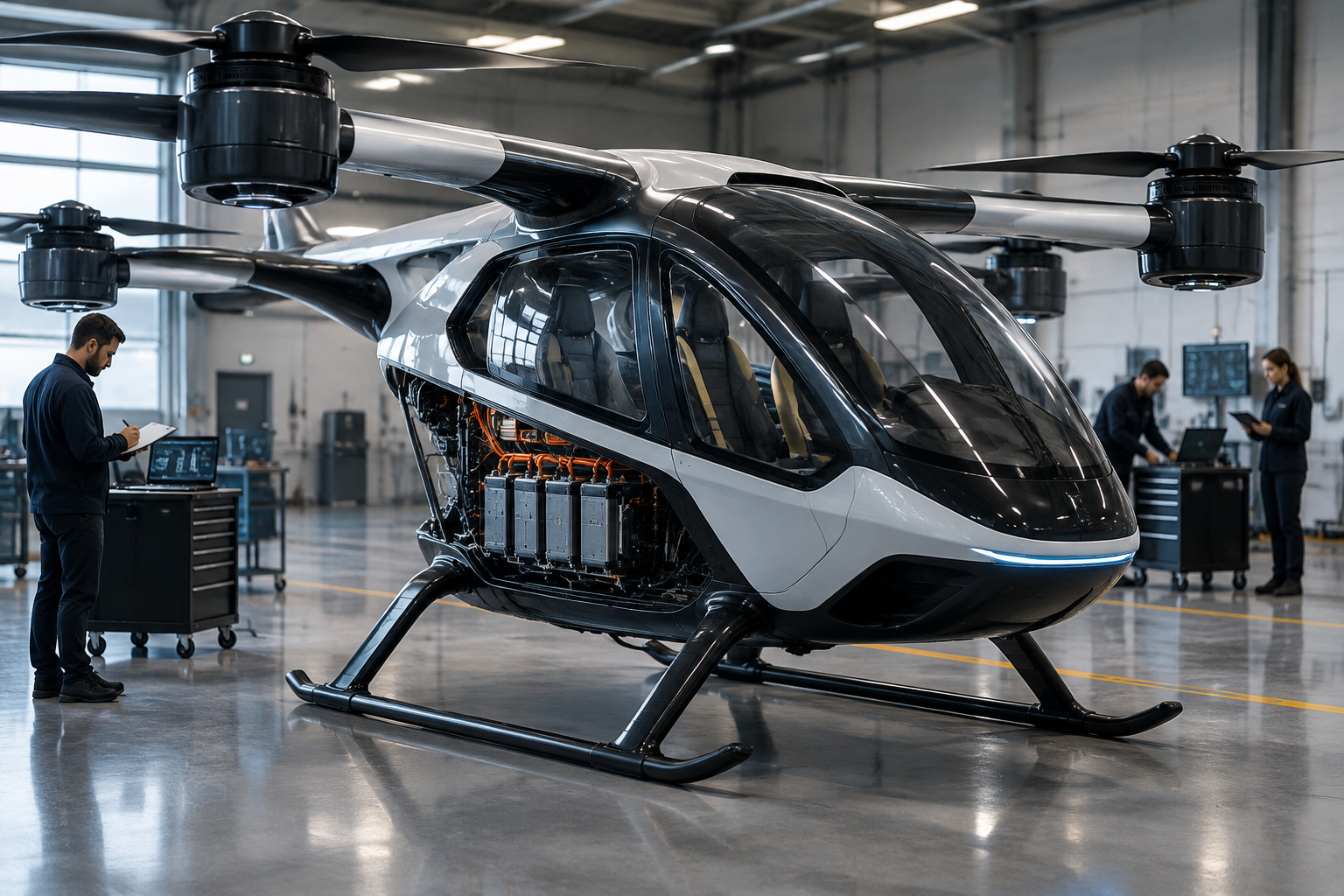
The company’s engineering team has spent years refining the technical architecture that makes personal vertical flight practical. Their platform features distributed electric motors, advanced battery management systems, and AI-assisted flight control that reduces pilot workload while maintaining safety as the paramount concern. The aerodynamic design balances efficiency with stability, allowing the Skyfly aircraft to achieve impressive range and payload capacity relative to its compact footprint.
What sets Skyfly apart is its integrated approach to the air mobility ecosystem. Rather than viewing the aircraft in isolation, the company has designed supporting infrastructure, digital platforms, and operational frameworks that enable seamless integration into urban environments. This holistic strategy addresses not just the hardware challenge, but the complex regulatory, logistical, and user experience requirements that will determine success in the personal air mobility market.
Strategic Impact of the $10 Million Funding Round
The $10 million funding announcement represents more than a simple capital injection—it validates the technical viability and market potential of Skyfly’s approach while providing the resources necessary to achieve critical milestones. These funds will be strategically allocated across multiple development and commercialization workstreams, accelerating the path from advanced prototype to certified, production-ready aircraft. Key allocation areas include completing the certification testing program, establishing manufacturing partnerships, scaling the production supply chain, and expanding the regulatory affairs team.
With adequate capitalization, Skyfly can now pursue parallel development tracks that were previously sequential constraints. The company will advance final aircraft testing while simultaneously engaging with aviation authorities in the UK, Europe, and other key markets to establish certification pathways. This parallel approach compresses the traditional development timeline, potentially bringing the first Skyfly aircraft to commercial operation 12-18 months ahead of previous projections.
The funding also strengthens Skyfly’s position for future capital rounds. Successfully deploying $10 million toward demonstrable progress—whether through regulatory approvals, production milestones, or commercial partnerships—will create compelling evidence for Series B investors. The British eVTOL sector is garnering increased international attention, and Skyfly’s momentum positions it to attract premium valuations and strategic partners from the aerospace, automotive, and technology sectors.
Technical Excellence and Innovation Pipeline
Skyfly’s engineering foundation reflects years of research into the fundamental challenges of personal vertical flight. The company’s aircraft architecture incorporates redundant systems for critical functions, including power generation, propulsion control, and flight management. Electric propulsion offers inherent advantages over combustion engines for urban operations—reduced noise signatures, zero direct emissions, lower vibration, and simplified mechanical systems that enhance reliability.
The current development aircraft demonstrates impressive performance characteristics, including vertical takeoff and landing, efficient forward flight, and extended range capabilities. Battery technology represents one of the most actively managed development variables, with Skyfly continuously evaluating new cell chemistries, pack configurations, and thermal management strategies. The company is positioned to benefit from ongoing improvements in lithium-ion and next-generation battery technologies that will steadily enhance payload capacity and range.
Beyond the core aircraft platform, Skyfly is developing proprietary software systems for mission planning, traffic management integration, and autonomous flight assistance. These digital systems will enable safe operation in increasingly complex urban airspace, supporting the distributed air mobility vision where multiple aircraft operate simultaneously with minimal pilot workload. The software development pipeline includes machine learning algorithms trained on simulated scenarios and flight test data, continuously improving system performance and safety margins.
Regulatory Pathway and Market Timing
The regulatory environment for eVTOL aircraft has matured significantly, with established certification frameworks now in place across major aviation authorities. The UK Civil Aviation Authority (CAA), European Union Aviation Safety Agency (EASA), and the U.S. Federal Aviation Administration (FAA) have all published special conditions and certification specifications tailored to electric and autonomous aircraft. Skyfly’s engagement with these bodies has positioned the company to leverage these frameworks efficiently, reducing uncertainty and accelerating the certification process.
Market timing is critical for Skyfly’s success, as the personal air mobility sector is expected to reach inflection point between 2027 and 2029. Early movers who achieve certification and secure initial customer agreements will establish brand presence, operational experience, and supply chain advantages that compound over time. The $10 million funding provides the resources necessary to position Skyfly as a first-mover in key markets, particularly in the UK and Europe where the regulatory environment is increasingly supportive.
Skyfly is actively exploring commercial partnerships with aviation services operators, urban air mobility platforms, and tourism companies that are eager to offer personal vertical flight experiences. These partnerships will provide early revenue streams and operational data that validate the commercial model while reducing financial risk. The company’s business strategy balances rapid market entry with long-term profitability, focusing on high-value applications where customers perceive clear benefits over traditional transportation.
The Broader eVTOL Investment Landscape
Skyfly’s funding success occurs within a broader context of increasing investment in eVTOL and advanced air mobility technologies. The global venture capital and strategic investment communities recognize the transformative potential of personal vertical flight, viewing it as a multi-hundred-billion-dollar market opportunity. Funding levels across the eVTOL sector have accelerated dramatically since 2024, with both traditional aerospace investors and new technology-focused firms deploying capital toward promising platforms.
Competition in the personal air mobility segment is intensifying, with numerous startups and established aerospace companies racing to achieve first-mover advantage. However, the market is sufficiently large that multiple successful competitors can coexist, serving different customer segments and geographic markets. Skyfly’s British heritage and European focus position it distinctly relative to other eVTOL developers, capturing the substantial European demand for urban air mobility solutions while pursuing selective international expansion.
The investment community views capital deployment in companies like Skyfly as essential infrastructure for the transportation transformation of the 21st century. Just as automotive electrification attracted unprecedented venture and strategic investment, personal air mobility is drawing commitment from forward-thinking investors who recognize that the future of urban transportation will be fundamentally three-dimensional. Skyfly’s $10 million milestone contributes to the growing momentum that will ultimately make personal vertical flight a commonplace reality.
Key Takeaways: What This Means for the Industry
- Skyfly’s $10M funding validates the commercial viability of personal eVTOL platforms and accelerates the timeline toward operational service launch.
- The capital enables simultaneous progress across aircraft certification, manufacturing scale-up, and commercial partnership development—compressing traditional development cycles.
- Skyfly’s success positions British eVTOL technology as a globally competitive force, with potential to capture significant market share in the emerging personal air mobility ecosystem.
The future of urban air mobility is taking shape, and Skyfly is positioning itself as a central player in that transformation. With $10 million in newly secured funding, the British eVTOL innovator has the resources, momentum, and technical foundation to bring personal vertical flight from concept to commercial reality. As the company advances through development milestones and regulatory certification processes, the entire air mobility ecosystem will benefit from validated operational models, infrastructure development, and market education that paves the way for broader adoption. Skyfly’s journey toward the sky is accelerating—and the transportation revolution is closer than we think.