HIGHLIGHTS
- Transportation Secretary Sean P. Duffy unveils New Mexico as the nation’s first formally designated advanced air mobility hub under Trump administration support
- FAA regulatory frameworks enable streamlined Part 135 commercial operations and advanced airspace management for mixed eVTOL, fixed-wing, and helicopter traffic
- Initiative projects thousands of high-skilled jobs in eVTOL manufacturing, maintenance, pilot training, and vertiport operations across New Mexico
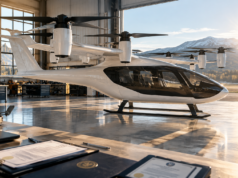
In a significant policy announcement, Transportation Secretary Sean P. Duffy has unveiled New Mexico’s first advanced air mobility initiative, marking a pivotal moment for vertical takeoff and landing (eVTOL) aircraft adoption in the Southwest United States. The announcement, made under the Trump administration’s broader transportation modernization agenda, signals accelerated federal support for emerging aerial mobility technologies and infrastructure development in the region.
New Mexico Positioned as eVTOL Hub
The Trump administration’s transportation strategy places New Mexico at the forefront of American air mobility innovation. Secretary Duffy’s announcement reflects the federal government’s commitment to diversifying transportation corridors beyond traditional aviation networks. This initiative opens substantial opportunities for New Mexico to establish itself as a testing ground and operational base for commercial eVTOL services.
The state’s geographic advantages—including clear skies, established aerospace manufacturing heritage, and proximity to major population centers—make it an ideal location for advanced air mobility deployment. New Mexico’s existing infrastructure relationships with NASA, the Air Force, and private aerospace contractors create a supportive ecosystem for rapid technology integration and certification processes.
By positioning the state as an eVTOL pioneer, the administration aims to attract investment, create high-skilled jobs, and establish regulatory frameworks that other states can replicate. This approach aligns with broader economic development goals while advancing transportation modernization objectives.
FAA Regulatory Framework Supporting the Initiative
The Federal Aviation Administration plays a central role in enabling New Mexico’s eVTOL development through streamlined certification and operational approval processes. The FAA’s recent regulatory guidance has created pathways for Part 135 commercial operations, allowing eVTOL operators to conduct passenger and cargo services under defined parameters. Secretary Duffy’s announcement likely coordinates with FAA initiatives to expedite Part 141 pilot training certifications specific to electric vertical takeoff aircraft.
New airspace management protocols tailored to mixed operations—combining traditional fixed-wing aircraft, helicopters, and eVTOLs—represent a critical infrastructure component. The FAA has been developing traffic management systems that enable safe, efficient integration of autonomous and piloted air vehicles. New Mexico’s initiative will likely serve as a testbed for these advanced airspace management technologies before nationwide scaling.
Regulatory certainty is essential for commercial operators, manufacturers, and infrastructure investors. The administration’s formal announcement suggests coordinated FAA rulemaking for battery safety standards, noise compliance zones, and operational boundaries specific to urban and rural eVTOL corridors. This regulatory clarity accelerates investment decisions and accelerates the timeline from prototype to revenue-generating operations.
Economic Impact and Job Creation
The advanced air mobility sector represents a multi-billion-dollar economic opportunity with substantial employment implications. New Mexico’s initiative is positioned to attract manufacturing facilities, maintenance hubs, pilot training centers, and design engineering operations. Industry estimates suggest that a mature eVTOL ecosystem generates 10-15 jobs per aircraft in manufacturing, operations, maintenance, and support services.
Secretary Duffy’s announcement emphasizes workforce development partnerships with New Mexico’s educational institutions and regional community colleges. eVTOL operations require specialized technicians trained in battery systems, electric propulsion, composite materials, and advanced avionics. These are high-wage positions that strengthen regional economic resilience and provide career pathways for workers transitioning from traditional aviation sectors.
Infrastructure investments in vertiports, charging stations, and ground support facilities represent another economic multiplier. Construction, engineering, electrical work, and security positions generate immediate employment while building long-term operational capacity. Real estate values around designated urban air mobility zones are expected to appreciate, stimulating commercial development and tax base expansion.
Strategic Implications for American Air Mobility Leadership
The Trump administration’s explicit focus on eVTOL development reflects competitive concerns about international air mobility markets. China and European nations have accelerated eVTOL programs with government backing. By directing federal resources toward New Mexico’s initiative, the administration signals commitment to maintaining American technological leadership in personal and regional air mobility.
This strategy also supports domestic aircraft manufacturers competing against foreign competitors. Companies developing electric propulsion systems, battery technologies, and lightweight composite structures benefit from government support, reducing capital constraints and accelerating time-to-market. The regulatory environment created by this initiative provides American manufacturers with operational advantages and market certainty.
New Mexico’s emergence as an eVTOL pioneer creates demonstration effects across the nation. Successful operations, safety records, and profitability in the state encourage similar initiatives in California, Texas, Florida, and the Northeast Corridor. This cascading effect could establish the United States as the global leader in advanced air mobility commercialization by the early 2030s.
Key Takeaways from Secretary Duffy’s Announcement
- Trump administration formally positions New Mexico as America’s first advanced air mobility hub with FAA regulatory support and federal infrastructure coordination
- Streamlined certification pathways and airspace management systems enable rapid transition from eVTOL testing to commercial passenger and cargo operations
- Initiative is projected to generate thousands of high-skilled jobs across manufacturing, maintenance, pilot training, and vertiport operations while strengthening American global competitiveness
Secretary Sean P. Duffy’s announcement of New Mexico’s advanced air mobility initiative represents a watershed moment for American eVTOL commercialization. By combining federal regulatory support, infrastructure investment, and workforce development, the Trump administration is creating conditions for rapid scaling of electric vertical takeoff aircraft operations. New Mexico’s geographic advantages, aerospace heritage, and FAA coordination position the state to become a proving ground for sustainable, efficient urban and regional air mobility. As the nation’s first formally designated eVTOL hub, New Mexico will demonstrate the feasibility, safety, and economic viability of advanced air mobility systems, paving the way for nationwide adoption and establishing American leadership in this transformative transportation sector.