
HIGHLIGHTS
- EHang partners with Sri Lanka’s aviation authority to develop regulatory frameworks for fully autonomous eVTOL operations without pilots onboard.
- This initiative positions Sri Lanka as a regional leader in air mobility innovation and governance in South Asia.
- Pilotless eVTOL services could revolutionize urban transportation and logistics across the Indian subcontinent within the next decade.
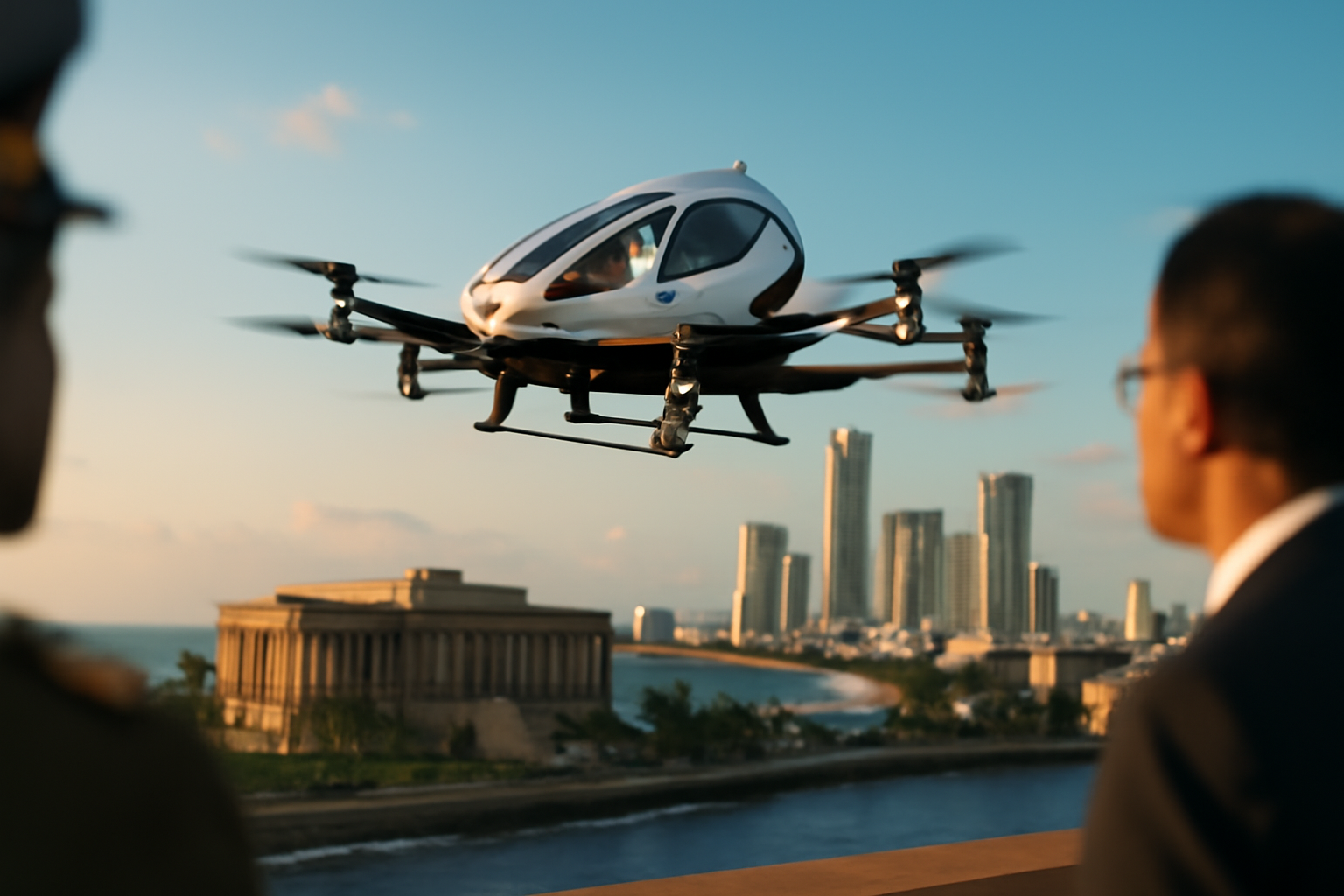
In a landmark development for the personal air mobility sector, Chinese eVTOL manufacturer EHang and the government of Sri Lanka have announced a collaborative initiative to explore and establish regulatory frameworks for pilotless electric vertical takeoff and landing aircraft. This partnership represents a significant milestone in advancing autonomous air mobility services beyond traditional crewed operations, opening new possibilities for commercial and public transportation across South Asia and the Indian Ocean region.
EHang’s Push Into Autonomous Operations
EHang has emerged as one of the world’s leading companies in autonomous eVTOL technology, with extensive experience operating pilotless aerial vehicles in controlled environments across China and Southeast Asia. The company’s EH216 and EH216-S platforms have already demonstrated successful autonomous flight capabilities, carrying passengers safely without pilots in the cockpit. This proven track record positioned EHang as an ideal partner for Sri Lanka’s regulators seeking to understand the technical and operational requirements of pilotless air mobility services.
The collaboration focuses on developing comprehensive safety standards, operational protocols, and certification frameworks that would govern how autonomous eVTOL aircraft can legally operate in Sri Lankan airspace. Rather than adopting existing aviation regulations designed for traditional crewed aircraft, both parties recognize the need for purpose-built governance structures tailored to the unique characteristics of autonomous electric aircraft. This approach has become increasingly common globally, as regulators acknowledge that pilotless operations present distinct challenges and opportunities compared to conventional aviation.
EHang’s involvement brings technical expertise, flight demonstration capabilities, and real-world operational data that can inform regulatory decision-making. The company can provide evidence-based insights into how autonomous systems perform in various weather conditions, traffic scenarios, and emergency situations—crucial information for building public confidence and establishing safety baselines.
Sri Lanka’s Strategic Interest in Air Mobility
Sri Lanka’s government recognizes that pioneering advanced transportation technologies could provide significant economic and infrastructure benefits to the island nation. As an island developing economy with growing urbanization pressures and emerging logistics demands, pilotless eVTOL services could address critical gaps in last-mile connectivity, medical supply delivery, and urban congestion management. The nation’s position as a major hub for regional trade makes it an attractive testbed for innovations that could eventually scale across South Asia.
By proactively engaging with EHang and developing regulatory frameworks now, Sri Lanka positions itself ahead of competitors like India, Thailand, and Indonesia in the emerging air mobility sector. Becoming an early adopter of autonomous eVTOL regulations could attract investment, talent, and manufacturing opportunities to the country. Additionally, successful pilotless operations in Sri Lanka could establish the nation as a trusted testing ground for other companies developing autonomous aviation technologies.
Sri Lanka’s aviation authority has demonstrated sophistication in understanding the regulatory challenges ahead. Rather than attempting to rapidly approve operations or impose overly restrictive blanket bans, the government is taking a collaborative, evidence-based approach that allows for thorough technical review while maintaining regulatory agility. This balanced stance has become the gold standard for forward-thinking aviation regulators worldwide.
The Regulatory Framework Challenge
Establishing regulations for pilotless eVTOL services requires addressing several complex technical and operational questions. How should airspace be managed when hundreds or thousands of autonomous aircraft operate simultaneously in urban areas? What redundancy and failsafe systems are necessary to ensure that communication losses or system malfunctions don’t result in catastrophic outcomes? How should liability be assigned when an autonomous aircraft causes damage or injury—to the manufacturer, operator, or government regulator? These questions don’t have simple answers, and different jurisdictions are exploring different approaches.
The EHang-Sri Lanka partnership will need to define minimum technical standards for autonomous flight control systems, including requirements for redundant sensors, encrypted communications, and automated contingency response protocols. The framework must also establish operator certification requirements, though these will differ significantly from pilot licensing since human operators won’t be directly controlling the aircraft during flight. Training and qualification standards will instead focus on fleet management, emergency response, and system monitoring capabilities.
Insurance and liability frameworks also require careful consideration. Unlike traditional aviation where pilot licenses and airline certifications provide clear accountability chains, autonomous operations involve multiple stakeholders—the aircraft manufacturer, the operating company, the software developer, and potentially the regulator itself. Sri Lanka’s regulatory framework will need to clarify these liability boundaries in ways that are both fair and encourage safe operation.
Regional Impact and Market Potential
South Asia represents one of the world’s fastest-growing urban regions, with cities like Mumbai, Delhi, Dhaka, and Colombo facing severe traffic congestion and last-mile delivery challenges. The region’s growing middle class and digital infrastructure adoption create favorable conditions for advanced mobility services. If EHang and Sri Lanka successfully establish a regulatory model that other South Asian nations adopt, the market opportunity could encompass hundreds of millions of potential passengers and valuable cargo routes.
Medical supply delivery represents a particularly compelling use case in South Asia’s context. Rural areas in Sri Lanka, India, and other regional nations often lack adequate healthcare infrastructure, with critical medications and blood products difficult to deliver quickly due to road conditions and distance. Autonomous eVTOL services could reduce delivery times from hours to minutes, potentially saving lives in emergency situations. This humanitarian angle may prove important for public acceptance and regulatory approval.
Logistics and e-commerce parcel delivery offer another substantial market segment. As digital commerce continues expanding rapidly across South Asia, companies like Amazon, Flipkart, and regional players are seeking faster, more efficient last-mile delivery solutions. Autonomous eVTOL fleets operated at scale could significantly reduce delivery costs while improving speed and reliability compared to ground transportation, especially in congested urban areas.
Key Considerations for Pilotless eVTOL Success
- Public Trust & Safety Perception: Successfully demonstrating autonomous operations in real-world conditions is essential for building public confidence. Sri Lanka’s regulatory approach should include transparent safety data sharing and community education initiatives.
- Airspace Integration: Establishing clear protocols for how autonomous eVTOLs interact with manned aviation, drones, and traditional helicopter services is critical for operational viability and safety as traffic density increases.
- Cybersecurity & System Resilience: Pilotless aircraft require exceptionally robust protections against communication jamming, GPS spoofing, and software attacks—regulatory frameworks must mandate redundant, separated control systems and continuous security monitoring.
- Infrastructure Requirements: Successful autonomous eVTOL operations will require significant ground infrastructure including charging networks, traffic management systems, and emergency response capabilities—regulatory frameworks should address these prerequisites.
- Environmental Impact: While eVTOL aircraft produce zero emissions during flight, electricity sources matter significantly for overall environmental benefit; regulations should consider how operations integrate with renewable energy infrastructure.
Global Context and Competitive Landscape
EHang’s partnership with Sri Lanka reflects broader competitive dynamics in the eVTOL sector. While American companies like Joby Aviation and Archer focus primarily on regulated markets in North America, and European manufacturers develop solutions aligned with European Aviation Safety Agency requirements, Chinese companies including EHang and others are actively seeking to establish leadership in emerging markets. The strategy of partnering with forward-thinking regulators in developing nations allows Chinese manufacturers to validate technologies and build market presence while Western competitors remain focused on their home markets.
This regulatory arbitrage pattern has historical precedent. China’s early embrace of mobile payments and digital commerce adoption created different regulatory and market conditions than Western nations experienced, allowing domestic companies to build advantages in those sectors. The EHang-Sri Lanka partnership may follow a similar trajectory, where pioneering autonomous eVTOL operations in an early-adopting nation could establish technological and regulatory precedents that favor the first mover.
Other nations in Asia-Pacific, particularly Singapore, Japan, and Australia, are also actively developing eVTOL regulations, but most remain focused on crewed electric aircraft at this stage. Sri Lanka’s explicit focus on pilotless operations represents a more aggressive regulatory posture than most developed nations have yet undertaken, reflecting the country’s willingness to embrace innovation and potentially leapfrog traditional transportation solutions.
The success or failure of the EHang-Sri Lanka initiative will have implications far beyond South Asia. Successful pilotless eVTOL operations could accelerate regulatory approval timelines in other nations, while accidents or safety incidents could trigger more conservative regulatory approaches globally. For EHang and other manufacturers, establishing a positive operational track record in Sri Lanka is therefore strategically invaluable.
Timeline and Implementation Outlook
The exact timeline for implementing pilotless eVTOL services in Sri Lanka remains unspecified, but international experience suggests regulatory development typically requires 2-4 years from initial partnership to first commercial operations. During this period, the partners will likely conduct extensive flight demonstrations, develop detailed technical standards, establish training programs for operators, and create public education campaigns. Early phases may involve limited operations under special authorization, gradually expanding as safety records establish confidence in autonomous systems.
The regulatory framework development process will likely follow phases: conceptual documentation and safety case development, followed by technical standards definition, operator certification scheme creation, and finally field trials under controlled conditions. Each phase requires stakeholder input from aviation authorities, manufacturers, insurance companies, and potentially environmental and urban planning agencies. Sri Lanka’s relatively modest air traffic volume compared to major global hubs may actually accelerate this process, as complexity and risk management requirements are somewhat lower in less congested airspace.
Success will require sustained political commitment and funding throughout the development process. As regulations are drafted, both EHang and Sri Lanka’s aviation authority will face pressure from various constituencies—safety advocates demanding extensive testing, commercial operators seeking rapid approval, and aviation labor unions concerned about employment impacts. Navigating these pressures while maintaining a credible regulatory approach will test Sri Lanka’s governance capacity.
Implications for the Global eVTOL Industry
The EHang-Sri Lanka partnership sends a clear signal to the global personal air mobility industry that autonomous aircraft operations are transitioning from theoretical possibility to regulatory reality. This development may accelerate investment in autonomous eVTOL companies and encourage other manufacturers to pursue similar regulatory partnerships in emerging markets. For investors, the Sri Lankan initiative represents tangible progress toward commercial viability of pilotless electric aircraft, potentially justifying higher valuations and supporting additional funding rounds.
The partnership also highlights how regulatory frameworks will emerge not from a single global standard-setter, but through multiple jurisdictions pioneering different approaches. Just as aviation evolved through bilateral air agreements and regional regulatory coordination, eVTOL governance will likely develop through a network of national frameworks that gradually harmonize around proven safety practices. Sri Lanka’s role in this evolutionary process may prove historically significant for the industry.
Perhaps most importantly, the collaboration demonstrates that pilotless air mobility services are not merely futuristic speculation—they represent near-term possibilities that responsible governments and manufacturers can begin implementing today. For a sector that has faced repeated promises of commercial service followed by delayed timelines, this concrete regulatory partnership provides tangible evidence of progress toward actual deployment of autonomous aircraft serving real passengers and cargo needs.
As the EHang-Sri Lanka initiative advances, aviation professionals, investors, and urban planners worldwide will be watching closely. Success could establish Sri Lanka as an unexpected leader in air mobility innovation and validate autonomous eVTOL technology for broader global adoption. For EHang, this partnership represents a critical opportunity to demonstrate that pilotless aircraft can operate safely, reliably, and effectively in real-world conditions—potentially opening massive market opportunities across South Asia and beyond.