HIGHLIGHTS
- Skye Air leverages proven drone delivery expertise and existing DGCA regulatory relationships to accelerate eVTOL certification in India
- Real-world operational data from drone operations provides critical intelligence on battery performance and efficiency specific to Indian airspace and climate
- Company positions itself to develop regionally-optimized eVTOL aircraft for emerging markets rather than importing premium aircraft designed for Western consumers
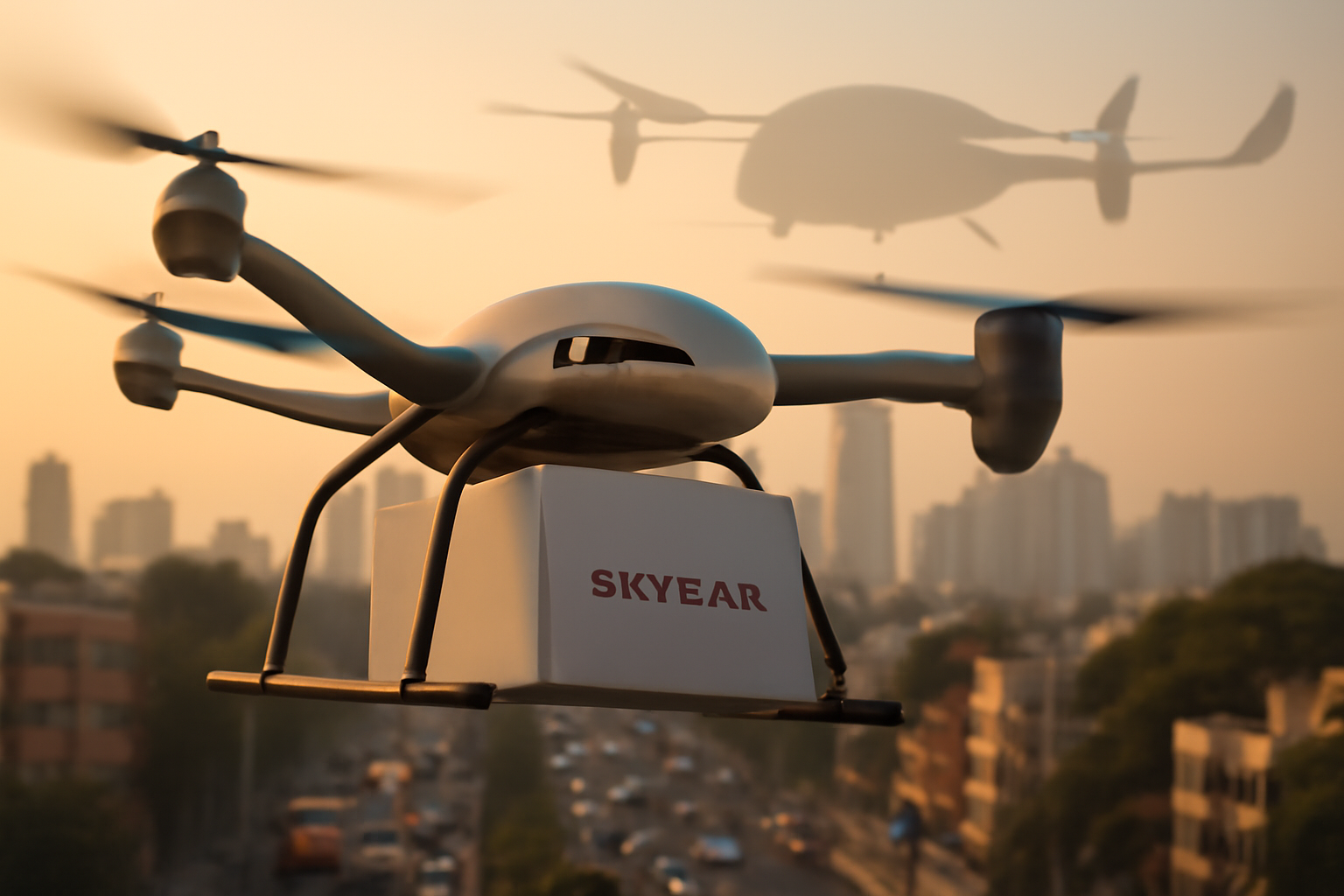
Skye Air, the Indian drone delivery innovator that has built a formidable reputation in autonomous logistics, is now pivoting its strategic focus toward electric vertical takeoff and landing (eVTOL) aircraft. This expansion marks a significant milestone for the company and signals a broader industry trend: successful drone delivery operators are leveraging their technical expertise and regulatory experience to enter the high-stakes world of passenger and cargo air mobility.
From Logistics to Urban Air Mobility: Skye Air’s Strategic Evolution
The progression from drone delivery to eVTOL represents a natural expansion for companies with deep expertise in autonomous flight systems, battery management, and airspace operations. Skye Air’s established track record in drone delivery across India has given the company invaluable insights into regulatory compliance, operational efficiency, and real-world flight challenges. These competencies directly transfer to eVTOL development, where similar technologies underpin passenger and cargo movements.
Skye Air’s vision extends beyond simply replicating existing eVTOL concepts. The company aims to develop aircraft tailored to India’s unique geography, urban density patterns, and regulatory environment. Rather than adopting one-size-fits-all solutions designed primarily for North American or European markets, Skye Air is positioning itself to create regionally optimized platforms that address specific pain points in Indian cities.
This strategy reflects a broader shift in the eVTOL industry. Early market leaders focused on developed nations with established aviation infrastructure, but companies like Skye Air recognize that emerging markets present enormous growth opportunities. India’s traffic congestion, rapidly expanding metropolitan areas, and tech-savvy consumer base create ideal conditions for urban air mobility adoption.
Building on Drone Delivery Expertise and Regulatory Leadership
Skye Air has already navigated India’s complex regulatory landscape with drone delivery operations, earning approvals from the Directorate General of Civil Aviation (DGCA). This regulatory experience is invaluable as the company pivots to eVTOL certification, as many of the frameworks, safety standards, and operational protocols overlap between unmanned and manned electric aircraft.
The company’s existing fleet of delivery drones has generated enormous data on battery performance, maintenance requirements, flight efficiency, and operational constraints specific to Indian airspace. This real-world operational intelligence significantly accelerates eVTOL development timelines compared to competitors starting from purely theoretical models. Skye Air can identify which design trade-offs work in practice and which theoretical optimizations fail in the field.
Furthermore, Skye Air’s relationships with Indian aviation authorities and its demonstrated commitment to safety standards position the company favorably for eVTOL certification. Early-stage operators that lack this credibility often face skepticism and protracted approval processes. Skye Air’s existing reputation shortens the pathway to market entry for passenger aircraft.
The Technical Foundation: From Unmanned to Manned Systems
Transitioning from autonomous delivery drones to piloted eVTOL aircraft requires significant technological adaptation, but the core competencies remain relevant. Battery chemistry, thermal management, structural design, and autonomous flight control systems developed for drones provide a foundation upon which eVTOL systems can be built. Skye Air’s engineering team possesses deep expertise in these domains.
The primary differences between the company’s drone delivery operations and future eVTOL aircraft involve scale, payload requirements, and redundancy systems. Passenger-carrying aircraft demand multiple backup power systems, collision avoidance technology, and fail-safe designs that exceed unmanned vehicle standards. However, these augmentations represent engineering extensions of existing capabilities rather than entirely novel problems.
Skye Air’s announced vision likely includes platforms capable of carrying multiple passengers or significant cargo loads over urban and regional routes. Early applications might focus on medical emergency transport, executive mobility, or high-value logistics corridors—niches where the premium pricing of eVTOL services finds justification.
Market Timing and Competitive Advantage in Emerging Markets
Skye Air’s entry into eVTOL development arrives at a pivotal industry moment. Global eVTOL startups have faced setbacks, regulatory delays, and capital constraints that have consolidated the market around a smaller number of well-funded competitors. This contraction creates an opening for regional specialists who understand local conditions and possess regulatory relationships.
India’s government has signaled strong interest in developing domestic aviation innovation as part of broader “Make in India” initiatives. Skye Air’s positioning as an Indian company with proven operational success gives it potential advantages in securing partnerships, regulatory support, and local investment compared to foreign competitors attempting market entry.
The company’s vision also reflects confidence that urban air mobility adoption in India will follow a different trajectory than Western markets. Rather than initially targeting affluent early adopters, Skye Air may develop scaled, efficient eVTOL platforms designed for middle-market pricing and high utilization rates. This approach could prove more commercially viable than premium-priced aircraft aimed at billionaires and luxury travel segments.
Key Factors Driving Skye Air’s eVTOL Expansion
- Established regulatory credibility and DGCA relationships earned through successful drone delivery operations in India
- Real-world operational data on battery performance, maintenance costs, and flight efficiency in Indian climate and airspace conditions
- Engineering expertise in autonomous systems, electric propulsion, and lightweight structures directly applicable to eVTOL certification
The expansion of Skye Air into eVTOL technology represents a maturation of the personal air mobility ecosystem. Companies that master drone delivery have already solved many foundational problems: they understand battery limitations, regulatory frameworks, operational safety, and customer integration. These companies are now in the ideal position to pioneer the next generation of air transportation. Skye Air’s vision signals that India will not remain a passive market for imported eVTOL solutions, but an active innovator developing aircraft for Asian cities and beyond.