HIGHLIGHTS
- Skyfly’s cargo variant extends range to 400 miles, enabling regional autonomous freight operations that previously required helicopter support or uneconomical ground transport.
- Converting the proven two-seat passenger eVTOL into a freighter accelerates regulatory certification by 18-24 months and reduces development costs by leveraging existing structural and propulsion validation data.
- Primary commercial applications target emergency medical delivery, remote industrial logistics, renewable energy component transport, and underserved rural communities across the UK and Europe.
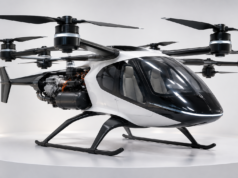
Skyfly, a British aircraft manufacturer, has announced a game-changing adaptation of its two-seat electric vertical takeoff and landing (eVTOL) aircraft: a conversion into a high-capacity cargo drone capable of undertaking 400-mile missions. This development marks a significant milestone in the evolution of autonomous aerial freight transport, bridging the gap between regional air mobility and dedicated logistics solutions. The transformation demonstrates how existing eVTOL platforms can be repurposed for commercial applications beyond passenger transport, opening new revenue streams and operational possibilities for the emerging urban air mobility sector.
Skyfly’s Strategic Pivot to Cargo Operations
Skyfly’s decision to convert its passenger-focused two-seat eVTOL into a cargo drone reflects broader industry trends toward maximizing aircraft utility and revenue potential. Rather than developing an entirely new airframe, the company leveraged its proven electric propulsion technology and structural design to create a freighter variant optimized for payload capacity. This approach reduces development costs, accelerates time-to-market, and capitalizes on regulatory certifications already in progress for the original passenger model, demonstrating smart engineering strategy in a capital-intensive industry.
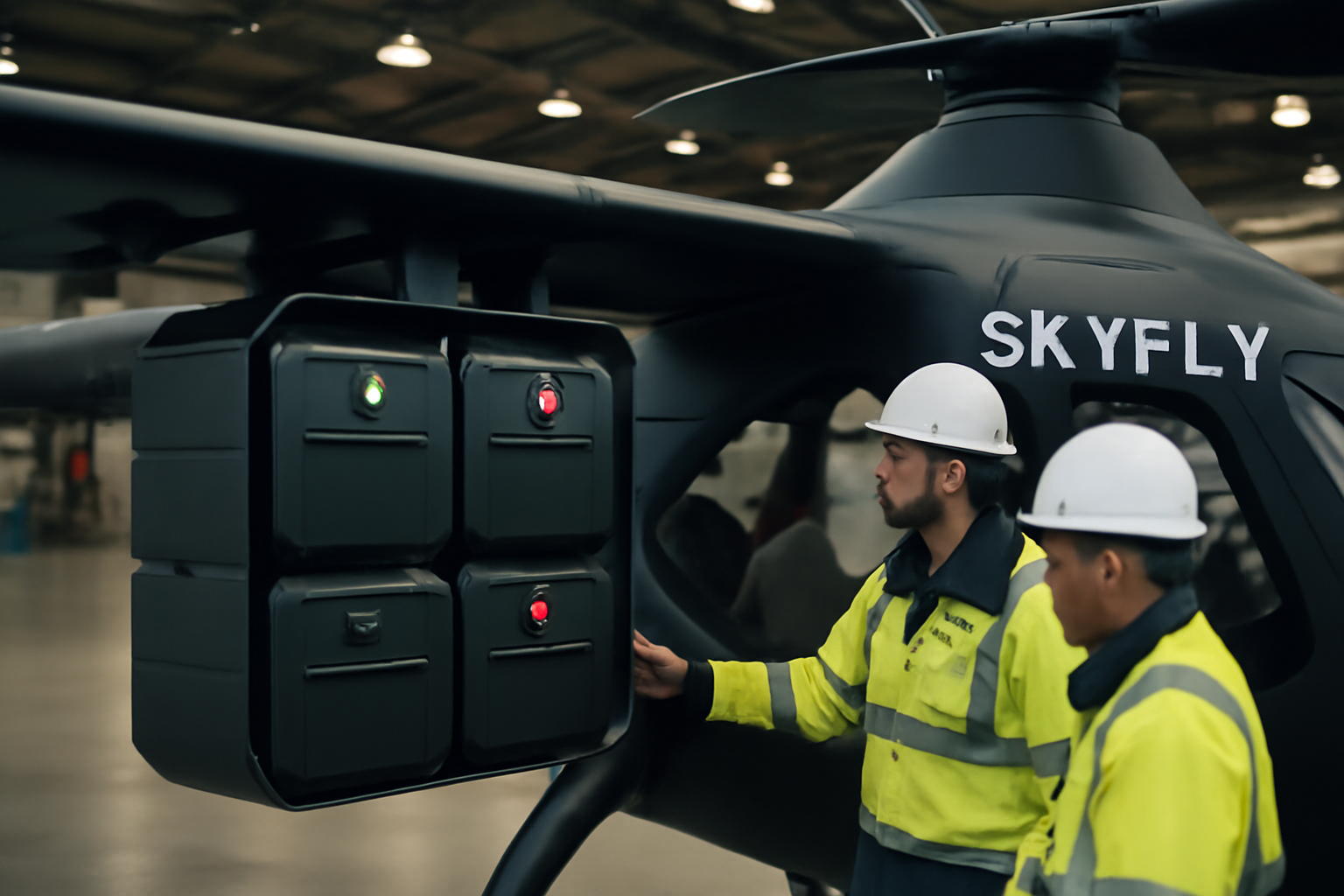
The cargo variant removes passenger accommodations and seats entirely, replacing them with modular cargo pods and enhanced battery systems designed specifically for freight transport. This weight redistribution and aerodynamic optimization enables the platform to achieve extended range capabilities that would be impossible in its original passenger configuration. Skyfly’s engineers have evidently prioritized range and payload efficiency over comfort and cockpit amenities, creating a purpose-built logistics aircraft that serves a distinct market segment.
This strategic diversification positions Skyfly to address multiple customer segments simultaneously: air taxi operators pursuing passenger revenue and logistics companies seeking beyond-visual-line-of-sight (BVLOS) autonomous delivery solutions. By offering both variants from a single core platform, Skyfly reduces manufacturing complexity, optimizes supply chain efficiency, and presents a flexible product portfolio to investors and potential customers. The dual-use approach also mitigates market risk, as early adopters in passenger services and freight logistics provide revenue while the UAM sector continues to mature.
400-Mile Range: Redefining Cargo Drone Capabilities
A 400-mile operational range fundamentally changes the economics and geography of autonomous aerial freight. Traditional cargo drones operate in tactical, short-range scenarios—typically 10 to 50 miles—serving last-mile delivery or isolated facility resupply. Skyfly’s extended-range platform enables regional courier operations, connecting distribution centers, remote research stations, and underserved communities across meaningful distances. This range capability rivals some traditional ground-based logistics routes, particularly in areas with challenging terrain or limited road infrastructure.
Achieving this extended range on an electric platform requires sophisticated battery management, aerodynamic efficiency, and propulsion system optimization. Skyfly’s designers likely incorporated lightweight composite structures, high-energy-density battery packs, and advanced motor controllers to maximize endurance. The 400-mile figure suggests a multi-hour flight duration—possibly 5 to 8 hours depending on cruise speed and payload weight—requiring autonomous navigation systems capable of sustained, unattended operation. This represents a substantial engineering achievement for a company transitioning from passenger-focused eVTOL development.
The extended range also opens possibilities for overnight freight operations, where cargo can be transported during off-peak hours, reducing interference with crewed helicopter and fixed-wing traffic. Long-duration flights enable remote inventory restocking, emergency supply delivery to disaster-affected regions, and scientific research support in inaccessible areas. For industries like mining, forestry, and offshore wind energy, a 400-mile autonomous cargo platform could dramatically reduce operational logistics costs while improving safety by eliminating human exposure to hazardous transport routes.
Regulatory Pathway and Certification Advantages
Skyfly’s conversion strategy offers distinct regulatory advantages compared to developing a new aircraft from scratch. The passenger eVTOL certification process establishes baseline structural integrity, stability characteristics, and propulsion system reliability that transfer to the cargo variant. Regulatory authorities such as the UK Civil Aviation Authority (CAA) and ultimately the European Union Aviation Safety Agency (EASA) can leverage existing test data and flight validation, accelerating the cargo model’s certification timeline. This represents substantial savings in both development time and regulatory compliance costs, enabling faster commercialization.
Cargo operations face different—and often less stringent—regulatory requirements than passenger transport. Specifically, unmanned or remotely-piloted cargo aircraft can operate with lower certification standards than those transporting humans, as regulatory frameworks account for risk assessment based on hazard exposure. The cargo variant may not require the redundant safety systems, emergency landing procedures, or fail-safe architectures mandated for passenger aircraft, further streamlining both design and certification processes. This regulatory asymmetry makes cargo drone development financially attractive for companies that have already invested in passenger eVTOL platforms.
Looking forward, the cargo variant’s success could influence Skyfly’s overall certification strategy, potentially accelerating approval for the passenger model by demonstrating successful real-world operations and building operational expertise. Positive early flight data from cargo operations provides evidence of aircraft reliability and autonomous system performance, strengthening subsequent applications for passenger certification. This sequential regulatory approach—piloting new technologies through less-restricted cargo operations before passenger services—represents prudent risk management and has become a standard industry practice among leading eVTOL developers.
Commercial Applications and Market Potential
The 400-mile cargo variant opens diverse commercial applications across multiple sectors. Emergency medical supply distribution represents a prime use case, where time-critical pharmaceutical shipments, blood products, and diagnostic samples can transit regional distances overnight without weather constraints or traffic delays that plague ground transport. Remote oil and gas operations in Scotland and the North Sea could utilize autonomous cargo aircraft for crew resupply, equipment transport, and maintenance component delivery, reducing expensive helicopter charter costs. Similarly, UK renewable energy developers could deploy Skyfly’s platform for wind turbine component delivery to offshore installation sites, addressing chronic logistics bottlenecks in the clean energy transition.
Agricultural applications in remote regions and underserved rural communities represent another high-potential vertical. Farmers in Scotland’s highlands, Lake District valleys, and Welsh mountains currently depend on long ground transport for animal feed, veterinary supplies, and equipment. Skyfly’s autonomous cargo drone could revolutionize rural logistics, enabling overnight delivery to isolated properties with minimal infrastructure investment. Additionally, conservation organizations and environmental research teams could utilize the platform for transporting survey equipment, wildlife monitoring devices, and research materials to remote natural areas without requiring traditional helicopter support.
The broader UK logistics market faces acute capacity constraints, particularly for suburban and regional routes where traditional ground transport has become economically marginal. Royal Mail, DPD, and other parcel carriers are actively evaluating autonomous aerial alternatives to supplement overloaded ground networks. Skyfly’s cargo platform directly addresses this market need, offering a scalable solution for scheduled regional runs that operate predictably and reliably. As the UK government continues developing regulatory frameworks for BVLOS autonomous cargo operations, early certifications for platforms like Skyfly’s will shape market competition and establish proof-of-concept for broader industry adoption.
Key Takeaways: Skyfly’s Cargo Transformation
- Skyfly’s cargo variant achieves 400-mile range, enabling regional autonomous freight operations previously impossible with tactical short-range drones.
- Converting the two-seat passenger eVTOL into a freighter leverages existing certification progress and reduces development costs while accessing less-stringent regulatory pathways for cargo operations.
- Applications span emergency medical delivery, remote industrial resupply, renewable energy logistics, and underserved rural communities—addressing genuine market gaps in UK and European autonomous freight markets.
Skyfly’s conversion of its two-seat eVTOL into a 400-mile cargo drone represents more than an engineering adaptation—it reflects the maturation of the autonomous air mobility industry toward practical, revenue-generating applications. By strategically repositioning existing passenger-oriented hardware for freight transport, Skyfly demonstrates how eVTOL manufacturers can maximize platform utility, accelerate time-to-revenue, and navigate regulatory pathways more efficiently than competitors pursuing single-use designs. As regulatory frameworks solidify and commercial operations commence, platforms like Skyfly’s cargo variant will establish precedents that shape the future of regional autonomous logistics. The British aircraft maker’s innovative approach proves that the next generation of air mobility economics will likely depend not on building more aircraft, but on building smarter, more versatile platforms that adapt to diverse operational needs. For UK aerospace and logistics stakeholders, Skyfly’s announcement signals that autonomous cargo delivery is transitioning from speculative concept to near-term commercial reality.