HIGHLIGHTS
- Volz Servos’ precision actuation systems are critical to Singapore’s first indigenous eVTOL, enabling reliable flight control across hover, transition, and forward flight modes.
- Singapore’s skunkworks development model combines entrepreneurial agility with advanced research capabilities, creating a replicable approach for other regional eVTOL programs.
- The aircraft’s success positions Singapore as a Southeast Asian leader in air mobility innovation, with potential to establish regional eVTOL standards and regulations.
Singapore has reached a pivotal moment in its aviation innovation journey with the development of its first indigenous electric vertical takeoff and landing (eVTOL) aircraft. This achievement represents far more than a simple engineering milestone—it signals the emergence of Southeast Asia as a serious player in the personal air mobility revolution. At the heart of this groundbreaking aircraft lies critical technology from Volz Servos, a trusted name in precision actuation systems that have proven essential to bringing this vision to life. The collaboration showcases how specialized component manufacturers are enabling entire nations to compete in the advanced air mobility space.
Singapore’s eVTOL Breakthrough: A Regional Game-Changer
Singapore, long positioned as a regional technology and innovation hub, has now extended its influence into the rapidly growing eVTOL sector. The development of a domestically designed and engineered eVTOL aircraft represents a strategic investment in establishing local expertise and reducing dependence on foreign aircraft imports. This indigenous development approach mirrors successful strategies seen in other high-tech industries where Singapore has built world-class capabilities. The aircraft demonstrates that island nations and compact city-states can successfully develop advanced air mobility solutions tailored to their unique urban environments and regulatory frameworks.
The team behind this achievement operates with the agility and innovation focus characteristic of skunkworks projects—lean, focused teams empowered to think creatively and move quickly. This organizational approach has proven ideal for eVTOL development, where rapid iteration and bold engineering solutions are essential to overcoming technical hurdles. By adopting this entrepreneurial mindset within a structured research environment, Singapore’s developers have accelerated their timeline to a functional aircraft. The success of this model could inspire other nations seeking to establish indigenous eVTOL programs without the overhead of massive traditional aerospace infrastructure.
Singapore’s geographic position and dense urban landscape make it an ideal testing ground for personal air mobility solutions. The nation’s efficient regulatory environment and commitment to smart city initiatives create favorable conditions for eVTOL deployment. With this indigenous aircraft now in development, Singapore can position itself as a leader in determining how eVTOL technology will be integrated into high-density metropolitan areas. This leadership could extend to establishing regional standards and best practices that other Southeast Asian cities will follow.
Volz Servos: Enabling Precision Flight Control
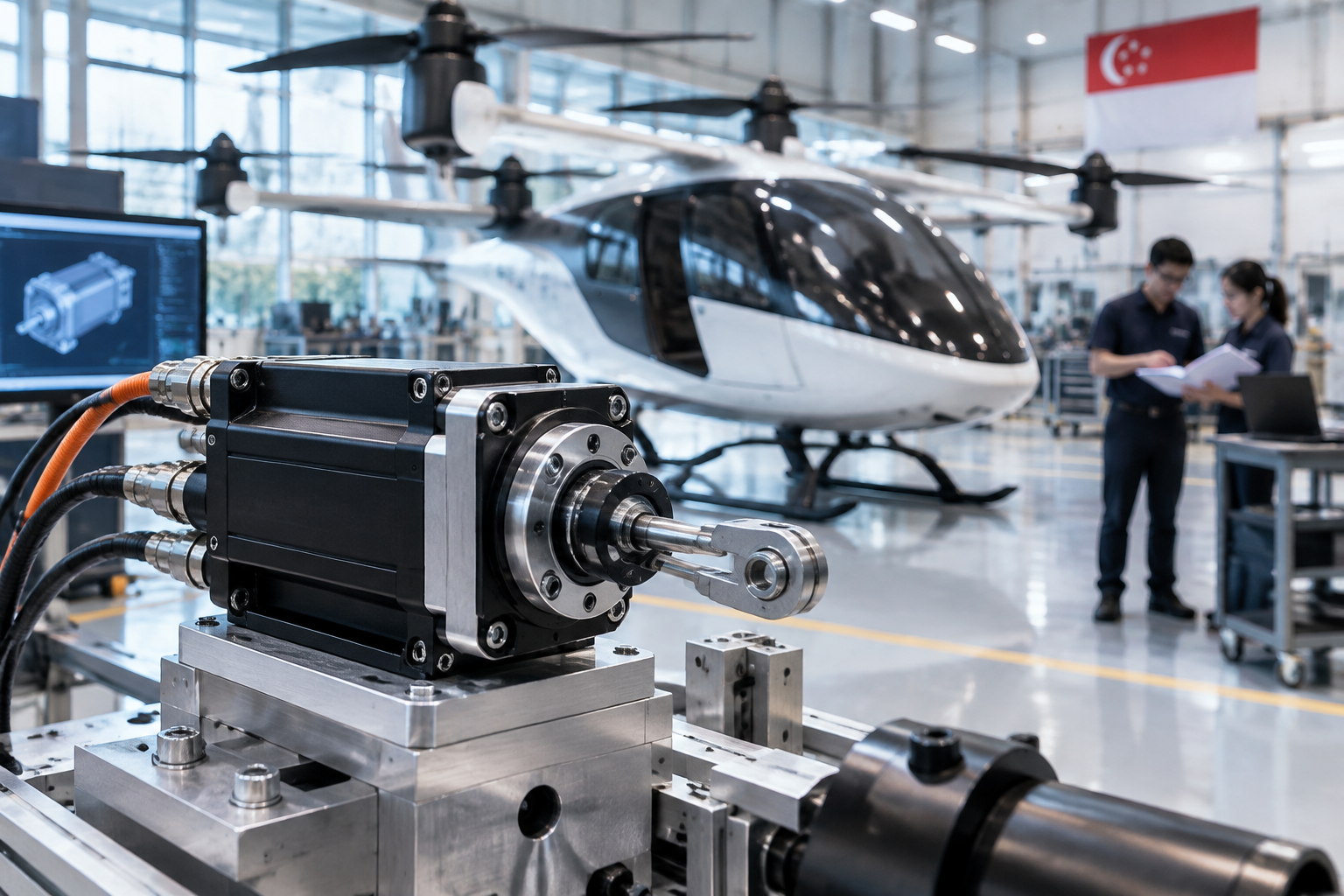
Volz Servos has established itself as a critical enabler of advanced aircraft design by providing high-performance servo systems and actuators that precisely control aircraft surfaces and systems. In eVTOL applications, servo quality directly impacts flight stability, control responsiveness, and overall safety—making component selection as important as overall architecture. The selection of Volz components for Singapore’s indigenous eVTOL underscores the company’s reputation for reliability and performance in demanding aerospace applications. Their proven track record in aviation systems gave the development team confidence to focus on other engineering challenges.
The requirements for eVTOL servo systems differ meaningfully from conventional fixed-wing aircraft, requiring faster response times, greater reliability under continuous transitional flight conditions, and integration with sophisticated flight control software. Volz Servos has successfully adapted its technology to meet these emerging demands, positioning itself ahead of competitors. The company’s ability to support not just single prototypes but potentially scaled manufacturing demonstrates its capacity to grow alongside the eVTOL industry. This scalability is crucial for companies supporting emerging aviation segments that may see rapid demand acceleration.
Collaboration between specialized component suppliers and aircraft developers creates a virtuous cycle of innovation. Volz Servos’ involvement in Singapore’s eVTOL project provides real-world flight data and operational experience that will inform future product improvements. Simultaneously, the aircraft developers benefit from access to cutting-edge actuation technology without the burden of developing servo systems in-house. This supplier-integrator relationship exemplifies how modern aerospace innovation distributes engineering effort across specialized companies, each focusing on their core competencies.
Technical Innovation in Actuation Systems for eVTOL
Modern eVTOL aircraft rely on sophisticated actuation systems to manage multiple flight modes—hover, transition, and forward flight—which require different control surface positions and response characteristics. Servo systems must seamlessly transition between these modes while maintaining pilot control authority and vehicle stability. The precision demanded exceeds what traditional aviation servo technology was originally designed to deliver. Volz Servos’ technology, refined through years of development for specialized aerospace applications, addresses these demanding requirements with proven performance margins.
Weight and power consumption are critical design considerations in eVTOL development, as every kilogram of servo system weight reduces payload or range. Volz’s engineering approach emphasizes efficiency and lightweight construction without compromising durability or control precision. In Singapore’s aircraft, this efficiency translates directly to performance gains—either extended flight duration or increased useful load. The elegance of a well-engineered servo system is that it performs its function quietly and reliably, with pilots and engineers never thinking about actuators unless something goes wrong.
The integration of advanced sensors within modern servo systems enables sophisticated flight control algorithms and autonomous capabilities. Volz Servos provides not just mechanical actuation but increasingly intelligent systems that report their status and performance characteristics to aircraft management computers. This data integration is essential for eVTOL development, where software and hardware must work in seamless coordination to deliver safe, efficient flight. Singapore’s indigenous eVTOL development benefits from these technological advances, allowing their engineering team to leverage cutting-edge control capabilities.
Regional Innovation and Southeast Asian Air Mobility Leadership
Singapore’s success in developing an indigenous eVTOL creates a template for other Southeast Asian nations seeking to participate in air mobility innovation. The region’s dense population centers, rapid urbanization, and technological sophistication make Southeast Asia an ideal market for eVTOL services. However, developing indigenous aircraft capabilities requires sustained investment, talented engineering teams, and access to specialized suppliers. Singapore’s project demonstrates that this combination is achievable, potentially inspiring regional competitors and partners to develop their own capabilities or collaborate on shared initiatives.
The involvement of international component suppliers like Volz Servos alongside indigenous engineering demonstrates the global nature of advanced aerospace development. No single nation possesses all the specialized capabilities required to develop modern aircraft alone. Successful programs build international networks of expertise, with each participant contributing their distinctive strengths. This collaborative model benefits Singapore by leveraging world-class components while maintaining indigenous system integration and design knowledge. The approach positions Singapore as capable of assembling and managing complex aerospace development programs.
As eVTOL technology matures, regions that establish early expertise and operational experience will enjoy significant competitive advantages. Singapore’s leadership in this domain could extend to regulatory development, pilot training, infrastructure planning, and passenger experience optimization. The nation’s success in autonomous vehicle regulation and smart city initiatives suggests it is well-positioned to also lead in eVTOL integration. This early positioning could yield economic benefits through technology exports, operational service provision, and establishing regional standards that other nations adopt.
Key Takeaways: Singapore’s Indigenous eVTOL Achievement
- Volz Servos precision actuation systems are integral to Singapore’s first indigenous eVTOL aircraft, providing the high-performance servo technology required for reliable, responsive flight control in multi-mode operations.
- Singapore’s skunkworks-style development approach combines entrepreneurial agility with structured research capabilities, establishing a replicable model for eVTOL programs in other Southeast Asian nations and compact urban centers.
- The aircraft’s successful development positions Singapore as a regional leader in personal air mobility innovation, with potential to influence eVTOL regulatory standards and operational integration across Southeast Asia.
Singapore’s development of its first indigenous eVTOL aircraft, powered by Volz Servos components, represents a defining moment for personal air mobility in Southeast Asia. This achievement demonstrates that advanced aviation development is no longer the exclusive domain of large historical aviation powers. With focused engineering expertise, access to specialized suppliers, and supportive regulatory frameworks, emerging aerospace nations can compete at the highest levels of innovation. As the eVTOL industry continues its rapid evolution, Singapore’s early success provides both technical capability and strategic positioning for years of growth ahead. The collaboration between local innovation teams and international suppliers like Volz Servos exemplifies how modern aerospace development thrives through specialized expertise and strategic partnerships.