HIGHLIGHTS
- France and Germany establish coordinated eVTOL integration framework for major airport hubs across the European continent.
- Seamless airport mobility infrastructure combines ground transportation with vertical takeoff operations, reducing passenger transfer times and congestion.
- European regulatory harmonization enables cross-border eVTOL operations and standardized safety protocols for commercial air mobility services.
Europe is entering a transformative era for personal air mobility as France and Germany lead an ambitious initiative to seamlessly integrate electric vertical takeoff and landing (eVTOL) aircraft into major airport infrastructure. This pioneering effort represents a watershed moment for the aviation industry, moving beyond theoretical concepts to create practical, interconnected systems that will fundamentally reshape how passengers and cargo move within and between European cities.
France and Germany’s Strategic Leadership in eVTOL Integration
France and Germany have positioned themselves at the forefront of European eVTOL adoption by developing comprehensive frameworks that address the complex intersection of urban air mobility and traditional aviation infrastructure. These nations recognize that successful integration requires more than regulatory approval—it demands coordinated planning, infrastructure investment, and technological standardization across borders. Their collaborative approach sets a precedent for how neighboring European nations can work together to create seamless transportation ecosystems.
The initiative focuses on major metropolitan airports and connecting cities throughout both countries. By concentrating on hub locations with existing passenger volumes and established infrastructure, France and Germany are creating proof-of-concept models that demonstrate how eVTOL services can complement rather than compete with conventional air travel. This strategic placement allows operators to tap into immediate demand while building confidence among aviation authorities, airport operators, and the traveling public.
Both nations have invested substantial resources in regulatory infrastructure, training programs, and certification pathways tailored specifically for eVTOL operations. These investments extend beyond the aircraft themselves, encompassing vertiport design standards, maintenance facilities, air traffic integration protocols, and emergency response procedures. By establishing these foundations now, France and Germany are creating sustainable ecosystems capable of supporting multiple operators and diverse vehicle types as the market matures.
Seamless Airport Mobility and Passenger Experience Transformation
The integration of eVTOL services into airport operations promises to revolutionize the passenger experience by dramatically reducing connection times and ground transportation inefficiencies. Traditional airport access involves surface-level transportation that experiences congestion during peak hours, creating bottlenecks that frustrate travelers and reduce overall system efficiency. By introducing vertical mobility corridors, airports can decongest ground transportation networks while offering premium time-sensitive services for business travelers and connecting passengers.
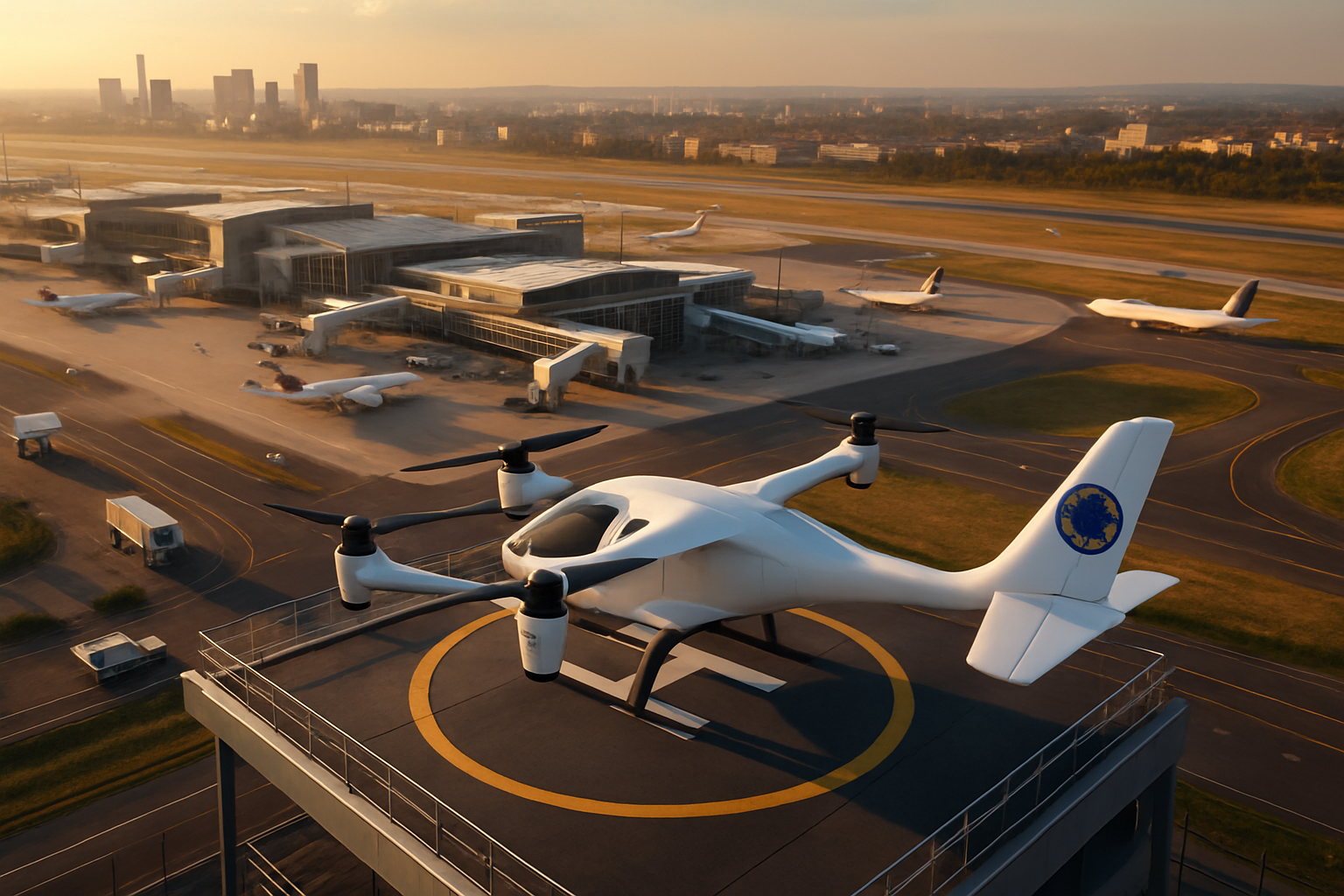
The seamless mobility concept goes beyond simple point-to-point connections between airports and city centers. French and German airports are designing integrated terminal facilities that combine conventional check-in processes, ground transportation hubs, and eVTOL vertiports into unified complexes. Passengers can transition directly from aircraft gate to eVTOL platform using existing security screening and baggage handling infrastructure, minimizing delays and creating fluid journey experiences. This integration requires careful coordination between airport authorities, airlines, eVTOL operators, and ground transportation providers.
Ground support infrastructure development represents a critical component of seamless mobility implementation. Dedicated eVTOL landing and charging stations positioned throughout metropolitan areas create networks that connect major employment centers, business districts, hotels, and transportation hubs. Electric infrastructure supporting rapid battery swaps or fast-charging enables high-frequency service operations, with some services operating on 5-10 minute intervals during peak periods. This frequency level transforms eVTOL from niche premium service to practical transportation alternative for time-conscious travelers.
Regulatory Harmonization and European Standardization Framework
One of the most significant achievements of the France-Germany initiative is the development of harmonized regulatory standards that enable cross-border eVTOL operations. Historically, aviation regulation has been fragmented, with different nations maintaining distinct airworthiness standards, pilot certification requirements, and operational rules. This fragmentation creates barriers to efficient international operations and increases costs for aircraft manufacturers and service operators. The European initiative addresses these challenges by establishing unified technical standards and certification pathways applicable across participating nations.
The regulatory framework encompasses aircraft certification standards aligned with European Union Aviation Safety Agency (EASA) requirements, ensuring that vehicles meeting these standards can operate throughout European airspace without additional national approvals. Pilot and operator certification programs create standardized competency assessments and training requirements, allowing qualified personnel to work across borders. Air traffic integration protocols establish procedures for eVTOL operations within controlled airspace near major airports, ensuring safety while maintaining efficient flows of conventional and vertical aircraft.
Beyond technical standards, the framework addresses operational and commercial aspects essential for sustainable growth. Standardized insurance requirements, noise limitation protocols, environmental impact assessments, and cybersecurity protocols create a level playing field for multiple operators while protecting public interests. This comprehensive approach demonstrates that eVTOL integration requires more than aircraft engineering—it demands careful attention to the legal, regulatory, and institutional frameworks that enable safe, equitable commercial operations.
Economic and Sustainability Implications for European Mobility
The economic potential of seamless airport mobility extends far beyond traditional aviation sectors. By reducing travel times between business centers and airports, eVTOL services enable commuters to work in locations previously considered inconveniently distant from major employment hubs. This expanded geographical flexibility promotes more efficient use of urban real estate, reduces commute-related congestion, and allows economic activity to distribute more evenly across metropolitan regions. European cities struggling with housing costs and traffic congestion see eVTOL integration as a potential tool for regional economic balancing.
Environmental sustainability represents a core motivation for European eVTOL adoption. Electric vertical takeoff aircraft produce zero direct emissions while operating with significantly lower noise levels than conventional helicopters. By replacing ground transportation for airport connections with electric aerial mobility, European cities can reduce carbon emissions while decreasing noise pollution in urban areas. As European electrical grids increasingly incorporate renewable energy sources, eVTOL operations become progressively cleaner, with lifecycle environmental benefits growing alongside renewable energy penetration.
The economic viability of commercial eVTOL services depends on achieving operational efficiencies and market adoption rates that justify the substantial infrastructure investments required. France and Germany’s integrated approach, combining vertiport infrastructure, regulatory frameworks, and pilot programs, demonstrates commitment to creating sustainable business conditions. Early revenue from premium airport connection services can subsidize development of broader mobility networks serving different market segments, eventual enabling eVTOL to function as infrastructure-supported public mobility option rather than exclusive luxury service.
Key Takeaways: European eVTOL Integration
- France and Germany’s coordinated eVTOL framework creates unified regulatory and infrastructure standards enabling seamless cross-border operations and efficient aircraft utilization throughout major metropolitan areas.
- Integrated vertiport infrastructure at major airports directly connects vertical and conventional aviation, reducing passenger connection times and transforming airport ground transportation efficiency.
- Harmonized European standards reduce certification costs, accelerate market entry for qualified manufacturers and operators, and create sustainable competitive conditions supporting long-term industry growth.
The France-Germany initiative represents a turning point for European personal air mobility, transforming eVTOL operations from isolated demonstrations into coordinated systems serving real transportation needs. By addressing regulatory frameworks, infrastructure requirements, and operational procedures simultaneously, these nations provide a blueprint for integrating advanced air mobility into existing transportation ecosystems. As the initiative expands to additional European nations and airport hubs, seamless airport mobility will transition from visionary concept to practical reality, fundamentally reshaping how Europeans experience urban and inter-city travel.