HIGHLIGHTS
- EHang’s EH216-S completed Central Asia’s first autonomous pilotless human-carrying eVTOL flight, marking a major expansion milestone for global adoption of crewed autonomous aviation.
- Regional aviation authorities certified the autonomous flight systems after comprehensive safety reviews, establishing a regulatory precedent that will accelerate eVTOL approvals across emerging markets beyond traditional aviation centers.
- The achievement demonstrates that emerging markets can leapfrog legacy infrastructure by adopting autonomous eVTOL technology early, addressing urban congestion and positioning Central Asia as an innovation leader in personal air mobility.
EHang’s groundbreaking EH216-S autonomous eVTOL aircraft has just achieved a historic milestone by completing Central Asia’s first pilotless human-carrying flight. This landmark demonstration underscores the rapid expansion of electric vertical takeoff and landing technology across new geographic markets and represents a critical validation of autonomous flight capabilities in the region.
The EH216-S Takes Flight Without a Pilot
The EH216-S, EHang’s fourth-generation autonomous eVTOL, successfully completed its maiden pilotless human-carrying flight in Central Asia, marking the first fully autonomous crewed flight of its kind in the region. This achievement demonstrates that the aircraft’s autonomous flight systems have matured to a level where regulatory authorities and stakeholders are willing to certify and permit crewed autonomous operations outside the traditional aviation strongholds of North America, Europe, and East Asia.
The flight was conducted under closely monitored conditions, with all systems performing as designed to ensure passenger safety. The EH216-S utilizes advanced redundancy in its flight control systems, power management, and navigation infrastructure to maintain the same safety standards as traditional piloted aircraft. This redundancy is essential for autonomous operations to gain regulatory approval and public confidence.
The successful flight validates EHang’s engineering approach and the company’s ability to scale production and certification across diverse regulatory environments. Central Asia’s embrace of the EH216-S signals that autonomous eVTOL adoption is no longer confined to a handful of developed nations but is becoming a genuinely global phenomenon.
Regional Expansion and Market Opportunity
Central Asia represents a strategic growth market for urban air mobility, with rapidly expanding metropolitan areas facing increasing congestion challenges. Countries in the region are actively exploring alternatives to ground-based transportation and have shown openness to advanced aviation technologies. The successful EH216-S flight opens the door for commercial air taxi services, emergency medical transport, and logistics applications across Kazakhstan, Uzbekistan, and neighboring nations.
EHang has been systematically expanding its international footprint through certification partnerships and demonstration flights. The Central Asia milestone builds on the company’s previous successes in China, Southeast Asia, and the Middle East, where it has established itself as the world’s leading autonomous eVTOL operator by number of commercial flights completed. Each regional achievement accelerates the path to widespread adoption.
The market opportunity is substantial: Central Asia’s urban populations are expected to grow significantly over the next decade, and infrastructure constraints make traditional transportation expansion difficult. Autonomous eVTOLs could address critical first-mile and last-mile connectivity gaps while reducing congestion in city centers. Early adoption by regional governments could position Central Asian nations as innovation leaders in air mobility.
Regulatory Progress and Safety Certification
The authorization of this pilotless human-carrying flight reflects significant progress in developing and implementing eVTOL certification frameworks in Central Asia. Regional aviation authorities worked closely with EHang to establish safety protocols, verify autonomous systems reliability, and conduct comprehensive operational risk assessments. This collaborative approach demonstrates that robust certification standards can be developed and deployed in emerging markets without simply copying Western regulations.
Autonomous eVTOL operations require certification of multiple interdependent systems: aircraft airworthiness, autonomous flight software, ground-based monitoring and contingency systems, pilot-less recovery procedures, and air traffic management integration. The fact that Central Asian regulators have approved these systems indicates confidence in EHang’s technical maturity and operational procedures. This precedent will facilitate future approvals for other operators and aircraft types in the region.
Safety remains the paramount consideration in autonomous aviation. The EH216-S incorporates multiple layers of fail-safe mechanisms, including redundant batteries, distributed electric motors with independent controls, and real-time ground monitoring with override capabilities. Every autonomous flight generates valuable operational data that continuously improves system reliability and regulatory confidence in the technology.
The EH216-S Platform and Its Capabilities
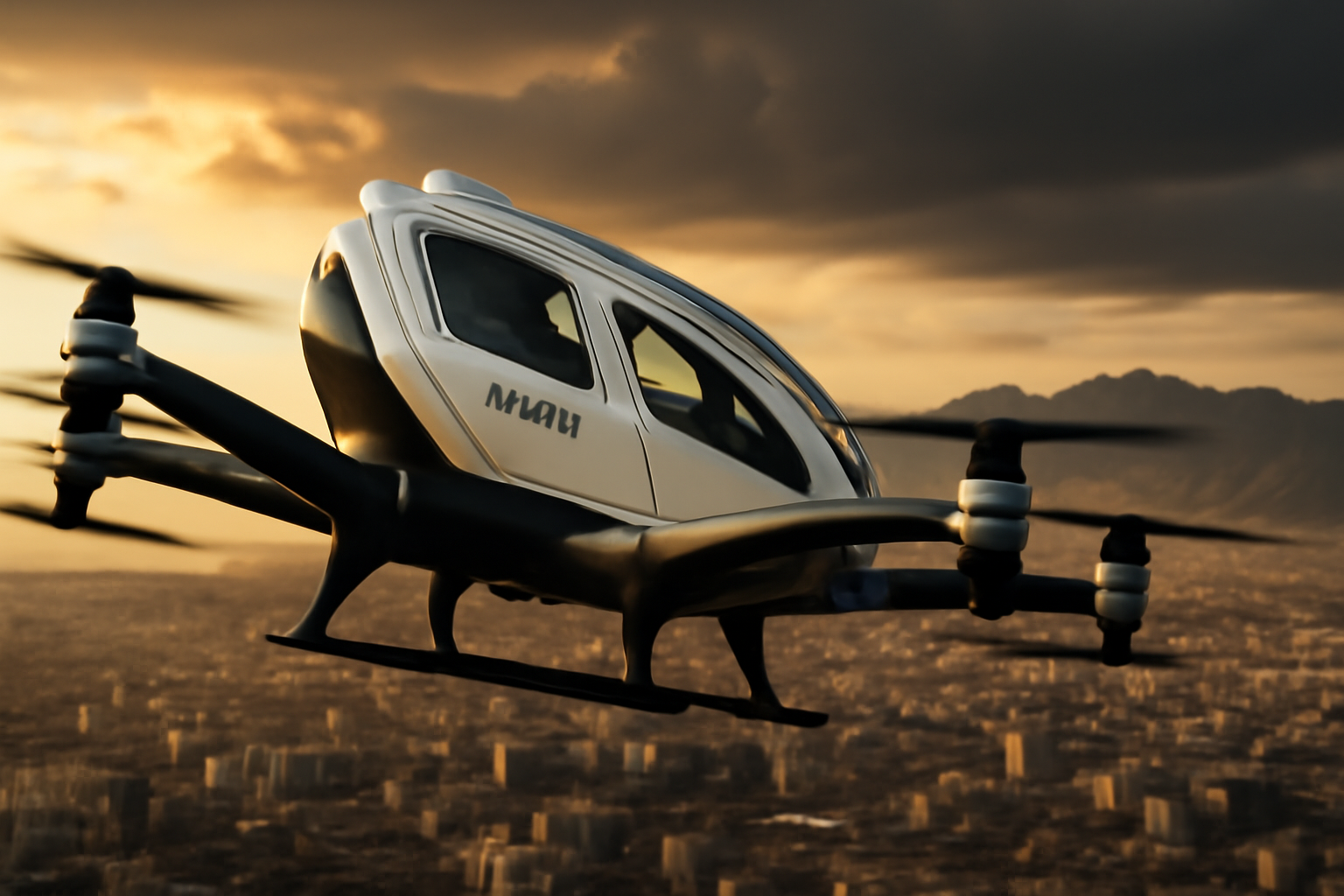
The EH216-S is purpose-built for urban air mobility, carrying two to four passengers depending on configuration and weight, with a cruise range of approximately 35 kilometers on a single charge. The aircraft features eight electric motors distributed across two main rotor booms, providing exceptional redundancy so that multiple motor failures do not compromise flight safety. This distributed electric propulsion architecture is fundamentally different from traditional helicopters and provides inherent safety advantages for autonomous operations.
The aircraft’s autonomous capabilities are powered by EHang’s proprietary flight control software and navigation systems, which integrate GPS, obstacle detection, weather monitoring, and real-time communication with ground control stations. The EH216-S can be programmed for specific routes and automatically execute flights while maintaining continuous monitoring from ground operators who can intervene if necessary. This human-in-the-loop approach provides an important safety layer during the early phases of autonomous operations.
EHang has accumulated thousands of flight hours with the EH216-S across multiple markets, providing extensive operational data and real-world validation of autonomous capabilities. The Central Asia flight adds to this growing experience base and generates insights into operating autonomous eVTOLs in new climatic and geographic conditions. This operational diversity is crucial for refining autonomous systems and building regulatory confidence.
Global eVTOL Market Implications
The Central Asia flight is significant not just for the region but for the entire personal air mobility industry. It demonstrates that eVTOL adoption and autonomous operations are not limited to wealthy developed nations or specific regulatory zones. The technology’s benefits—reduced emissions, efficient use of urban airspace, decongestion of ground transportation—apply everywhere, and emerging markets are increasingly positioned to adopt advanced aviation technologies.
EHang’s achievement also underscores competitive advantages that first-mover operators can establish in new markets. By achieving regulatory approvals and completing successful flights before competitors, EHang is building market presence, regulatory relationships, and operational experience that will be difficult for later entrants to replicate. Other eVTOL developers pursuing international expansion are watching these milestones closely.
The normalization of autonomous eVTOL operations across diverse regions will eventually accelerate innovation and drive down costs. As the installed base of autonomous eVTOLs grows and operational procedures become standardized, manufacturers will achieve economies of scale that make the technology accessible to smaller cities and emerging markets. Central Asia’s early adoption positions the region to benefit from this trajectory.
Key Takeaways from the EH216-S Central Asia Achievement
- EHang successfully completed Central Asia’s first pilotless human-carrying eVTOL flight with the EH216-S, validating autonomous operations in a new geographic market and strengthening global confidence in autonomous aviation technology.
- Regional aviation authorities approved the autonomous flight after comprehensive safety and certification reviews, establishing a precedent for developing robust eVTOL regulatory frameworks outside traditional aviation centers and accelerating adoption timelines.
- The achievement demonstrates that emerging markets can leapfrog traditional aviation infrastructure by adopting autonomous eVTOL technology early, addressing urban congestion and transportation connectivity while positioning themselves as innovation leaders in air mobility.
The EH216-S’s successful pilotless flight in Central Asia represents a watershed moment for the global eVTOL industry. It proves that autonomous electric aviation is advancing beyond proof-of-concept demonstrations in controlled environments and becoming operationally proven technology that regulators in diverse markets trust with human passengers. As more regions achieve similar milestones, the vision of autonomous urban air mobility serving cities worldwide moves from aspiration to reality. Central Asia’s pioneering flight today will be remembered as a critical inflection point in aviation history.