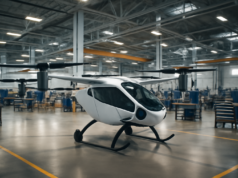
Honda Aircraft Company recently celebrated two decades of aviation innovation, marking a significant milestone in the company’s journey toward transforming personal air mobility. This achievement coincides with the unveiling of a 1/3-scale Honda electric vertical takeoff and landing (eVTOL) aircraft concept, demonstrating the company’s commitment to sustainable aviation solutions. As the personal air mobility industry continues to evolve at an unprecedented pace, Honda’s legacy of engineering excellence and innovation positions the company as a key player in the emerging eVTOL and EV drone marketplace.
Honda’s 20-Year Legacy in Aviation Excellence
Over the past two decades, Honda Aircraft Company has established itself as a pioneer in personal aviation innovation. Beginning with the development of the HondaJet, the company has consistently pushed the boundaries of what’s possible in small aircraft design and manufacturing. The HondaJet’s revolutionary over-the-wing engine mount design and composite fuselage construction set new standards for efficiency and performance in the general aviation industry.
Honda’s commitment to aviation extends beyond commercial success. The company has invested heavily in research and development, establishing aerospace divisions dedicated to exploring next-generation propulsion systems and aerodynamic innovations. This foundational work in engineering excellence has prepared Honda to transition toward electric and hybrid-electric aviation solutions that will define the future of personal air mobility.
The company’s aerospace heritage demonstrates that Honda understands the unique challenges of aviation, including safety requirements, regulatory compliance, and the critical importance of reliability. These factors are essential as the industry shifts toward eVTOL aircraft and autonomous aerial vehicles that will require unprecedented levels of engineering precision and quality assurance.
Understanding Honda’s 1/3-Scale eVTOL Concept
The recently unveiled 1/3-scale Honda electric vertical takeoff and landing aircraft represents a significant step forward in the company’s eVTOL development strategy. This prototype demonstrates key technological concepts that will inform Honda’s full-scale eVTOL designs. Scale models serve as crucial testing platforms for aerodynamic properties, battery performance, electric propulsion systems, and control mechanisms that are essential for safe flight operations.
This scaled prototype allows Honda’s engineering teams to validate multiple critical systems simultaneously. Electric propulsion efficiency, battery thermal management, weight distribution, and structural integrity can all be assessed at scale before committing to full-size production prototypes. The 1/3-scale model provides valuable data regarding how electric motors perform in vertical takeoff and hover modes, which are dramatically different from conventional fixed-wing aircraft operations.
The development of this prototype also signals Honda’s timeline for eVTOL commercialization. Companies that are investing in multiple prototype scales typically aim for commercial certification within 5-7 years. For Honda, this means that eVTOL aircraft offerings could reach early adopters and commercial operators in the latter part of this decade, aligning with broader industry projections for advanced air mobility market growth.
Key Technical Considerations in Honda’s eVTOL Design
- Electric propulsion systems optimized for vertical takeoff and hover efficiency
- Advanced battery architecture supporting 30-50 minute flight durations
- Composite materials reducing overall aircraft weight
- Redundant safety systems for autonomous and piloted operations
- Noise reduction technologies for urban air mobility applications
The Global eVTOL Market and Honda’s Strategic Position
The global personal air mobility market is experiencing unprecedented growth, with analysts projecting a multi-billion dollar industry within the next decade. Major manufacturers including Joby Aviation, Lilium, and Archer are advancing toward commercial certification, while traditional aerospace companies like Airbus and Boeing are developing their own eVTOL solutions. Honda’s entry into this market segment leverages the company’s manufacturing expertise, supply chain infrastructure, and reputation for reliability.
Honda’s strategic advantage lies in its ability to scale manufacturing operations efficiently. Unlike startup eVTOL companies, Honda possesses established factories, quality control systems, and distribution networks that can rapidly scale production once certification is achieved. The company’s automotive division has perfected lean manufacturing principles that can be adapted for aircraft production, potentially allowing Honda to achieve cost efficiencies that competitors cannot match.
The competitive landscape also includes regional differences in eVTOL development priorities. While North American and European companies focus on urban air mobility and air taxi services, Honda may target additional markets including cargo transport, emergency medical services, and leisure aviation. This diversified approach could provide multiple revenue streams and reduce dependence on any single market segment.
Market Opportunities for Honda’s eVTOL Offerings
- Urban air mobility services in congested metropolitan areas
- Emergency medical transport and organ delivery networks
- Executive and business aviation with electric efficiency
- Tourism and leisure aerial experiences
- Regional cargo transport between distribution centers
Regulatory Pathways and Certification Challenges Ahead
The regulatory environment for eVTOL aircraft represents both an opportunity and a significant challenge. Regulatory agencies including the Federal Aviation Administration (FAA), European Union Aviation Safety Agency (EASA), and national aviation authorities worldwide are developing special conditions and certification specifications for electric vertical takeoff and landing aircraft. These regulatory frameworks must balance innovation acceleration with safety assurance, creating a complex landscape that manufacturers must navigate.
Honda’s experience with FAA certification for the HondaJet provides valuable expertise in navigating complex regulatory processes. The company understands the documentation requirements, testing protocols, and stakeholder engagement necessary for certification approval. However, eVTOL aircraft present novel regulatory challenges, including electric propulsion safety, battery management systems, and autonomous flight operation protocols that extend beyond traditional certification frameworks.
The path to certification will likely include extensive flight testing programs, safety assessments, and public engagement initiatives. Honda’s resources position the company well to conduct these comprehensive validation programs. Early engagement with regulatory authorities, participation in industry standards development, and transparent communication about safety capabilities will be essential for Honda to achieve timely certification while maintaining public confidence in eVTOL aviation safety.
Critical Regulatory Milestones for eVTOL Certification
- Special conditions and certification specification development with aviation authorities
- Comprehensive safety assessment protocols for electric propulsion systems
- Battery thermal runaway and failure scenario testing and validation
- Autonomous flight and redundancy system certification requirements
- Noise compliance verification for urban operations
The Future of Personal Air Mobility and Honda’s Vision
As personal air mobility transitions from concept to commercial reality, Honda’s two decades of aviation innovation position the company as a credible participant in this transformation. The company’s ability to combine automotive manufacturing excellence with aerospace engineering expertise creates a unique competitive advantage in the eVTOL marketplace. While challenges remain in battery technology, regulatory certification, and establishing viable business models, Honda’s resources and commitment suggest that meaningful contributions to urban air mobility are forthcoming.
The development of the 1/3-scale eVTOL prototype indicates that Honda is actively advancing its technical roadmap toward full-scale production aircraft. The timeline for commercial operations will depend on successful prototype testing, regulatory approvals, and market demand validation. However, given Honda’s track record of bringing innovative products to market efficiently, early commercial operations could begin within the next 5-7 years.
Looking forward, the convergence of electric propulsion technology, advanced battery systems, autonomous flight controls, and evolving regulatory frameworks is creating unprecedented opportunities for personal air mobility. Honda’s entry into the eVTOL market signals that established aerospace and automotive manufacturers view this sector as a significant commercial opportunity. For consumers and businesses interested in advanced air mobility solutions, Honda’s involvement suggests that high-quality, reliable eVTOL aircraft will soon be available from a trusted manufacturer with decades of aviation heritage.
Honda’s two decades of aviation innovation combined with its new eVTOL development efforts demonstrate that the personal air mobility revolution is gaining momentum from established manufacturers, not just startups.
The personal air mobility industry stands at an inflection point where scaling production, achieving regulatory certification, and establishing sustainable business models will determine which manufacturers succeed. Honda’s proven ability to execute complex manufacturing programs, coupled with its commitment to innovation demonstrated by the 1/3-scale eVTOL concept, positions the company well to capture significant market share in this emerging industry. As eVTOL technology matures and commercial operations expand, Honda’s contributions will likely shape how millions of people experience air transportation in the decades ahead.