HIGHLIGHTS
- Joby Aviation’s six-passenger eVTOL aircraft are now operational in Tampa, Florida—the first real-world deployment of commercial electric air taxis in a major U.S. metropolitan area.
- Florida is developing a statewide aerial highway network with designated flight corridors and vertistations, representing the nation’s most ambitious state-level UAM infrastructure plan.
- Electric air mobility offers zero-emission transportation, reduced urban congestion, and new economic opportunities while meeting rigorous FAA safety certification standards.
Joby Aviation’s electric vertical takeoff and landing (eVTOL) aircraft have officially landed in Tampa, Florida, marking a significant milestone for personal air mobility in the United States. This groundbreaking event coincides with Florida’s ambitious plans to develop a comprehensive aerial highway network designed to support widespread adoption of electric air taxis and urban air mobility (UAM) services. The convergence of operational eVTOLs and infrastructure planning signals that the future of transportation is no longer distant—it’s arriving in real time.
Joby Aviation’s Tampa Arrival: A Pivotal Moment for eVTOL Operations
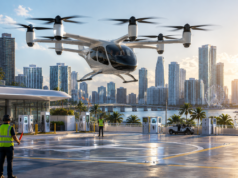
Joby Aviation, one of the world’s leading eVTOL manufacturers, has successfully deployed its electric air taxi aircraft to Tampa, representing a crucial step toward commercial air mobility services. The company’s sleek, six-passenger aircraft combines cutting-edge battery technology with advanced aerodynamics to deliver zero-emission point-to-point transportation. This arrival in Tampa demonstrates that Joby’s years of research, testing, and certification efforts have culminated in operational capability within a major U.S. metropolitan area.
The aircraft’s presence in Tampa is not merely symbolic—it reflects real progress toward regulatory approval and operational integration. Joby has been working closely with the Federal Aviation Administration (FAA) and local aviation authorities to ensure compliance with all safety and operational standards. The company’s commitment to rigorous testing protocols and transparent collaboration with regulators has paved the way for this deployment, establishing a template for how eVTOL operators can successfully integrate into existing aviation infrastructure.
Tampa’s selection as a deployment location is strategic, given the city’s robust infrastructure, favorable climate for year-round operations, and dense urban corridors that benefit from efficient air taxi services. The metropolitan area’s growing tech sector and tourism industry position it as an ideal testing ground for urban air mobility solutions that can reduce ground congestion and provide rapid transit alternatives.
Florida’s Aerial Highway Network: Reimagining Transportation Infrastructure
Florida is not waiting passively for eVTOL adoption to develop organically—the state is proactively designing and implementing an aerial highway network framework. This infrastructure initiative represents one of the most ambitious state-level commitments to urban air mobility in the country. The aerial highway concept involves designated flight corridors, vertistations (vertical takeoff and landing hubs), and integrated air traffic management systems that will allow eVTOL aircraft to operate safely and efficiently across urban and regional distances.
The development of this network requires coordination among state transportation agencies, local municipalities, the FAA, and private eVTOL operators. Florida’s leadership recognizes that successful UAM adoption hinges on infrastructure readiness—simply having aircraft is insufficient without established landing zones, charging stations, regulatory clearances, and traffic management protocols. By planning these systems in advance, Florida positions itself as a national leader in UAM infrastructure and potentially becomes a hub for future eVTOL operations and manufacturing.
The aerial highway network will integrate with existing ground transportation systems, creating seamless multimodal journeys for passengers. Travelers could, for example, depart from a downtown vertistation, fly across congested traffic corridors, and land at an airport or regional hub within minutes—a time savings that becomes increasingly valuable in major metropolitan areas. This integration approach ensures that aerial mobility enhances rather than complicates existing transportation ecosystems.
Regulatory Pathways and Safety Certification Challenges
Joby Aviation’s deployment in Tampa underscores the complexity of eVTOL certification and regulatory approval. The FAA has established rigorous standards for new aircraft categories, including structural integrity, propulsion system reliability, emergency procedures, and pilot training requirements. Joby’s successful navigation of these requirements demonstrates that commercial eVTOL operations are not merely theoretical—they can meet the exacting safety standards that have governed aviation for decades.
The certification process has involved extensive flight testing, computer simulations, and independent audits to validate that Joby’s aircraft perform reliably across diverse operating conditions. The company has invested heavily in demonstrating that its battery systems, electric propulsion, and autonomous flight features meet or exceed conventional aircraft safety margins. This commitment to regulatory excellence is essential for building public confidence and enabling scaling of eVTOL services.
Florida’s role in supporting this regulatory pathway is crucial. By partnering with state agencies and municipal authorities, Joby and other eVTOL operators gain access to airspace for testing, operational data collection, and real-world performance validation. These partnership models will likely inform how other states and countries approach eVTOL integration, making Florida’s approach a proving ground for global best practices.
Economic and Environmental Implications for Urban Mobility
The successful deployment of Joby’s eVTOLs in Tampa carries profound economic implications for Florida’s transportation sector. Electric air taxi services promise to create new employment opportunities in aircraft maintenance, vertistation management, air traffic control, and pilot training. The development of a comprehensive aerial highway network will stimulate investment in supporting infrastructure, technology, and services—a potential economic catalyst for the region.
Environmental benefits are equally significant. Joby’s electric aircraft produce zero direct emissions, offering a compelling alternative to ground transportation that contributes to urban air quality improvement and reduced carbon footprints. As Florida’s energy grid increasingly incorporates renewable power sources, the environmental advantage of eVTOL services will amplify. Cities struggling with traffic congestion and air pollution see electric air mobility as a pathway toward sustainable urban transportation systems.
The economic model for eVTOL operations is still evolving, but early projections suggest that as battery technology improves and production scales, air taxi fares will become competitive with premium ground transportation and short-range flights. This affordability curve, combined with time savings, creates a compelling value proposition for commuters, business travelers, and passengers connecting between regional hubs.
Key Takeaways: Tampa’s eVTOL Milestone
- Joby Aviation’s eVTOLs are now operational in Tampa, representing the first real-world deployment of commercial electric air taxis in a major U.S. city and validating years of certification and development work.
- Florida is building a statewide aerial highway network with designated flight corridors, vertistations, and air traffic management systems—the most comprehensive state-level UAM infrastructure plan in the nation.
- Successful eVTOL integration requires parallel development of aircraft technology and infrastructure, with regulatory approval, pilot training, and vertistation networks essential for scaling beyond initial deployments.
Tampa’s emergence as a hub for eVTOL operations marks a watershed moment for personal air mobility. Joby Aviation’s aircraft are no longer prototypes or test vehicles—they are flying passengers and cargo across an American city. Simultaneously, Florida’s commitment to building aerial highway infrastructure demonstrates that stakeholders recognize the transformative potential of this technology. As regulatory pathways clarify, battery technology improves, and operational experience accumulates, other cities and regions will follow Florida’s model. The convergence of Joby’s operational capability and Florida’s infrastructure vision illustrates how commercial eVTOL services transition from speculative technology to integrated transportation systems, reshaping how people move through urban environments.