HIGHLIGHTS
- Automotive, tech, and energy companies are entering the eVTOL market, injecting capital and expertise that accelerates development beyond traditional aerospace timelines.
- Air taxi services are transitioning to near-term commercial deployment with integrated urban infrastructure across Singapore, Dubai, São Paulo, and Seoul.
- Smart grid integration and supply chain innovations are making electric aviation compatible with existing infrastructure, faster than expected by industry skeptics.
Electric aviation has emerged as one of the most dynamic sectors in sustainable transportation, yet its growth trajectory is defying conventional expectations. Rather than following the traditional pathways predicted by industry analysts, the electric vertical takeoff and landing (eVTOL) revolution is being driven by innovations, partnerships, and breakthroughs occurring in sectors that few anticipated just a few years ago. As we approach the 2026 timeline, the convergence of clean energy technologies, regulatory frameworks, and urban mobility demands is catalyzing an electric aviation boom that extends far beyond the typical aerospace boundaries.
The Unexpected Players Reshaping Electric Aviation
The eVTOL industry is no longer dominated solely by aerospace startups and legacy aircraft manufacturers. Companies from the automotive sector, technology firms, and even energy providers are entering the market with fresh perspectives and proven expertise in battery management, autonomous systems, and manufacturing at scale. These unconventional entrants bring capital, infrastructure, and consumer-facing brands that traditional aviation companies lack, creating a competitive landscape that accelerates innovation and reduces development timelines.
Traditional automakers have recognized that the skills required to build electric vehicles—lightweight materials, high-density battery systems, manufacturing efficiency, and supply chain expertise—translate directly to eVTOL production. Their entry into the personal air mobility space has legitimized the industry while injecting resources that smaller startups struggle to secure independently. This cross-pollination of automotive and aviation expertise is producing hybrid solutions that are both technologically sophisticated and commercially viable.
Beyond manufacturers, energy companies, telecommunications firms, and even logistics providers are positioning themselves as critical stakeholders in the electric aviation ecosystem. Their involvement signals a fundamental shift in how stakeholders view urban air mobility—not as an isolated transportation mode, but as an integrated component of smart cities and sustainable infrastructure networks.
Air Taxi Integration: From Concept to Reality
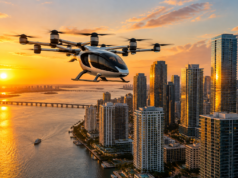
Air taxi services, once relegated to science fiction and speculative business plans, are transitioning from proof-of-concept demonstrations to near-term commercial deployment. Cities worldwide are actively developing infrastructure, regulatory pathways, and operational frameworks to support urban air mobility networks. The integration of air taxis into existing transportation ecosystems requires coordination across multiple sectors—urban planning, energy utilities, telecommunications, and traditional transit authorities.
The unexpected dimension of air taxi development is the collaborative model emerging across industries. Rather than individual companies developing isolated solutions, we’re witnessing ecosystem partnerships where technology providers, urban planners, energy managers, and regulatory bodies work in tandem. This approach accelerates deployment while reducing the risk profile for individual investors. Cities like Singapore, Dubai, São Paulo, and Seoul have become testing grounds where air taxi pilots are informing global best practices.
Financial models for air taxi services are also evolving in unexpected directions. Rather than positioning air taxis as premium luxury services, operators are exploring integration with existing public transit systems, enabling ride-sharing at scale, and leveraging dynamic pricing models that could make aerial transportation accessible to broader demographics. These innovations suggest that air taxis may reshape urban commuting more fundamentally than initially predicted.
Flying Cars: Market Realities and Timeline Shifts
Flying cars represent perhaps the most emblematic example of how electric aviation is defying conventional wisdom. While predictions about consumer-oriented flying cars have circulated for decades, the convergence of battery technology improvements, autonomous flight systems, and regulatory frameworks is creating genuine commercial opportunities sooner than many anticipated. However, the “flying car” category is fragmenting into distinct market segments, each with different timelines and use cases.
The reality of flying cars in 2026 looks different from 1950s visions—they’re more specialized, more integrated with digital infrastructure, and more dependent on regulatory approval than raw engineering capability. Some vehicles are targeting niche markets like premium air commuting for high-value corridors, while others focus on last-mile delivery, emergency response, or tourism experiences. This segmentation reflects market maturity and demonstrates that the flying car future isn’t monolithic but rather a ecosystem of aerial mobility solutions tailored to specific needs.
Regulatory progress has been surprisingly swift in some regions while remaining glacial in others, creating a patchwork of opportunities. Jurisdictions that have embraced forward-thinking aviation frameworks are attracting manufacturers and operators, creating competitive advantages that are reshaping where electric aviation innovation concentrates geographically.
The Sustainability Factor Driving Unexpected Growth
One of the most striking developments in electric aviation is how climate and sustainability imperatives are accelerating adoption beyond market forces alone. Governments, corporations, and cities are factoring environmental benefits into their urban mobility strategies, effectively subsidizing or incentivizing electric aviation adoption through policy and investment frameworks. This creates a positive feedback loop where early regulatory support attracts capital, which accelerates innovation, which drives costs down, making the technology increasingly viable.
The energy infrastructure required to support widespread electric aviation deployment is also evolving in unexpected ways. Rather than requiring entirely new power generation capacity, smart grid integration, demand management, and coordination with renewable energy sources are making electric aviation compatible with existing and planned electrical infrastructure. This finding has surprised skeptics who predicted that eVTOL proliferation would encounter severe energy constraints.
Supply chain innovations are another factor driving unexpected growth. Battery production, materials sourcing, and manufacturing techniques that were specialized niches a few years ago are now scaling rapidly. This scaling effect benefits the entire electric aviation ecosystem while simultaneously driving cost reductions that make air mobility economically competitive with traditional transportation alternatives in specific use cases.
Key Developments and Future Outlook
Essential Takeaways
- Unexpected players from automotive, technology, and energy sectors are reshaping eVTOL development through cross-industry collaboration and capital infusion that accelerates timelines.
- Air taxi services are transitioning from speculative concepts to near-term commercial deployment with integrated urban planning frameworks across multiple cities globally.
- Electric aviation is benefiting from sustainability policies, smart grid integration, and supply chain innovations that create favorable conditions for faster market adoption than traditional economic models predicted.
The trajectory of electric aviation through 2026 and beyond reveals an industry that is both more mature and more dynamic than early predictions suggested. The convergence of technological capability, regulatory framework development, and unexpected entrants from adjacent sectors is creating a compound effect that accelerates progress. Air taxi services are moving from concept to commercial operation, flying cars are diversifying into specialized market segments with distinct timelines, and the supporting infrastructure is developing faster than anticipated. The electric aviation revolution isn’t following a single pathway—it’s branching into multiple applications, markets, and business models that collectively transform how we think about urban mobility. For stakeholders in the aerospace, automotive, energy, and urban development sectors, the next few years will determine whether electric aviation fulfills its transformative potential or encounters unanticipated constraints that slow adoption and reshape industry expectations.