HIGHLIGHTS
- ITA Airways plans electric air taxi service from Rome Fiumicino Airport to city centre in just 10 minutes versus 30-60 minutes by ground transport
- Airport-to-city connectivity is the most viable near-term eVTOL market, requiring fewer regulatory hurdles than broader urban air mobility networks
- ITA Airways gains first-mover advantage among European legacy carriers, potentially establishing Rome as a template for other major city-airport pairs
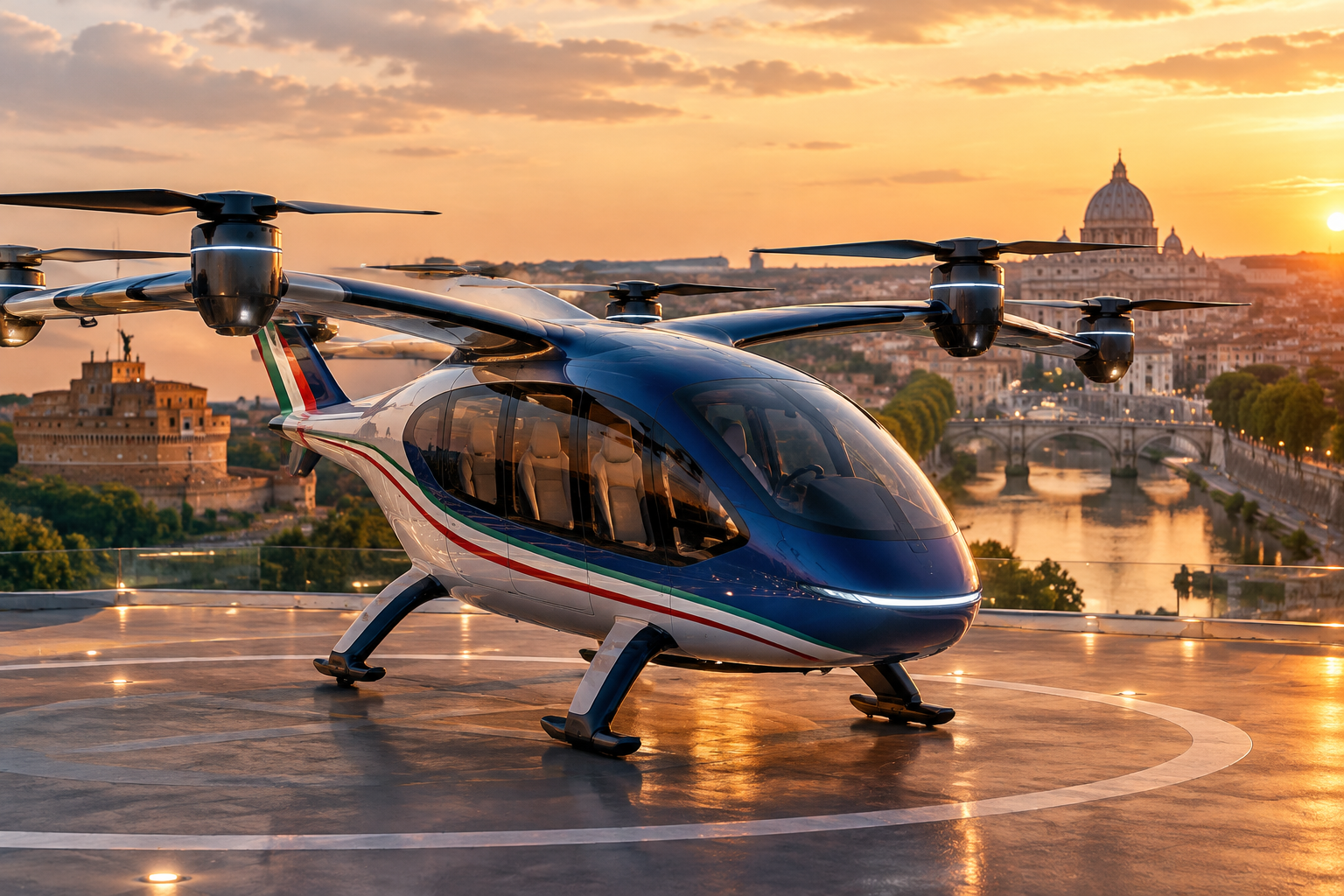
ITA Airways, Italy’s flagship carrier, is stepping into the future of urban transportation by exploring electric air taxi services that could transport passengers from Rome Fiumicino Airport to the city centre in approximately 10 minutes. This ambitious initiative marks a significant shift in how legacy airlines are engaging with personal air mobility technology, positioning electric vertical takeoff and landing (eVTOL) aircraft as a practical solution for time-pressed travellers and airport connectivity challenges. The exploration represents a convergence of traditional aviation and emerging air mobility markets that could reshape ground transportation networks across Europe’s major cities.
ITA Airways Enters the Electric Air Taxi Market
ITA Airways’ decision to explore electric air taxi operations reflects a broader recognition among established carriers that urban air mobility is transitioning from concept to commercial reality. The airline’s focus on connecting Rome Fiumicino Airport—one of Europe’s busiest hubs—to the city centre demonstrates confidence in eVTOL technology’s maturity and reliability. By partnering with operators in the emerging air taxi space, ITA Airways is positioning itself at the intersection of traditional aviation and innovative mobility solutions.
The 10-minute flight time from airport to city centre represents a compelling value proposition compared to traditional ground transportation, which typically takes 30 to 60 minutes depending on traffic conditions. This dramatic time reduction could justify premium pricing for business travellers, tourists, and passengers connecting to international flights. ITA Airways’ involvement signals that legacy carriers see electric air taxis as a complementary service rather than a threat to conventional aviation operations.
Rome, as Italy’s capital and a major international tourism hub, provides an ideal testing ground for this service. The city’s notorious traffic congestion and high volume of business travellers create strong demand for premium, time-saving transportation options. By establishing early operations in Rome, ITA Airways could create a template for similar services in other European cities served by the carrier, from Milan to Venice.
The Strategic Advantage of Airport-to-City Connectivity
Airport connectivity represents one of the most promising near-term applications for eVTOL aircraft and electric air taxis. Unlike broader urban air mobility networks that require extensive infrastructure and regulatory frameworks, point-to-point airport shuttle services operate within defined corridors with established landing zones and air traffic management protocols. ITA Airways’ focus on this specific use case demonstrates a pragmatic approach to market entry that prioritizes operational feasibility over experimental applications.
The Rome operation addresses a critical pain point in the travel experience: airport ground transportation. Business travellers represent a high-value customer segment willing to pay premium fares for time savings, making airport-to-city connections an attractive first market for electric air taxi operators. By integrating this service into its customer journey, ITA Airways can differentiate its Rome operations and potentially increase ancillary revenue through premium mobility packages.
From an airline perspective, offering electric air taxi services creates multiple strategic benefits. It enhances customer experience and brand positioning as an innovative, sustainability-focused carrier. It also generates partnership opportunities with eVTOL operators and airport authorities. These partnerships strengthen ITA Airways’ ecosystem and create potential revenue-sharing arrangements that extend beyond traditional ticket sales.
Regulatory and Infrastructure Considerations
Implementing electric air taxi services in Rome requires coordination with Italian aviation authorities, including ENAC (Ente Nazionale per l’Aviazione Civile) and Eurocontrol, to establish operational procedures within European airspace. Rome’s airspace is already congested with conventional aircraft operations, making the development of dedicated eVTOL corridors essential. Regulatory approval must address safety standards, noise limitations, pilot certification, and air traffic integration—all prerequisites for commercial service launch.
Infrastructure development presents another significant consideration. The Rome-to-city-centre route requires designated vertiports or landing facilities at both endpoints, as well as contingency sites for emergency operations. Fiumicino Airport already possesses the infrastructure and air traffic management capabilities to accommodate eVTOL operations, but establishing a secure, efficient city centre landing site requires coordination with Rome’s municipal government and local stakeholders. These infrastructure investments represent substantial upfront costs that typically require joint public-private partnerships.
Environmental regulations under the EU’s stringent emissions standards and noise directives also shape the service’s viability. Electric propulsion systems offer significant advantages in this regard, as eVTOL aircraft produce minimal emissions and lower noise levels than conventional helicopters. These environmental benefits can accelerate regulatory approval and community acceptance, particularly in dense urban areas where noise and air quality are political concerns.
Market Outlook and Competitive Implications
ITA Airways’ exploration of electric air taxi services positions the airline ahead of many competitors in recognizing the commercial potential of urban air mobility. While other legacy carriers have announced partnerships or exploratory studies, few have made as concrete a commitment to connecting major airports with city centres. This first-mover advantage in the European market could yield significant reputational and commercial benefits as the sector matures.
The electric air taxi market is rapidly attracting investment and technological advancement. Companies including Lilium, Archer, and Joby Aviation are developing commercial-grade eVTOL aircraft, with several targeting European certification within the next 2-3 years. As these aircraft become operationally available, established carriers like ITA Airways gain the ability to rapidly scale services across multiple city pairs. The Rome project serves as a pilot that tests operational viability and customer demand before broader rollout.
Competitive pressure may drive other European airlines to develop similar partnerships. Airlines including Lufthansa and British Airways have shown interest in urban air mobility, but concrete airport-to-city initiatives remain limited. ITA Airways’ Rome project could catalyze industry-wide adoption, establishing electric air taxis as a standard premium service offering at major European hubs. Success in Rome could inspire similar operations in Milan, Florence, and other Italian cities, positioning ITA Airways as a leader in aviation innovation.
Sustainability and Future Implications
Electric air taxi services align with both ITA Airways’ sustainability commitments and Europe’s broader decarbonization goals. The airline industry faces increasing pressure to reduce emissions and demonstrate environmental responsibility, particularly in short-haul operations where eVTOL technology can directly substitute for conventional aircraft or ground transportation. By offering passengers an emission-free alternative to car services or shuttle buses, ITA Airways strengthens its ESG credentials and appeals to environmentally conscious travellers.
The Rome project demonstrates how legacy carriers can integrate emerging technologies into their operations while maintaining focus on core aviation services. Rather than viewing electric air taxis as disruptive threats, ITA Airways is positioning them as complementary mobility solutions that enhance overall customer value. This approach reflects a maturing perspective across the aviation industry regarding the role of eVTOL aircraft in the broader transportation ecosystem.
Looking forward, successful implementation of electric air taxi services in Rome could establish a model that ITA Airways and other European carriers replicate across major city-airport connections. As regulatory frameworks evolve, infrastructure develops, and eVTOL aircraft mature, airport-to-city air taxi networks could become as commonplace as conventional ground transportation. ITA Airways’ willingness to explore this future positions the airline to capture significant value as the market develops.
Key Takeaways
- ITA Airways’ electric air taxi initiative could reduce Rome airport-to-city travel time from 30-60 minutes to just 10 minutes, addressing a major pain point in urban airport connectivity
- Airport-to-city connections represent the most pragmatic near-term market for eVTOL services, requiring minimal regulatory hurdles compared to broader urban air mobility networks
- Success in Rome could establish a replicable model for ITA Airways across other European cities while positioning the airline ahead of competitors in emerging air mobility markets
ITA Airways’ exploration of electric air taxi services to Rome’s city centre represents a watershed moment in aviation history. As one of Europe’s leading carriers, the airline’s commitment to integrating eVTOL technology into passenger operations signals that urban air mobility has transitioned from speculative technology to practical transportation solution. The Rome project will test regulatory frameworks, infrastructure requirements, and customer demand—lessons that will inform eVTOL deployment across Europe’s aviation network. As environmental regulations tighten and passenger expectations for innovation rise, electric air taxis will likely become a defining feature of premium aviation experiences at major European hubs, with ITA Airways positioned as a pioneer in this transformation.