HIGHLIGHTS
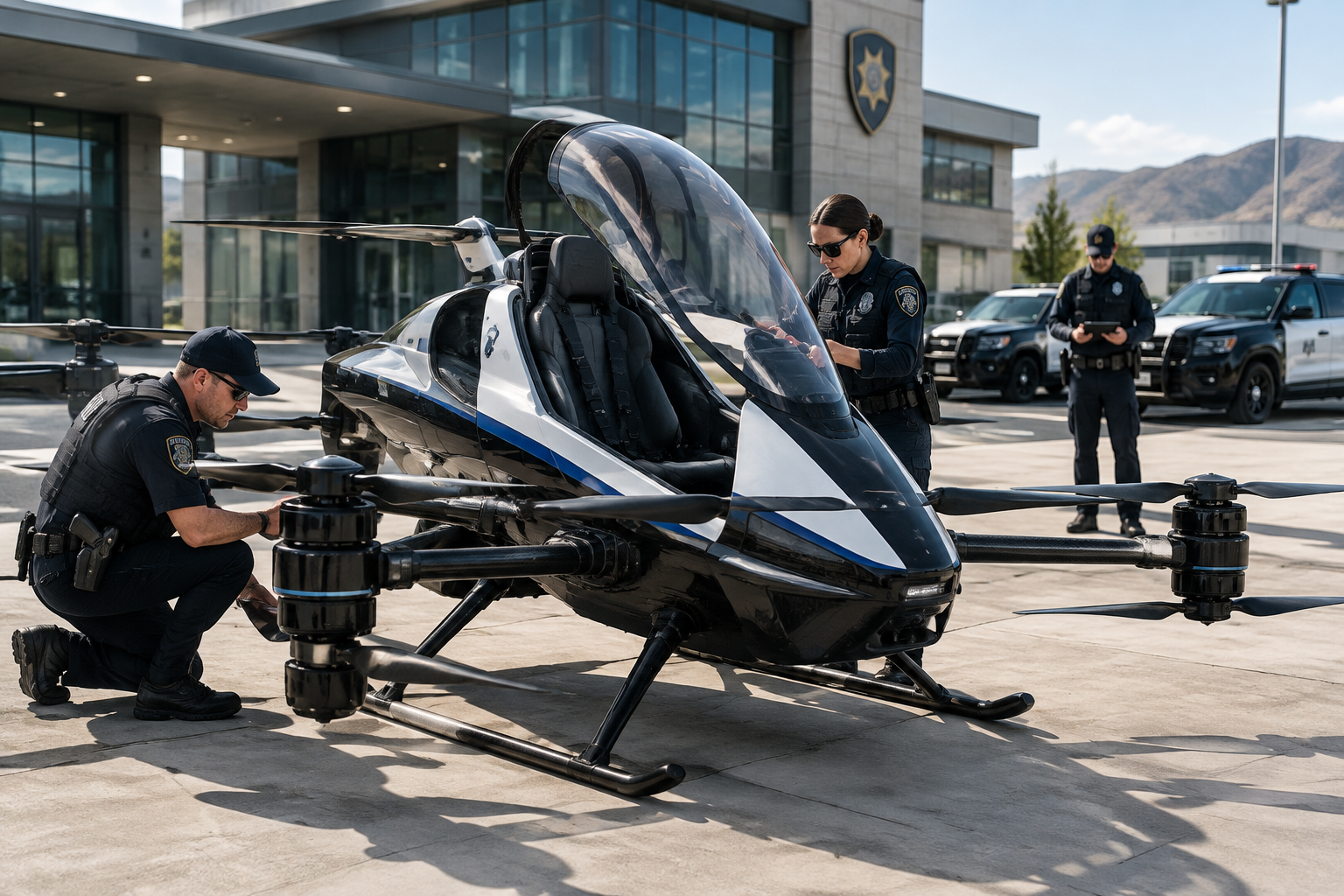
- Jetson ONE selected for law enforcement integration, demonstrating eVTOL technology’s readiness for high-stakes emergency services and public safety operations
- Electric propulsion and VTOL capability enable covert surveillance, rapid response, and cost-effective deployment in urban environments without dedicated runways
- Law enforcement success establishes regulatory precedents that will accelerate eVTOL adoption across emergency services, disaster response, and specialized government missions
The Jetson ONE has reached a major milestone in its commercial trajectory, with selection for law enforcement integration signaling growing confidence in personal electric vertical takeoff and landing (eVTOL) aircraft for emergency services. This development represents a pivotal moment for the personal air mobility industry, demonstrating that regulatory bodies and law enforcement agencies view eVTOL technology as operationally viable for critical public safety missions.
Law Enforcement Adoption of eVTOL Technology
Law enforcement agencies worldwide have traditionally relied on helicopters for aerial surveillance, reconnaissance, and emergency response operations. However, the high operational costs, noise pollution, and infrastructure requirements of conventional helicopters have limited their deployment to major metropolitan areas and well-resourced departments. The selection of Jetson ONE for law enforcement integration opens new possibilities for agencies with limited budgets and environmental constraints.
The Jetson ONE’s compact design and electric propulsion system make it ideal for rapid response scenarios where agility and minimal environmental impact are critical. Police departments can now consider deploying personal eVTOLs for pursuits, search and rescue operations, traffic monitoring, and event security without the same logistical overhead required by traditional rotorcraft. This democratization of aerial capabilities could fundamentally reshape how law enforcement agencies approach emergency response.
The adoption of Jetson ONE by law enforcement also validates the safety and reliability standards embedded in its design and operations. For agencies to integrate a new aircraft into their fleet, rigorous testing and certification processes must be completed, ensuring that the aircraft meets all regulatory requirements and operational standards necessary for public safety missions.
Technical Specifications Supporting Law Enforcement Missions
The Jetson ONE combines several technical features that align well with law enforcement requirements. The aircraft’s vertical takeoff and landing capability eliminates the need for dedicated runways or heliports, allowing deployment from parking lots, sports fields, or other improvised locations during emergency situations. This operational flexibility is particularly valuable in urban environments where real estate is scarce and rapid response times are essential.
Powered by electric motors, the Jetson ONE produces significantly less noise than conventional helicopters, a critical advantage for covert operations, surveillance in residential areas, or search missions where noise disruption must be minimized. Electric propulsion also reduces operational costs compared to fuel-based systems, making sustained law enforcement deployment more economically feasible for departments with constrained budgets.
The aircraft’s range and endurance specifications support typical law enforcement patrol and surveillance missions. With advancements in battery technology and optimized flight profiles, operators can extend mission duration while maintaining the responsiveness and precision required for emergency services. The lightweight construction and simple control systems also reduce pilot training requirements compared to helicopter operations.
Regulatory and Safety Implications
The selection of Jetson ONE for law enforcement use carries significant regulatory implications, suggesting that aviation authorities have established clear operational parameters for personal eVTOLs in controlled airspace. Law enforcement integration requires compliance with additional safety protocols beyond commercial air taxi operations, including provisions for armed operations, high-speed maneuvering, and deployment in dynamic emergency scenarios.
This milestone indicates that regulators have confidence in the Jetson ONE’s certifications and operational safety record. The aircraft’s demonstrated reliability and performance characteristics have likely satisfied stringent aviation authority requirements, paving the way for other eVTOL manufacturers to pursue similar law enforcement partnerships. Successful deployment in law enforcement contexts will generate critical operational data that informs broader regulatory frameworks for personal air mobility.
The integration also establishes precedents for eVTOL aircraft operating in restricted airspace, conducting rapid altitude changes, and performing emergency maneuvers—capabilities that extend beyond typical commercial air taxi operations. These operational approvals will accelerate the development of regulatory frameworks for other specialized eVTOL applications in civil protection, disaster response, and medical evacuation services.
Impact on the Personal Air Mobility Industry
Jetson ONE’s selection for law enforcement represents validation of the personal air mobility market from institutional customers with high operational standards. When government agencies adopt new technology, it signals maturity and reliability that influences investor confidence and consumer perception. This endorsement from law enforcement authorities strengthens the industry’s position as a legitimate sector worthy of continued investment and innovation.
The law enforcement application serves as a proof-of-concept for specialized eVTOL deployment scenarios beyond consumer transportation and air taxi services. Other emergency services—including fire departments, search and rescue teams, and medical services—may now consider eVTOL integration based on Jetson ONE’s demonstrated capabilities. This diversification of use cases expands the addressable market for personal air mobility manufacturers and accelerates industry growth.
Successful law enforcement integration also generates positive publicity that counters lingering safety and environmental concerns about eVTOL aircraft. When respected government agencies endorse and deploy a new technology, public perception shifts from skepticism to acceptance. This cultural shift facilitates faster adoption across other sectors and creates momentum for regulatory approvals in additional jurisdictions.
Future Applications and Industry Growth
The law enforcement integration of Jetson ONE may catalyze demand from other public sector agencies seeking affordable, efficient, and environmentally responsible aerial capabilities. Border patrol, coast guard operations, and national park management could all benefit from eVTOL deployment, particularly in remote or logistically challenging environments. These applications will drive next-generation eVTOL designs optimized for specialized government missions.
The success of Jetson ONE in law enforcement contexts will likely accelerate the commercialization timeline for competitor products targeting government buyers. Companies developing police-specific eVTOL variants—with enhanced surveillance systems, communication integration, and tactical capabilities—may find more receptive regulatory and procurement environments. This competition will drive innovation and improve the overall capability and cost-effectiveness of law enforcement aerial assets.
Long-term, the integration of eVTOL aircraft into law enforcement fleets represents a fundamental shift in how public safety agencies leverage aerial technology. As costs decline and regulatory frameworks mature, eVTOL aircraft could become standard equipment for police departments worldwide, fundamentally transforming emergency response capabilities and setting the stage for broader adoption across transportation, logistics, and medical sectors.
Key Takeaways
- Jetson ONE’s selection for law enforcement integration validates eVTOL safety and reliability standards, accelerating industry credibility and adoption across emergency services
- Electric propulsion, vertical takeoff capability, and minimal noise signature make Jetson ONE ideal for rapid response, surveillance, and covert operations while reducing operational costs
- Law enforcement success with Jetson ONE establishes regulatory precedents for specialized eVTOL applications, expanding the addressable market beyond air taxi services and consumer transportation
The integration of Jetson ONE into law enforcement operations represents a watershed moment for the personal air mobility industry. By demonstrating that eVTOL aircraft can meet the rigorous safety, reliability, and operational standards demanded by government agencies, this milestone opens doors for expanded deployment across emergency services, civil protection, and specialized government missions. As law enforcement agencies gain operational experience with eVTOL aircraft, data-driven insights will inform the next generation of regulations and technology development, accelerating the transition from experimental aviation to mainstream commercial and government use. The success of Jetson ONE in these demanding applications will inspire confidence among investors, regulators, and consumers, propelling personal air mobility toward its full potential as a transformative transportation technology.