HIGHLIGHTS
- Transmissions enable eVTOL aircraft to operate electric motors at peak efficiency while optimizing rotor speeds for performance and noise reduction, extending flight range by 8-12%
- Multi-rotor transmission redundancy satisfies aviation certification requirements, eliminating single-point failures and providing fail-safe architectures for commercial operations
- Additive manufacturing and advanced materials reduce transmission weight by 20-25%, with integrated modular powerplants accelerating certification timelines and cross-platform standardization
As the eVTOL industry matures, engineers face a critical engineering challenge that often goes unnoticed by the general public: transmission technology. While batteries and electric motors capture headlines, the systems that transfer power efficiently from motor to rotor are becoming increasingly important as aircraft grow larger and demand higher performance. Understanding transmissions in eVTOL design reveals why the next generation of urban air mobility depends on innovations far more complex than simply scaling existing technology.
The Evolution of eVTOL Drivetrain Systems
Early-stage eVTOL prototypes relied on direct-drive motor configurations, where electric motors spin rotors without intermediate gearboxes. This approach worked for smaller, lighter aircraft with modest power requirements and flight durations measured in minutes. However, as manufacturers pursue larger payload capacity, extended range, and passenger comfort requirements, direct-drive systems reveal inherent limitations that transmissions are designed to overcome.
The transition toward transmission-equipped aircraft marks a maturation phase in eVTOL development. Traditional helicopter manufacturers have relied on complex gearbox systems for decades to optimize the speed and torque relationships between engines and rotors. Electric propulsion presents unique opportunities to reimagine these designs, creating lighter, more efficient systems tailored specifically to electric motor characteristics rather than reciprocating engines.
Leading developers including Joby Aviation, Archer Aviation, and Lilium are investing heavily in custom transmission solutions, recognizing that off-the-shelf automotive gearboxes cannot meet the specialized demands of vertical takeoff and landing aircraft. These custom systems represent a significant portion of development budgets and timelines, underscoring how central transmission innovation has become to commercial viability.
Why Transmissions Improve eVTOL Efficiency
Electric motors operate most efficiently within specific RPM ranges, typically between 3,000 and 6,000 revolutions per minute for aerospace-grade components. However, lifting rotors for passenger-carrying eVTOL aircraft often require much lower rotational speeds to maintain blade loading within safe structural limits and minimize noise generation. A transmission bridges this gap, allowing motors to operate at peak efficiency while rotors spin at optimal speeds for flight performance and acoustic signature.
Battery capacity remains the primary constraint limiting eVTOL range and payload. Every percentage point of drivetrain efficiency translates directly into extended flight duration or increased useful load. By optimizing the speed ratio between motor and rotor, transmissions can reduce energy losses typically associated with direct-drive systems. For a 60-minute urban air taxi mission, transmission-equipped aircraft can achieve 8-12% longer flight endurance with identical battery capacity, a margin that determines whether a route is commercially viable.
Thermal management benefits also emerge from transmission-enabled designs. Direct-drive motors experience higher sustained currents when operating below peak efficiency, generating excess heat that batteries must dissipate. Transmissions allow motors to operate cooler, reducing thermal stress on battery packs and extending their service life—a cost factor that dominates eVTOL operating economics across thousands of flight hours.
Mechanical Reliability and Safety Considerations
Certification authorities worldwide require demonstrable redundancy in critical aircraft systems, including power transmission. Aviation regulators, particularly EASA and FAA, have established certification specifications for eVTOL aircraft that demand fail-safe architectures. Multi-rotor configurations with individual motor-transmission units provide inherent redundancy: even if one drivetrain fails, remaining systems maintain sufficient control authority for safe landing.
Transmission design must account for the unique loads experienced during vertical takeoff, hover, and forward flight transitions. Unlike fixed-wing aircraft with continuously stable aerodynamic conditions, eVTOL aircraft experience rapid thrust vector changes and dynamic load redistribution across multiple rotors. Advanced simulations and physical testing reveal that improperly designed transmissions can introduce fatigue failure modes that aren’t immediately apparent, requiring extensive validation programs that span 2,000+ test hours per aircraft type.
The reliability of transmission systems directly impacts insurance costs and operator confidence. One catastrophic gearbox failure leading to rotor separation could delay commercial operations by years and damage investor confidence in the entire sector. Manufacturers are therefore designing transmissions with safety factors significantly higher than automotive standards, incorporating bearing redundancy, advanced lubrication systems, and condition monitoring technologies that continuously track drivetrain health during flight.
Advanced Transmission Technologies Reshaping Urban Air Mobility
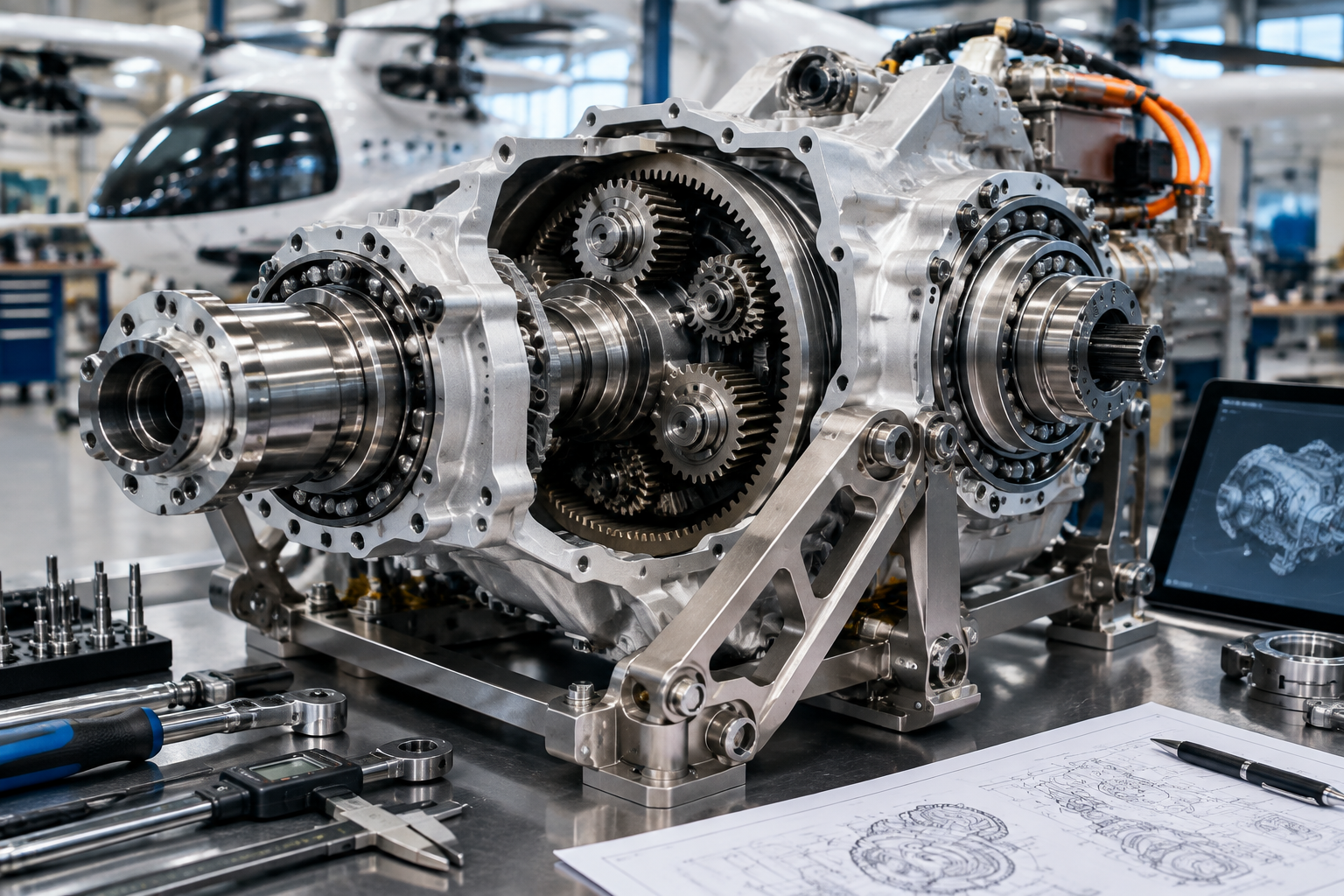
Developers are exploring innovative transmission architectures specifically tailored to electric propulsion. Hybrid transmission designs combine high-speed planetary gearboxes with variable-speed motors, enabling optimized operation across the full flight envelope rather than fixed-ratio designs. Some manufacturers are experimenting with magnetic gearboxes that eliminate mechanical contact, reducing losses and enabling silent operation—an attractive feature for noise-sensitive urban environments.
Three-dimensional additive manufacturing is revolutionizing transmission production, enabling weight reductions of 15-25% compared to traditional forged gearbox housings. Aerospace-grade titanium and advanced composite materials, combined with topology optimization algorithms, produce transmission components that are simultaneously lighter and stronger than earlier designs. These manufacturing breakthroughs directly translate to better power-to-weight ratios and extended range capabilities.
Integrated drivetrain systems that combine motor, transmission, and control electronics into single modular units are emerging as a dominant architecture. These “integrated powerplants” simplify aircraft design, reduce wiring complexity, and enable rapid component replacement and standardization across eVTOL platforms. Companies like Bye Aerospace and Overair are adopting modular transmission units that can be certified once and deployed across multiple aircraft variants, accelerating time to market.
Key Transmission Innovations Driving eVTOL Advancement
- Planetary gearbox configurations enabling 6-8:1 speed reductions with losses under 3%, optimizing electric motor efficiency across diverse flight regimes
- Redundant transmission pathways in multi-rotor designs provide safety margins that satisfy aviation certification requirements and minimize single-point failure risks
- Additive manufacturing and advanced materials reduce transmission weight by 20-25%, directly extending flight range and payload capacity for commercial operations
As eVTOL aircraft transition from concept demonstrations to commercial service, transmission technology will become as critical to success as battery innovation. The manufacturers that perfect efficient, reliable, and lightweight drivetrain systems will establish competitive advantages that persist throughout the decades-long commercialization cycle. For investors, operators, and regulators monitoring the eVTOL sector, transmission development represents an often-overlooked indicator of technical maturity and operational readiness. The next generation of urban air mobility will be defined not by rotor designs or battery chemistry alone, but by the elegant mechanical systems that translate electrical energy into reliable, efficient flight.