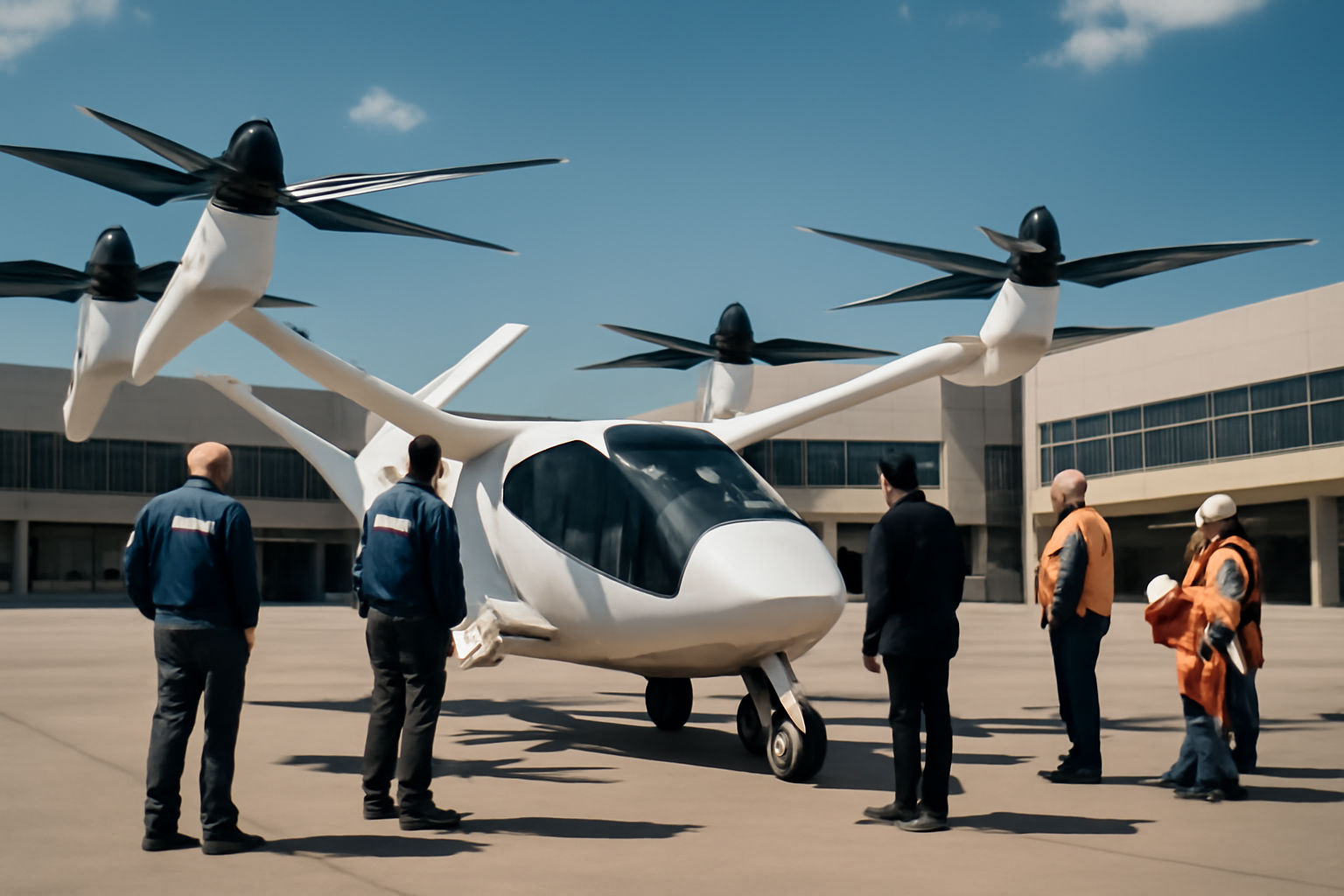
HIGHLIGHTS
- Joby Aviation launches FAA-supported air taxi demonstrations at a Texas airport, bringing commercial eVTOL operations closer to reality
- Federal Aviation Administration backing validates the safety and operational readiness of Joby’s electric vertical takeoff technology
- Texas airport demonstrations mark a critical regulatory milestone for the personal air mobility industry’s path to commercial certification
Joby Aviation has announced the commencement of FAA-backed air taxi demonstrations at a Texas airport, marking a significant milestone in the journey toward commercial electric vertical takeoff and landing (eVTOL) operations in the United States. This development underscores the growing confidence of federal regulators in the company’s technology and operational safety protocols, bringing the vision of urban air mobility closer to mainstream adoption. The demonstrations represent years of intensive research, development, and regulatory engagement finally reaching a demonstrable phase where real-world operations can validate the soundness of Joby’s approach.
Joby Aviation’s Path to Commercial Operations
Joby Aviation has been at the forefront of eVTOL development since its founding, with a singular focus on creating safe, efficient, and sustainable electric aircraft designed for short-distance urban transportation. The company’s proprietary aircraft design features multiple electric rotors that enable vertical takeoff and landing capabilities similar to traditional helicopters but with zero direct emissions and significantly reduced noise levels. This fundamental difference positions Joby as a game-changer for metropolitan areas seeking to reduce congestion and environmental impact.
The Texas demonstrations build on Joby’s extensive testing program, which has included thousands of flights in controlled environments and increasingly complex operational scenarios. The company has invested heavily in understanding the regulatory landscape, working closely with the FAA to establish safety standards and certification pathways that don’t yet exist in aviation law. This collaborative approach has proven effective, as the FAA’s willingness to support live demonstrations signals their confidence in Joby’s safety culture and technical capabilities.
By choosing a Texas airport as the demonstration venue, Joby has selected a location with strong aerospace heritage and forward-thinking infrastructure partners. Texas has long been a hub for aviation innovation and has actively welcomed emerging technologies that promise economic growth and job creation. The partnership between Joby, the FAA, and local authorities demonstrates how public-private collaboration can accelerate the development of transformative transportation solutions.
FAA Support and Regulatory Implications
The Federal Aviation Administration’s backing of these demonstrations is not merely ceremonial—it represents a formal acknowledgment that Joby’s technology meets preliminary safety and operational standards. The FAA has historically approached new aviation technologies with appropriate caution, reflecting decades of experience in ensuring public safety at scale. The fact that regulators are willing to greenlight public demonstrations suggests that Joby has successfully demonstrated technical competence and reliable systems across numerous evaluation criteria.
These demonstrations serve multiple regulatory purposes. First, they provide real-world data on how Joby’s aircraft performs in an operational airport environment, generating evidence on noise levels, electromagnetic interference with existing navigation systems, and ground operations procedures. Second, they allow FAA inspectors and safety engineers to observe actual flights and evaluate pilot proficiency, emergency procedures, and communication protocols. Third, they create a public record of safety performance that will inform future certification decisions for Joby and potentially establish precedents for other eVTOL manufacturers.
The regulatory pathway forward remains complex. While demonstrations validate certain operational aspects, Joby still faces the lengthy Type Certification process required for any new aircraft design. This process typically involves hundreds of test flights, thousands of hours of simulation, and exhaustive documentation of every system’s performance under normal and emergency conditions. However, FAA support at this stage suggests the agency is actively working with Joby to streamline where possible without compromising safety, potentially accelerating the timeline toward commercial certification.
Commercial eVTOL Market Development
The personal air mobility market represents an enormous opportunity for investors, manufacturers, and service operators worldwide. Market research firms estimate that the urban air mobility market alone could be worth tens of billions of dollars annually by 2035, assuming regulatory frameworks are established and safety records support public confidence. Companies like Joby, Archer Aviation, Lilium, and others are racing to achieve certification first, as early movers will likely capture significant market share in underserved routes and premium passenger segments.
Texas demonstrations specifically position Joby to capture market opportunity in a state known for vast geographic distances, congested urban areas, and high-income populations willing to pay premium prices for time savings. Routes connecting Dallas-Fort Worth airports to downtown business districts, or Austin’s tech corridor to outlying research facilities, represent viable initial markets where eVTOL service economics could quickly become attractive. The demonstrations help establish Joby as a credible operator in these markets and build relationships with airports and ground infrastructure partners.
Beyond direct passenger service, the demonstrations validate use cases for emergency medical transport, logistics, and government applications. eVTOL aircraft’s speed, zero-emission operation, and ability to function from distributed vertiport networks make them particularly attractive for time-critical services. Joby’s early success in FAA-backed demonstrations could accelerate adoption timelines for these higher-value applications, which can help subsidize the development costs associated with scaling the technology.
Safety, Noise, and Environmental Considerations
One of Joby’s core competitive advantages is the dramatically reduced noise signature of electric propulsion compared to traditional helicopter and turbine-powered aircraft. eVTOL aircraft operating in urban environments must meet strict noise standards to gain public acceptance and regulatory approval. Early demonstrations of Joby’s aircraft have shown noise levels comparable to heavy traffic, enabling operations in populated areas where traditional helicopters would face significant community opposition. This characteristic is essential for the viability of urban air mobility as a practical service.
The environmental benefits of eVTOL technology extend beyond noise reduction. Operating electric aircraft powered by increasingly renewable energy sources represents a major step forward in decarbonizing aviation. The transportation sector accounts for a significant portion of global greenhouse gas emissions, and eVTOL services could eventually reduce overall emissions if they’re powered by clean electricity and operate at high utilization rates. The Texas demonstrations will generate valuable data on actual energy consumption and operational efficiency that will inform environmental impact assessments.
Safety remains paramount in aviation culture, and Joby’s design philosophy emphasizes redundancy, fault tolerance, and continuous monitoring. Multiple independent electric motors provide propulsion, so loss of any single motor doesn’t render the aircraft uncontrollable. Advanced flight control systems continuously assess aircraft state and automatically compensate for failures. Integration of ground-based air traffic management systems ensures that eVTOL operations remain coordinated and deconflicted from manned and unmanned aircraft. These safety features, demonstrated through extensive testing and now validated in live demonstrations, are essential prerequisites for regulatory approval.
Key Takeaways and Industry Outlook
Critical Milestones Ahead
- Joby’s FAA-backed Texas demonstrations represent a decisive validation of eVTOL technology readiness and a major step toward commercial certification
- Federal Aviation Administration support accelerates regulatory pathways by enabling real-world data collection and building public confidence in safety performance
- Successful demonstrations position Joby to capture early market opportunities in premium urban air mobility and emerge as an industry leader in commercial eVTOL operations
Joby Aviation’s FAA-backed air taxi demonstrations at a Texas airport represent a transformational moment for personal air mobility. The regulatory acknowledgment and public demonstration of Joby’s technology signal that the eVTOL industry is transitioning from prototype development toward commercial reality. While significant regulatory and operational challenges remain before passengers routinely travel in electric aircraft, the Texas demonstrations prove that the technology works and that federal regulators have the confidence and processes necessary to oversee this evolution responsibly. As other manufacturers watch closely and the FAA builds experience with eVTOL operations, the pathway to a new era of urban transportation becomes increasingly clear. The next few years will be critical in determining which companies achieve certification first and establish themselves as leaders in this emerging market.