HIGHLIGHTS
- China unveils a production-ready 6-seat tilt-rotor eVTOL at Hangzhou’s Digital Trade Expo, marking a major milestone in multi-passenger electric aviation
- Larger capacity enables viable commercial ride-sharing and cargo services with improved per-seat economics compared to smaller aircraft
- Accelerated Chinese regulatory timelines suggest commercial urban air mobility operations could launch within 12-24 months in Asian cities
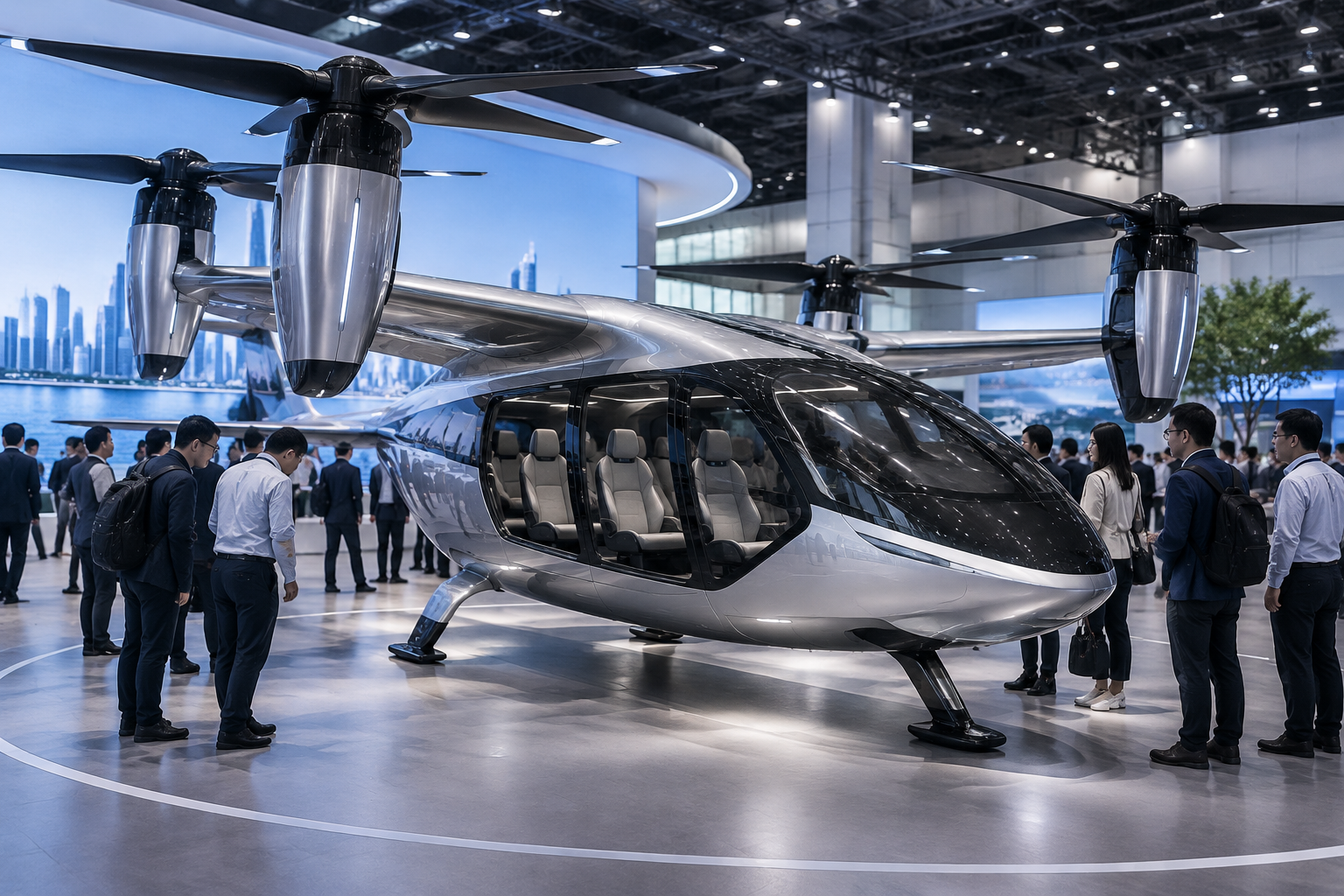
The 5th Global Digital Trade Expo in Hangzhou recently showcased a remarkable milestone in electric aviation: a fully functional 6-seat tilt-rotor eVTOL aircraft that represents the next generation of personal air mobility. This aircraft, displayed prominently at one of Asia’s largest trade exhibitions, demonstrates how advanced aerial technologies are transitioning from prototype labs into commercially viable transportation solutions.
The Rise of Multi-Passenger eVTOLs in China
China has emerged as a global leader in electric aviation innovation, with manufacturers rapidly scaling up from single-seat drone platforms to multi-passenger aircraft. The debut of a 6-seat eVTOL at the Hangzhou Digital Trade Expo underscores Beijing’s strategic commitment to developing sustainable urban air mobility infrastructure. This represents a significant leap forward in capacity, moving beyond traditional single-pilot or two-seat configurations that have dominated the industry.
The Chinese market has been particularly aggressive in eVTOL development, with government support accelerating certification timelines and manufacturing investments. Hangzhou’s position as a tech hub and e-commerce center makes it an ideal venue for showcasing cutting-edge aerospace innovations. The city’s focus on digital transformation and smart urban solutions aligns perfectly with the progressive deployment of autonomous and electric aircraft technologies.
Multi-seat eVTOL platforms are crucial for commercial viability, as they enable ride-sharing and cargo operations that generate sufficient revenue to offset development costs. A 6-seat configuration maximizes passenger capacity while maintaining the efficiency and agility that make electric aircraft attractive alternatives to ground-based transportation in congested metropolitan areas.
Technical Specifications and Design Innovation
The tilt-rotor design showcased at Hangzhou represents a hybrid approach that combines the vertical takeoff capabilities of traditional helicopters with the forward flight efficiency of fixed-wing aircraft. This configuration allows operators to depart and land vertically in urban environments while achieving higher cruise speeds and extended range during transit. The rotor system can transition smoothly between modes, optimizing power consumption for each phase of flight.
Battery technology remains the critical bottleneck for multi-seat eVTOLs, and a 6-passenger aircraft must carry substantially more energy storage than smaller prototypes. Modern lithium-ion and emerging solid-state battery packs provide the necessary power density while meeting weight constraints essential for vertical takeoff operations. The aircraft’s range and endurance depend on aerodynamic efficiency, battery capacity, and mission-specific payload requirements.
Distributed electric propulsion—using multiple smaller motors instead of traditional large engines—offers redundancy, improved control authority, and simplified mechanical architecture. This design philosophy has become standard across the eVTOL industry and is particularly evident in the 6-seat tilt-rotor platform displayed in Hangzhou. The electrical architecture must coordinate dozens of systems simultaneously, requiring sophisticated flight control computers and safety-critical software.
Regulatory Pathways and Certification Progress
China’s aviation regulatory authorities have been streamlining certification processes for electric aircraft, creating a more favorable environment for rapid commercialization compared to Western regulatory frameworks. The public display of a fully integrated 6-seat eVTOL suggests that the aircraft has cleared preliminary safety and performance evaluations, bringing it closer to operational certification. This accelerated timeline reflects China’s strategic bet on becoming the world’s leading eVTOL manufacturer.
International certification standards are evolving to accommodate the unique characteristics of electric vertical takeoff aircraft, which differ fundamentally from traditional helicopters and fixed-wing planes. Regulators must develop new testing protocols, pilot training requirements, and airspace integration procedures for this emerging category. The visibility of prototype aircraft at major trade expos often signals readiness for the next phase of regulatory engagement.
Once certified, multi-passenger eVTOLs will operate under specific operational limitations that define airspace corridors, weather minimums, and mission profiles. Urban air mobility services typically begin with predefined routes between major transportation hubs, gradually expanding geographic coverage as operational experience and regulatory confidence increase. The Hangzhou eVTOL’s public debut suggests that Chinese manufacturers expect certification within the next 12-24 months.
Commercial Applications and Urban Mobility Integration
A 6-seat eVTOL opens diverse commercial possibilities beyond simple passenger transportation. Ride-sharing operators could deploy these aircraft for premium urban mobility services connecting airports, business districts, and entertainment venues. The increased capacity justifies higher infrastructure investment and creates meaningful cost-per-passenger economics compared to smaller point-to-point aircraft.
Hangzhou’s booming tech economy and tourist attractions make it an ideal initial deployment market for commercial eVTOL services. Cities with severe traffic congestion, where air mobility can save significant time, are natural early adopters. Corporate campuses, industrial zones, and inter-city routes represent additional near-term applications that don’t depend on full urban air mobility ecosystems.
The environmental benefits of electric aviation resonate strongly in Chinese markets, where air quality concerns drive policy prioritization and public support. A 6-seat eVTOL can remove dozens of individual cars from congested roadways, reducing overall emissions and improving urban livability. This sustainability narrative attracts government incentives, including infrastructure grants and operational subsidies for early commercial services.
Key Takeaways from Hangzhou’s eVTOL Showcase
- China demonstrates eVTOL leadership with a production-ready 6-seat tilt-rotor aircraft at a major international trade exposition
- Multi-passenger configurations enable commercial viability by supporting ride-sharing and cargo operations with improved per-seat economics
- Accelerated Chinese certification timelines suggest commercial urban air mobility services could launch within 12-24 months in major Asian cities
The 5th Global Digital Trade Expo in Hangzhou marks a pivotal moment in electric aviation history. The public unveiling of a fully integrated 6-seat eVTOL demonstrates that the technology has matured beyond research stages into commercially relevant platforms. As China continues advancing electric aircraft development, the gap between prototype demonstrations and revenue-generating operations continues to narrow, bringing the reality of urban air mobility closer to everyday travelers worldwide.