HIGHLIGHTS
- Comac’s 19-seat demonstrator leverages state-backed funding and existing aerospace infrastructure to accelerate eVTOL development beyond startup competitors.
- The 19-seat capacity class targets a commercially viable market segment balancing current battery limitations with passenger economics and regional transport viability.
- Comac’s entry signals intensified geopolitical competition in electric aviation, requiring international manufacturers to accelerate their own development timelines and confront new pricing pressures.
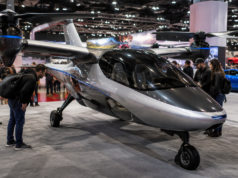
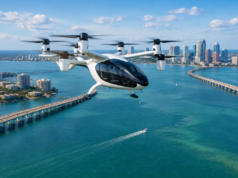
China’s Commercial Aircraft Corporation (Comac), the state-owned manufacturer behind the C919 narrowbody jetliner, has reportedly built a 19-seat electric aircraft demonstrator, signaling the country’s serious commitment to developing scalable electric vertical takeoff and landing (eVTOL) platforms. This development represents a strategic pivot for Comac beyond conventional fixed-wing aircraft manufacturing and into the rapidly expanding personal air mobility sector. The construction of such a substantial demonstrator—capable of carrying up to 19 passengers—suggests Comac’s ambitions extend far beyond niche urban air mobility applications into regional and medium-capacity electric transport solutions.
Comac’s Entry Into the eVTOL Market
Comac has historically focused on developing and manufacturing large commercial aircraft to reduce China’s dependence on Boeing and Airbus. The Commercial Aircraft Corporation of China has invested heavily in aerospace infrastructure, engineering talent, and manufacturing capabilities over the past two decades. This established foundation of expertise, combined with government backing and access to battery and electric motor suppliers across China’s industrial ecosystem, positions Comac uniquely to scale electric aircraft development rapidly.
The reported 19-seat demonstrator marks Comac’s most visible commitment to the emerging eVTOL and electric aviation sector. Unlike startups that must build manufacturing facilities from scratch, Comac can leverage existing production lines, supply chain relationships, and regulatory navigation experience gained through C919 certification. This operational advantage accelerates the timeline from prototype to production-ready aircraft, potentially allowing Comac to compete with international players already flight-testing their designs.
The decision to build a 19-seat variant rather than smaller urban air mobility platforms reflects strategic thinking about market scalability. A 19-seat aircraft serves regional routes, airport shuttle services, and medium-capacity transportation corridors more effectively than six- to eight-seat competitors. This capacity class positions Comac’s demonstrator in a commercially viable sweet spot that balances battery weight, range constraints, and passenger economics inherent to current electric propulsion technology.
Technical Specifications and Design Philosophy
A 19-seat electric aircraft imposes significant engineering challenges, primarily around battery energy density and thermal management. Modern lithium-ion battery technology operates in the 200–300 watt-hour per kilogram range, meaning a demonstrator capable of carrying 19 passengers plus crew would require battery packs weighing several thousand kilograms. Comac engineers must balance structural weight, motor efficiency, and aerodynamic optimization to achieve practical range and payload performance within these constraints.
The demonstrator likely employs distributed electric propulsion across multiple motors, a design philosophy increasingly favored by eVTOL manufacturers to optimize efficiency and improve safety through redundancy. Comac’s aerospace heritage suggests the aircraft will incorporate advanced composites, systems redundancy, and fault-tolerance architecture refined through C919 development. These engineering disciplines prove invaluable when certifying novel electric propulsion systems with civil aviation authorities.
Range and charging infrastructure remain critical unknowns. Electric aircraft of this capacity typically achieve ranges between 200–500 kilometers per charge, depending on payload and altitude profiles. The demonstrator’s intended mission profile—whether optimized for short-hop regional routes or longer intercity corridors—will significantly influence battery selection, charging architecture, and operational cost modeling. Comac’s access to China’s rapidly expanding fast-charging infrastructure may provide testing advantages unavailable to competitors operating in regions with less developed EV support ecosystems.
Geopolitical and Market Implications
Comac’s eVTOL initiative reflects broader strategic positioning within China’s industrial policy frameworks. The Chinese government has prioritized personal air mobility and electric aviation as key technologies for 14th and 15th Five-Year Plans, allocating substantial research funding and regulatory support. Comac’s demonstrator aligns perfectly with these national technology roadmaps and signals confidence that the domestic market will sustain commercial operations once certification pathways mature.
The 19-seat capacity class occupies a competitive space currently targeted by international companies including the European Union’s Urban Air Mobility Initiative participants, Japanese SkyDrive, and various North American startups. By establishing credibility in this market segment early, Comac can capture regional airline partnerships, aerospace supplier relationships, and regulatory precedent that will prove valuable as electric aviation matures. China’s domestic operators, potentially including Air China and China Southern Airlines, represent enormous potential end-users if Comac can achieve performance and cost targets.
International certification harmonization remains uncertain, but Comac’s track record with C919 demonstrates the company’s ability to navigate multi-regulatory environments. A commercially successful eVTOL platform could penetrate markets across Asia, Africa, and emerging economies where Comac already maintains diplomatic and economic relationships. This represents a significant competitive advantage over Western manufacturers primarily targeting North American and European airspace.
Challenges and Timeline Considerations
Moving from demonstrator to certified, commercially viable electric aircraft requires surmounting substantial regulatory and technical hurdles. China’s Civil Aviation Administration (CAAC) has not yet established comprehensive certification frameworks for electric aircraft, requiring parallel development of safety standards, pilot training protocols, and maintenance procedures. Comac must work closely with CAAC to define these pathways, a process that typically spans multiple years even with government prioritization.
Battery technology remains the limiting factor for electric aircraft at this capacity level. While lithium-ion chemistry continues improving incrementally, transformative advances in solid-state batteries or alternative chemistries are likely five to ten years away. Comac’s timeline for commercial service will partially depend on whether interim battery improvements suffice to achieve economically viable performance or whether the company must wait for next-generation energy storage breakthroughs.
Manufacturing scale-up presents another challenge. Transitioning from a single demonstrator to producing dozens or hundreds of aircraft annually requires securing component suppliers, training manufacturing workforces in novel assembly processes, and establishing quality assurance protocols for complex electric propulsion systems. Comac’s existing production infrastructure accelerates this process compared to greenfield manufacturers, but scaling electric aircraft production remains fundamentally different from conventional airframe manufacturing.
Competitive Landscape and Industry Response
Comac’s reported demonstrator entry accelerates competitive pressures across the global eVTOL sector. Companies including Eviation (Alice), Heart Aerospace, and Bye Aerospace have faced extended development timelines and funding challenges. The introduction of a well-capitalized, government-backed competitor with aerospace manufacturing expertise raises the performance bar for certification and commercialization timelines. International manufacturers must now anticipate that Comac will compete aggressively on cost, backed by China’s industrial policy subsidies and state enterprise financing.
Supply chain implications extend beyond aircraft manufacturers to component suppliers. Battery manufacturers, motor producers, avionics integrators, and composite material suppliers will face increased competition as Comac prioritizes sourcing from Chinese suppliers. This geographic shift in the eVTOL supply ecosystem could reshape international competitiveness and accelerate technology transfer within China’s industrial sector.
The demonstrator’s existence, though unconfirmed officially by Comac, signals that critical technical breakthroughs have been achieved internally. The company clearly believes a 19-seat electric aircraft is feasible within near-term timeframes and commercially viable at acceptable cost structures. This confidence suggests Comac possesses proprietary advances in battery integration, motor efficiency, or aircraft design that warrant investment in a full-scale demonstrator rather than incremental testbed approaches.
Key Takeaways for the eVTOL Industry
- China’s Comac has reportedly constructed a 19-seat electric aircraft demonstrator, representing the nation’s most substantial eVTOL commitment by an established aerospace manufacturer and signaling confidence in near-term commercialization timelines.
- The 19-seat capacity class addresses a commercially viable market segment balancing battery constraints with passenger economics, positioning Comac competitively against international eVTOL startups targeting similar operational niches.
- Comac’s government backing, existing aerospace manufacturing infrastructure, and access to China’s EV supply chain provide competitive advantages in scaling from demonstrator to production, potentially disrupting international eVTOL market timelines and pricing expectations.
Comac’s reported 19-seat electric aircraft demonstrator represents a watershed moment in the global eVTOL sector. As China’s flagship aerospace manufacturer, Comac brings manufacturing discipline, government resources, and regulatory relationships that distinguish its eVTOL program from venture-backed startups pursuing similar objectives. The next critical milestones will involve CAAC certification pathway definition, performance validation through flight testing, and supplier ecosystem development. If Comac successfully navigates these challenges, the company could accelerate commercial eVTOL deployment across Asia while intensifying competition for international manufacturers. The aviation industry should monitor Comac’s progress closely, as the outcomes will significantly influence how rapidly electric aviation transitions from experimental technology to operational transportation infrastructure. Stakeholders worldwide now face an accelerated timeline for developing their own electric aircraft capabilities to remain competitive in what appears to be an increasingly contested market landscape.