HIGHLIGHTS
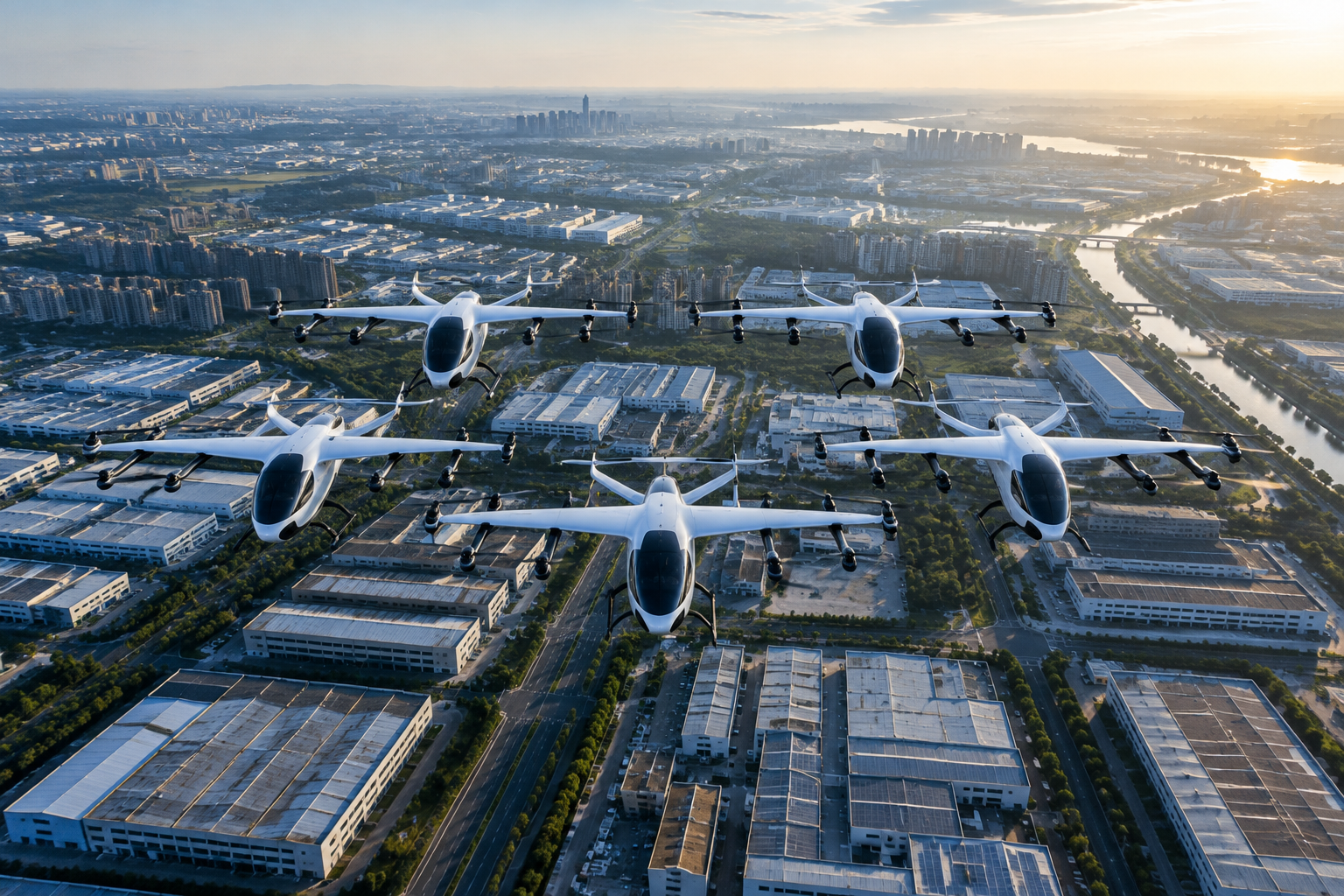
- AutoFlight completes synchronized five-aircraft formation flight in Kunshan, demonstrating production-ready autonomous coordination capabilities
- Real-time multi-aircraft control proves technical feasibility of commercial fleet operations in shared urban airspace environments
- Chinese eVTOL manufacturer’s breakthrough achievement accelerates regulatory approval pathways and intensifies competitive pressure globally
Chinese eVTOL manufacturer AutoFlight has achieved a significant technological milestone by completing a coordinated formation flight with five aircraft simultaneously over Kunshan. This breakthrough demonstration showcases the company’s expertise in autonomous flight coordination and represents a major step forward for the personal air mobility industry. The successful multi-aircraft maneuver highlights AutoFlight’s progress toward scalable, safe urban air mobility solutions that could reshape transportation infrastructure across Asia and beyond.
AutoFlight’s Path to Formation Flight Excellence
AutoFlight has established itself as one of China’s most ambitious eVTOL developers, with a focus on distributed electric propulsion systems designed for efficiency and reliability. The company’s engineering team has spent years refining autonomous flight control systems capable of managing complex aerial operations safely. This formation flight represents the culmination of extensive research, simulation, and ground testing that demonstrates their readiness to advance beyond single-aircraft demonstrations.
The Kunshan location was strategically chosen for its airspace conditions and proximity to major transportation corridors in the Yangtze River Delta region. AutoFlight coordinated with Chinese aviation authorities to secure the necessary clearances and airspace access for the multi-aircraft operation. This collaborative approach with regulators is essential for building the infrastructure and trust required for widespread urban air mobility deployment.
The five-aircraft formation represents a tangible proof-of-concept for fleet operations in commercial air mobility networks. Operating multiple eVTOLs in coordinated flight requires sophisticated communication systems, collision avoidance algorithms, and synchronized autonomous control. AutoFlight’s successful execution demonstrates the technical maturity necessary for eventual passenger and cargo transport scenarios that could involve dozens or hundreds of simultaneous airborne vehicles.
Technical Achievements in Autonomous Coordination
Formation flight represents one of the most demanding challenges in autonomous aviation because it requires real-time decision-making and precise spatial coordination between independent aircraft. Each vehicle in the formation must continuously monitor the positions and velocities of its neighbors while maintaining safe separation distances. AutoFlight’s autonomous systems managed these calculations and aircraft control inputs in real-time, accounting for atmospheric conditions, wind patterns, and potential emergency scenarios.
The technical complexity extends to communication architecture, as each aircraft must share telemetry data with the formation leader and neighboring vehicles. Low-latency, redundant communication links ensure that if any single aircraft experiences an anomaly, the formation can safely adapt without compromising overall mission safety. AutoFlight’s systems incorporate fail-safe protocols that would allow any aircraft to safely exit the formation and execute autonomous landing procedures if necessary.
Sensor fusion plays a critical role in formation stability, combining input from GPS, inertial measurement units, radar, and visual systems to maintain precise relative positioning. The integration of these diverse sensor streams into coherent flight control commands requires sophisticated algorithms tested extensively in simulation before physical flight. AutoFlight’s engineering team demonstrated mastery of this multi-sensor environment during the Kunshan demonstration.
Industry Implications for Urban Air Mobility Networks
The successful five-aircraft formation flight signals to investors, regulators, and competitors that AutoFlight possesses the technological foundation for scaled commercial operations. Urban air mobility networks will eventually require the simultaneous operation of numerous eVTOLs operating in shared airspace, managed through automated air traffic management systems. AutoFlight’s demonstration provides practical evidence that such coordination is achievable with current technology.
Chinese regulatory authorities are watching eVTOL development closely as they consider certification frameworks for new aircraft categories. AutoFlight’s formation flight achievement will likely inform future regulations governing fleet operations, autonomous flight authority, and safety standards for distributed electric aviation. Successful demonstrations by domestic manufacturers help policymakers develop evidence-based rules that encourage innovation while maintaining safety.
For the broader Asia-Pacific region, AutoFlight’s capabilities position Chinese manufacturers as serious contenders in the global eVTOL race alongside established American, European, and other Asian competitors. The formation flight demonstrates that eVTOL technology development is no longer limited to small-scale prototype operations but advancing toward operationally realistic scenarios. This competitive momentum accelerates the timeline for commercial air mobility deployment across densely populated Asian cities.
Path Forward: From Demonstration to Commercial Deployment
Formation flight demonstrations serve as important waypoints on the journey toward certified commercial operations, but significant milestones remain ahead. AutoFlight must continue building safety cases through extensive flight testing, regulatory engagement, and validation of human-machine interfaces. The company is likely conducting parallel development of passenger-carrying prototypes, cargo variants, and ground-based air traffic management systems required for real-world deployment.
Infrastructure development represents another critical challenge beyond aircraft technology. Vertiport design, ground charging systems, maintenance facilities, and integration with existing transportation networks require substantial capital investment and coordination with city planning authorities. AutoFlight’s technology demonstrations position them to partner with municipal governments and transportation agencies developing urban air mobility ecosystems.
The five-aircraft formation flight also advances public perception of autonomous aviation safety by demonstrating controlled, coordinated operations in real airspace. As media coverage and technical documentation spread throughout industry and public channels, confidence in eVTOL technology and autonomous flight capabilities increases. This perception shift is essential for regulatory approval and eventual passenger adoption of air mobility services.
Key Takeaways from AutoFlight’s Formation Flight Achievement
- AutoFlight successfully executed a coordinated five-aircraft formation flight in Kunshan, demonstrating advanced autonomous systems required for commercial air mobility fleet operations
- The demonstration proves that sophisticated real-time coordination, collision avoidance, and distributed autonomous control are technically feasible with current technology, accelerating the timeline toward certified operations
- AutoFlight’s achievement signals to Asian regulators and international investors that Chinese eVTOL manufacturers are advancing rapidly toward commercial deployment, intensifying global competition in the air mobility market
AutoFlight’s successful five-aircraft formation flight represents a watershed moment for Chinese eVTOL development and signals the industry’s transition from isolated prototype flights toward coordinated multi-aircraft operations. As the company continues advancing its technology roadmap, additional demonstrations will likely showcase increasingly complex scenarios such as dynamic fleet management, urban airspace integration, and mixed autonomous-piloted operations. The formation flight achievement underscores that the technical barriers to commercial air mobility are yielding to sustained engineering effort, bringing closer the reality of electric aircraft revolutionizing transportation across Asia’s rapidly urbanizing regions.