HIGHLIGHTS
- Congressman Higgins launches first major government-backed eVTOL pilot program in Houma, Louisiana, with dedicated vertiport infrastructure
- Pilot expected to generate high-skilled jobs in engineering, operations, and maintenance while attracting aerospace suppliers and tech firms to the region
- Safety and regulatory data from Houma will inform comprehensive FAA eVTOL standards and create replicable models for nationwide air mobility deployment
Congressman Clay Higgins has announced a groundbreaking advanced air mobility pilot program launching in Houma, Louisiana, representing a significant milestone for the commercialization of electric vertical takeoff and landing aircraft in the Gulf Coast region. This initiative underscores growing momentum in the U.S. aviation sector to integrate sustainable, innovative transportation solutions into existing infrastructure and communities. The Houma pilot represents one of the first major government-backed efforts to establish operational frameworks for eVTOL services in a regional hub, setting precedent for similar programs across the nation.
Strategic Location and Infrastructure Development
Houma’s selection as the site for this advanced air mobility pilot program is strategic, given its position as a major industrial and energy hub in Louisiana. The city’s existing infrastructure, including transportation networks and commercial facilities, provides an ideal foundation for testing eVTOL operations at scale. Houma’s geographic advantages include proximity to multiple population centers and established emergency response capabilities, which are critical for safe testing and eventual commercial deployment of air mobility services.
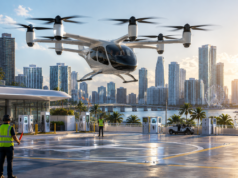
The groundbreaking marks the beginning of physical infrastructure development, including the construction of vertiports—specialized landing and charging facilities designed for eVTOL aircraft. These facilities represent a new category of aviation infrastructure, distinct from traditional heliports and airports, and require innovative design to accommodate electric propulsion systems, passenger amenities, and rapid turnaround operations. Houma’s pilot will serve as a proving ground for vertiport design and operational standards that could become models for other regions.
This investment in regional infrastructure demonstrates confidence from both government and private stakeholders in the commercial viability of eVTOL technology. By establishing dedicated facilities and operational zones in Houma, the pilot program will gather critical data on passenger demand, safety protocols, environmental impact, and cost efficiency that inform broader rollout strategies across the United States.
Economic and Employment Opportunities
The advanced air mobility pilot program is expected to generate significant economic opportunities for Houma and surrounding areas. Construction and ongoing operations will create jobs spanning mechanical engineering, aviation operations, maintenance technicians, pilots, and ground support personnel. These high-skilled positions align with Louisiana’s growing focus on retaining talent in advanced technology sectors and diversifying beyond traditional energy industries.
Beyond direct employment, the program will attract ancillary businesses and service providers to Houma, including aerospace suppliers, battery technology firms, and logistics companies. The pilot’s success could position Houma as a regional hub for eVTOL manufacturing, testing, and operations, generating long-term economic growth and establishing the city as a leader in advanced air mobility technology. Companies specializing in autonomous systems, software development, and fleet management are likely to establish presences to support operational needs.
Congressman Higgins’ backing of this initiative signals strong federal support for eVTOL development in Louisiana, potentially attracting additional federal funding and private investment. The program demonstrates how government leadership can catalyze innovation while creating measurable economic benefits for local communities, positioning Houma as a model for regional development through emerging technologies.
Regulatory Framework and Safety Standards
The Houma pilot program will operate under established Federal Aviation Administration guidelines while simultaneously gathering data to inform the development of comprehensive eVTOL regulations. Current FAA frameworks for electric aircraft are still evolving, and pilot programs like Houma’s serve as critical testing grounds for identifying regulatory gaps and opportunities for streamlined certification processes. The program will generate safety data specific to regional operations, weather conditions, and urban-adjacent flight patterns.
Safety protocols established during the Houma pilot will address critical operational challenges including emergency procedures, traffic management in shared airspace, communication standards between eVTOL operators and traditional aviation, and passenger safety training requirements. These standards will be documented and made available to other pilot programs and future commercial operators, accelerating the industry’s ability to achieve consistent safety benchmarks across the United States.
The groundbreaking also signals regulatory confidence in eVTOL technology readiness. Federal and state agencies involved in the Houma pilot have conducted extensive technical reviews confirming that current electric aircraft designs meet or exceed safety standards for commercial operations. This regulatory validation is crucial for building public confidence and attracting private investment to the eVTOL sector.
Environmental and Sustainability Impact
The Houma advanced air mobility pilot exemplifies the broader shift toward sustainable transportation solutions in aviation. Electric vertical takeoff and landing aircraft produce zero direct emissions, significantly reducing the carbon footprint compared to traditional helicopter or fixed-wing aviation. For a region historically dependent on hydrocarbon industries, the adoption of eVTOL technology demonstrates Louisiana’s commitment to environmental stewardship and energy transition.
The program will provide concrete data on emission reductions, noise pollution mitigation, and environmental benefits compared to conventional aircraft. Houma’s proximity to sensitive ecosystems including wetlands and bayou environments makes it an important testing location for understanding eVTOL impacts on wildlife and natural habitats. Results from the pilot will inform best practices for future air mobility operations in environmentally sensitive regions.
Electric aircraft also offer operational efficiencies that translate to lower noise levels during takeoff and landing operations. This environmental advantage makes eVTOL particularly suitable for integration into regional transportation networks, where noise considerations have historically limited aviation development. The Houma pilot will measure and document these noise reductions, providing evidence to support community acceptance and potential expansion of air mobility services.
Key Takeaways from the Houma Pilot Program
- Houma’s advanced air mobility pilot represents one of the first major government-backed eVTOL infrastructure projects, establishing vertiports and operational frameworks in Louisiana’s industrial hub
- The program is expected to generate high-skilled employment across engineering, aviation operations, and maintenance while positioning Houma as a regional center for eVTOL technology development
- Safety and regulatory data gathered during the pilot will inform comprehensive FAA eVTOL standards and create replicable models for future air mobility programs nationwide
Congressman Clay Higgins’ groundbreaking ceremony at Houma marks a pivotal moment for advanced air mobility in the United States. As the eVTOL industry transitions from prototype demonstrations to commercial-scale operations, pilot programs like Houma will prove essential for establishing the infrastructure, regulatory frameworks, and operational practices that enable widespread adoption. The program’s success will demonstrate that American communities can successfully integrate sustainable aviation technologies while generating economic growth and environmental benefits. Future developments in Houma will be closely monitored by aviation regulators, industry stakeholders, and communities nationwide considering their own air mobility initiatives.