
HIGHLIGHTS
- ProjectAir’s circular fuselage distributes structural stress evenly, reducing weight and material needs while improving durability compared to traditional linear eVTOL designs.
- Circular geometry provides superior aerodynamic efficiency, better lateral stability, and smoother hover-to-flight transitions without requiring larger batteries.
- Circular aircraft are faster and cheaper to manufacture using advanced composite wrapping and standardized components, enabling rapid scaling for commercial production.
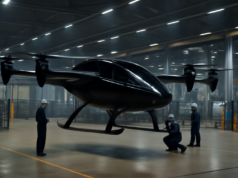
ProjectAir has unveiled a groundbreaking approach to electric vertical takeoff and landing (eVTOL) aircraft design that fundamentally challenges the conventional wisdom dominating the personal air mobility industry. By constructing a giant circle-based aircraft, the company has demonstrated that circular geometry offers distinct aerodynamic and operational advantages over the traditional straight-line configurations that have defined eVTOL development for years. This innovative shift in aircraft architecture could reshape how manufacturers approach future vehicle designs and accelerate the adoption of personal air mobility solutions worldwide.
The Geometry Revolution in Aircraft Design
The traditional eVTOL market has been dominated by designs featuring elongated fuselages, fixed-wing or multirotor configurations, and linear power distribution systems. ProjectAir’s departure from this paradigm represents a bold reimagining of what personal air mobility vehicles can look like. By embracing circular geometry, the company has created an aircraft that challenges fundamental assumptions about aircraft layout, structural efficiency, and aerodynamic performance that have governed aviation design for over a century.
Circular design principles offer several theoretical advantages that linear configurations cannot match. A circular fuselage distributes stress more evenly across the airframe, potentially reducing structural weight while improving overall durability. This uniform stress distribution means that circular designs can handle higher operational loads with less material, directly translating to lighter, more efficient aircraft that require less battery capacity for equivalent performance.
The breakthrough achieved by ProjectAir’s experimental circle plane demonstrates that these theoretical advantages are achievable in practice. Flight testing and operational data from the circular aircraft have provided empirical evidence supporting the engineering models that predicted superior performance compared to conventional straight-line designs. This validation opens the door for other manufacturers to explore circular geometries in their own eVTOL development programs.
Aerodynamic Benefits of Circular Architecture
Aerodynamic efficiency is the cornerstone of practical eVTOL performance, directly affecting flight range, payload capacity, and energy consumption. ProjectAir’s circular design offers distinct aerodynamic advantages that traditional configurations struggle to match. The symmetrical geometry of a circular fuselage creates more consistent airflow characteristics across the entire aircraft, reducing turbulence and drag that plague conventional designs during various flight phases.
One of the most significant aerodynamic benefits is improved vertical takeoff and landing performance. The circular geometry allows for more balanced thrust vectoring and more efficient rotor arrangements, enabling smoother transitions between hover mode and forward flight. This smoother transition reduces energy waste that occurs during mode changes in conventional tiltrotor or multirotor designs, extending overall flight endurance without requiring larger battery packs.
Additionally, the circular design provides superior lateral stability characteristics. Traditional eVTOLs often require complex control systems and multiple stabilization sensors to maintain safe flight, particularly in windy conditions or during unexpected maneuvers. ProjectAir’s circle plane architecture inherently provides better lateral stability due to its symmetrical geometry, potentially reducing the complexity of flight control systems and improving overall safety margins during diverse operational scenarios.
Manufacturing and Production Advantages
Beyond aerodynamics, ProjectAir’s circular design offers compelling manufacturing advantages that could streamline production and reduce costs as the eVTOL industry scales. Circular fuselages can be manufactured using advanced composite wrapping techniques that are faster and more efficient than traditional panel assembly methods required for conventional aircraft. This production efficiency could reduce manufacturing time and labor costs significantly compared to current eVTOL construction practices.
The uniform geometry of a circular design also simplifies quality control processes. Each component and section of the airframe follows the same geometric specifications, reducing variability and the need for custom-fitted parts. Standardization across the production process means fewer errors, faster assembly times, and higher overall product consistency—critical factors for scaling production to meet the anticipated demand for personal air mobility vehicles.
Component integration becomes more straightforward in a circular architecture. Battery packs, avionics, control systems, and propulsion components can be arranged in concentric rings or distributed along the circular fuselage with better spatial efficiency. This organized arrangement reduces cable runs, simplifies maintenance access, and improves overall system reliability compared to the cramped, linear fuselage designs typical of current eVTOLs.
Market Implications and Industry Response
ProjectAir’s successful demonstration of circle-based aircraft technology is already generating significant interest throughout the eVTOL industry. Established manufacturers, startup companies, and research institutions are beginning to evaluate how circular geometry might be integrated into their own development roadmaps. The validation of this alternative design approach expands the design space for personal air mobility vehicles, encouraging innovation and competition across multiple architectural concepts.
The circular design concept has immediate implications for the competitive landscape of personal air mobility. Companies like Jetson, which have established market positions with conventional designs, now face decisions about whether to invest in exploring alternative geometries or maintain their current development paths. The emergence of viable circular designs creates pressure to innovate and could accelerate the overall pace of eVTOL development as manufacturers seek competitive advantages.
Regulatory bodies are also paying close attention to ProjectAir’s achievements. Aircraft certification standards and airworthiness requirements will need to evolve to accommodate circular designs, potentially requiring new testing protocols and validation procedures. Early engagement with regulators could position ProjectAir and early adopters of circular geometry as category leaders in the next generation of eVTOL aircraft, with standards developed around their innovative approach.
Future Development and Scaling Potential
ProjectAir’s success with the giant circle plane represents a proof-of-concept that opens numerous paths for refinement and optimization. Future iterations will likely explore variations in circular geometry, including different diameter-to-height ratios, hybrid designs that blend circular and traditional elements, and modular approaches that allow customization for specific mission profiles. Each variation will contribute to a growing body of knowledge about circular aircraft performance across diverse operational scenarios.
Scaling the circular design to commercial production represents the next critical milestone. ProjectAir’s current focus on demonstrating the viability of the concept must transition into developing manufacturing processes, supply chain relationships, and certification pathways that enable mass production. Partnerships with established aerospace suppliers and component manufacturers will be essential for achieving the production volumes necessary to serve the growing personal air mobility market.
The circular design’s potential extends beyond individual passenger vehicles. Cargo variants, autonomous delivery platforms, and specialized configurations for surveillance or emergency response applications could all benefit from circular architecture. This versatility suggests that ProjectAir’s innovation could establish a foundational design principle that influences multiple segments of the emerging air mobility economy for decades to come.
Key Takeaways from ProjectAir’s Circle Plane Innovation
- ProjectAir’s circular aircraft design distributes structural stress more evenly, reducing weight while improving durability—a fundamental advantage over conventional linear eVTOL fuselages
- Circular geometry delivers superior aerodynamic efficiency with better lateral stability and smoother hover-to-flight transitions, extending range without larger batteries
- Manufacturing circular aircraft is faster and more cost-effective using advanced composite wrapping and standardized components, enabling scaled production for commercial markets
ProjectAir’s giant circle plane represents a watershed moment for personal air mobility innovation. By proving that circular geometry outperforms conventional straight-line designs across aerodynamics, manufacturing, and operational efficiency, the company has fundamentally altered the trajectory of eVTOL development. As the industry absorbs these findings and explores circular architecture applications, we can expect a wave of innovation from competitors seeking to leverage similar advantages. The next chapter of air mobility evolution will be shaped by the principles ProjectAir has validated, making this circular design revolution a pivotal milestone in the race toward practical, efficient, and accessible personal air vehicles.