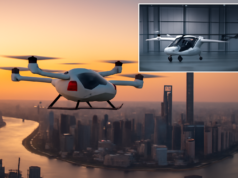

The personal air mobility industry reached a significant milestone in July 2026 when Orlando International Airport announced plans to establish flying taxi landing pads near its train station. This groundbreaking development represents a crucial step toward integrating electric vertical takeoff and landing aircraft (eVTOL) into mainstream transportation networks. As multiple eVTOL companies position themselves to capitalize on this opportunity, the aviation industry is witnessing a transformative shift that could reshape urban transportation for decades to come.
Orlando International Airport Leads the eVTOL Revolution
Orlando International Airport’s decision to install flying taxi landing pads marks a watershed moment for the eVTOL industry. The proximity of these landing pads to the airport’s train station creates a seamless multimodal transportation hub that could serve millions of travelers annually. This strategic positioning demonstrates how airports are evolving beyond traditional runway-based operations to accommodate next-generation aircraft.
The development reflects growing confidence among major infrastructure operators that eVTOL technology has matured sufficiently for real-world deployment. By investing in landing pad infrastructure, Orlando International Airport is signaling to the market that electric air taxis are no longer theoretical concepts but practical solutions for congestion mitigation and passenger connectivity.
This initiative aligns with broader trends across major metropolitan airports worldwide. Leading aviation hubs from Singapore to Paris have begun exploring similar infrastructure investments, creating a competitive landscape where early adoption provides significant advantages in attracting eVTOL operators and capturing market share in the emerging urban air mobility sector.
The Strategic Advantage of Train Station Integration
The placement of flying taxi pads adjacent to Orlando’s train station represents sophisticated transportation planning. This configuration allows travelers to seamlessly transition between different modes of transport, maximizing efficiency and passenger convenience. A visitor arriving at the train station can immediately access air taxi services, while departing eVTOL passengers can quickly connect to rail transportation.
This integrated approach addresses one of the critical challenges facing urban air mobility: the last-mile connectivity problem. By positioning eVTOL pads near existing public transportation infrastructure, Orlando is creating a truly multimodal transportation ecosystem that enhances accessibility while reducing reliance on ground-based vehicles in congested urban areas.
The synergy between rail and air taxi networks could unlock significant economic benefits for the region. Shorter travel times between downtown Orlando and the airport via flying taxi could boost tourism, attract business travelers, and increase property values in surrounding areas. This infrastructure investment may also serve as a catalyst for similar developments throughout Florida’s transportation network.
Key Integration Benefits
- Seamless passenger transfers between air and rail transportation modes
- Reduced ground congestion through multimodal transportation options
- Enhanced accessibility for airport passengers and downtown commuters
- Increased operational efficiency for eVTOL fleet management
- Improved economic competitiveness for the Orlando region
Multiple eVTOL Companies Position for Market Opportunity
The announcement has attracted significant attention from the eVTOL industry, with several manufacturers expressing interest in operating from Orlando’s new infrastructure. Leading companies in the electric air taxi space recognize that early access to mature landing facilities at major airports provides substantial competitive advantages. These firms are investing heavily in regulatory compliance, certification processes, and operational readiness to capitalize on this unprecedented opportunity.
Competition among eVTOL operators is intensifying as the industry matures. Companies are differentiating themselves through technology innovation, safety records, environmental sustainability, and passenger experience. The Orlando opportunity represents a proving ground where multiple operators can demonstrate their capabilities to investors, regulators, and the traveling public.
The involvement of multiple eVTOL companies also creates healthy market competition that will ultimately benefit consumers through improved services, competitive pricing, and technological advancement. Rather than a monopolistic scenario, this distributed approach ensures that the eVTOL industry in Orlando will benefit from diverse operational philosophies and technical innovations.
Infrastructure Development and Future Scalability
Orlando International Airport’s landing pad infrastructure is designed with scalability in mind, allowing for expansion as eVTOL demand grows. Initial installations will likely accommodate a limited number of aircraft, with plans for phased expansion based on operational experience and demand metrics. This measured approach reduces risk while maximizing learning opportunities from early operations.
The technical specifications of these landing pads represent significant engineering achievements. Modern eVTOL pads incorporate sophisticated ground support systems, charging infrastructure, weather monitoring equipment, and safety features specifically designed for electric aircraft operations. These facilities are fundamentally different from traditional helicopter landing zones, reflecting the unique requirements of eVTOL technology.
Future scalability depends not only on physical infrastructure but also on regulatory frameworks, air traffic management systems, and the maturation of eVTOL technology itself. Orlando’s role as an early adopter positions it to influence how these systems develop across North America. The operational data generated at Orlando will inform best practices for eVTOL infrastructure development in other major metropolitan areas.
Infrastructure Considerations for Success
- Advanced ground support systems for eVTOL charging and maintenance
- Weather monitoring and operational safety equipment
- Noise mitigation technologies to minimize community impact
- Scalable design allowing expansion with growing demand
- Integration with airport ground transportation networks
- Dedicated air traffic management coordination systems
Industry Impact and Market Implications
Orlando’s flying taxi infrastructure represents more than a local development; it signals to the global investment community that eVTOL commercialization is accelerating toward reality. Venture capital firms, aerospace manufacturers, and transportation companies are closely monitoring Orlando’s progress as an indicator of broader market viability. Successful operations at this facility could unlock billions in additional investment across the eVTOL sector.
The initiative also underscores the critical importance of government and airport authority support in eVTOL commercialization. Without forward-thinking infrastructure investment from public institutions like Orlando International Airport, the transition from development to deployment would proceed far more slowly. This public-private partnership model is likely to become the standard approach for eVTOL infrastructure development worldwide.
From an environmental perspective, Orlando’s embrace of eVTOL technology demonstrates commitment to sustainable transportation alternatives. Electric air taxis produce zero direct emissions and significantly reduce noise pollution compared to traditional helicopter services. As cities worldwide face pressure to reduce transportation-related carbon emissions, eVTOL adoption offers a practical solution for premium mobility segments.
Orlando International Airport’s flying taxi initiative marks a pivotal moment in the evolution of personal air mobility and urban transportation. By establishing landing pad infrastructure near its train station and welcoming multiple eVTOL operators, the airport is creating a model that other major metropolitan hubs are likely to emulate. As technology continues advancing and regulatory frameworks mature, Orlando is positioned to become a global leader in next-generation transportation innovation, offering travelers and commuters revolutionary options for urban mobility.